
Table of Contents
- Understanding Night Blindness and Low-Light Vision
- Medical Causes of Poor Night Vision
- How to Improve Night Driving Vision
- Best Vitamins for Eye Health and Night Vision
- Digital Eye Strain and Blue Light Impact on Night Vision
- Surgical and Advanced Treatment Options
- Practical Home and Driving Strategies to Improve Night Vision
- When to Schedule a Comprehensive Eye Exam
Last Updated: August 13, 2026
Understanding Night Blindness and Low-Light Vision
Night blindness, clinically known as nyctalopia, is a condition where your eyes struggle to function in low-light environments. Your vision dims, contrast sensitivity drops, and objects blur, affecting your ability to drive safely after dark and navigate dimly lit spaces.
Your eyes contain specialized photoreceptor cells called rod cells that handle vision in dim light. These rods contain a light-sensitive protein that depends on vitamin A to function properly. When light enters your eye, rod cells convert that light into electrical signals your brain interprets as images. This process requires adequate vitamin A, a clear cornea, and an eye’s optical system that can gather and focus available light effectively. Damage to any of these components degrades your night vision.
Clear Vision San Antonio recognizes that improving night vision often requires a multi-faceted approach. Some cases need prescription updates or specialized lens coatings. Others benefit from nutritional support for retinal health. Still others require evaluation for underlying eye diseases like cataracts or dry eye disease. The key is identifying which factors are limiting YOUR vision specifically, rather than applying generic solutions.
Medical Causes of Poor Night Vision
Poor night vision rarely appears without a reason. The most common culprits fall into several categories: refractive errors, lens opacity, retinal health issues, and corneal problems.
Refractive errors, myopia, hyperopia, and astigmatism, become more problematic in low light because your eye’s focusing system must work harder to gather limited available light. When you have uncorrected or outdated prescription glasses, your eye compensates by constricting the pupil, which reduces the amount of light reaching your retina. Many people notice their night driving vision improves immediately after a prescription update.
Cataracts represent one of the most significant causes of poor night vision in adults over 50. A cataract is a clouding of the natural lens caused by protein aggregation and oxidative damage. Early cataracts scatter incoming light rather than transmitting it clearly to the retina, creating a glare effect and reducing contrast. The only definitive treatment is surgical removal and replacement with an artificial lens, though early-stage cataracts can sometimes be managed with updated prescription glasses and anti-glare lens coatings.
Dry eye disease impairs night vision by compromising your tear film, which serves as the eye’s outermost optical surface. When tears are insufficient or of poor quality, the cornea becomes irregular, scattering light and reducing visual clarity. Dry eye worsens in low light because your pupils dilate to gather more light, but the enlarged pupil exposes more of the irregular corneal surface, amplifying the scattering effect.
Diabetic retinopathy and age-related macular degeneration represent more serious retinal conditions that degrade night vision by damaging the photoreceptors themselves. These conditions require specialized monitoring and treatment from a retinal specialist.
How to Improve Night Driving Vision
Night driving demands the sharpest possible vision because your reaction time depends on how quickly you can identify hazards. Improving night driving vision involves both immediate optical interventions and longer-term eye health optimization.
Prescription Updates and Anti-Reflective Coatings
Your current prescription may be several years old. Vision changes gradually, especially after age 40 when presbyopia compounds any existing refractive error. An updated prescription is often the single most impactful change you can make for night driving. Schedule a comprehensive eye exam and specifically mention that night driving has become difficult.
Anti-reflective coating on your lenses is equally important. This coating reduces the amount of light reflecting off the front and back surfaces of your lens, allowing more light to transmit through to your eye. In low light, every photon counts. The coating also reduces halos and glare from oncoming headlights.
Request that your anti-reflective coating include a hydrophobic layer. This makes the lens surface water-resistant, which is crucial for night driving when rain, fog, and moisture can coat the lens. A hydrophobic surface sheds water droplets rather than allowing them to distort your vision.
Specialized Lens Technologies for Glare Reduction
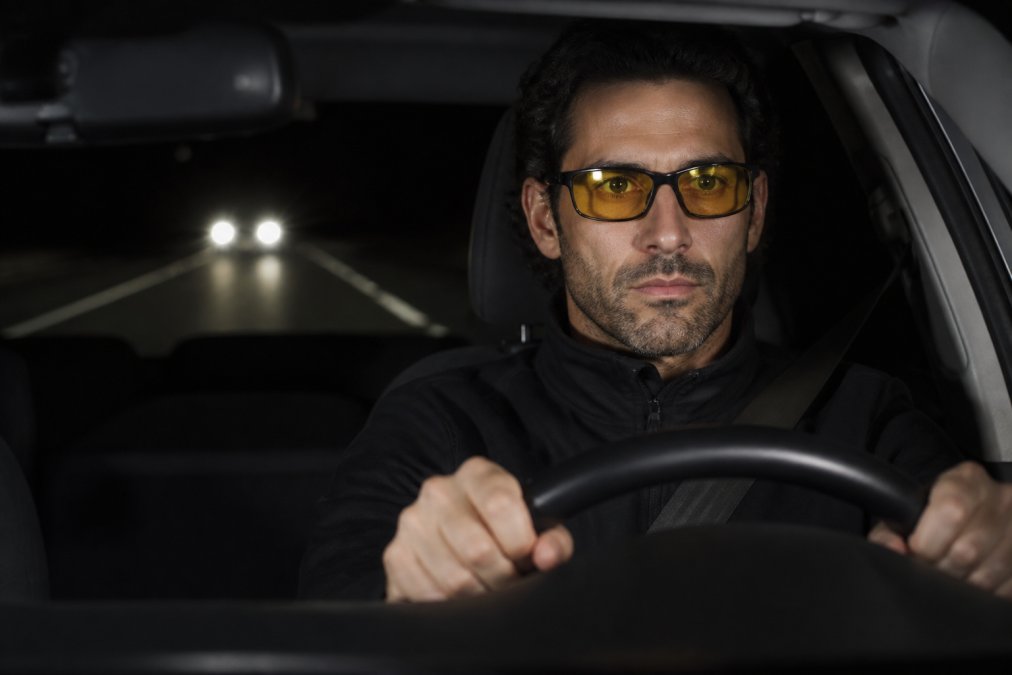
Beyond standard anti-reflective coatings, specialized lens technologies address night driving challenges. Polarized lenses reduce glare by filtering horizontally polarized light, though they can reduce visibility of LCD digital displays in your dashboard. A more effective option for night driving is a yellow-tinted lens, which enhances contrast by filtering blue wavelengths that scatter more readily in dim conditions.
Some advanced lens designs incorporate a gradient tint, darker at the top to reduce overhead light scatter, lighter at the bottom to preserve your ability to see the dashboard. These progressive night-driving lenses require custom fitting but provide superior performance compared to uniform tints.
Best Vitamins for Eye Health and Night Vision
Your retina’s ability to function in low light depends directly on the micronutrients available to support rod cell function and protect against oxidative damage.
Key Nutrients: Lutein, Zeaxanthin, and Vitamin A
Vitamin A is the foundational nutrient for night vision. Rod cells contain a molecule called rhodopsin, which is composed of the protein opsin bound to retinal, a form of vitamin A. Without adequate vitamin A, your rod cells cannot produce sufficient rhodopsin, and your night vision deteriorates.
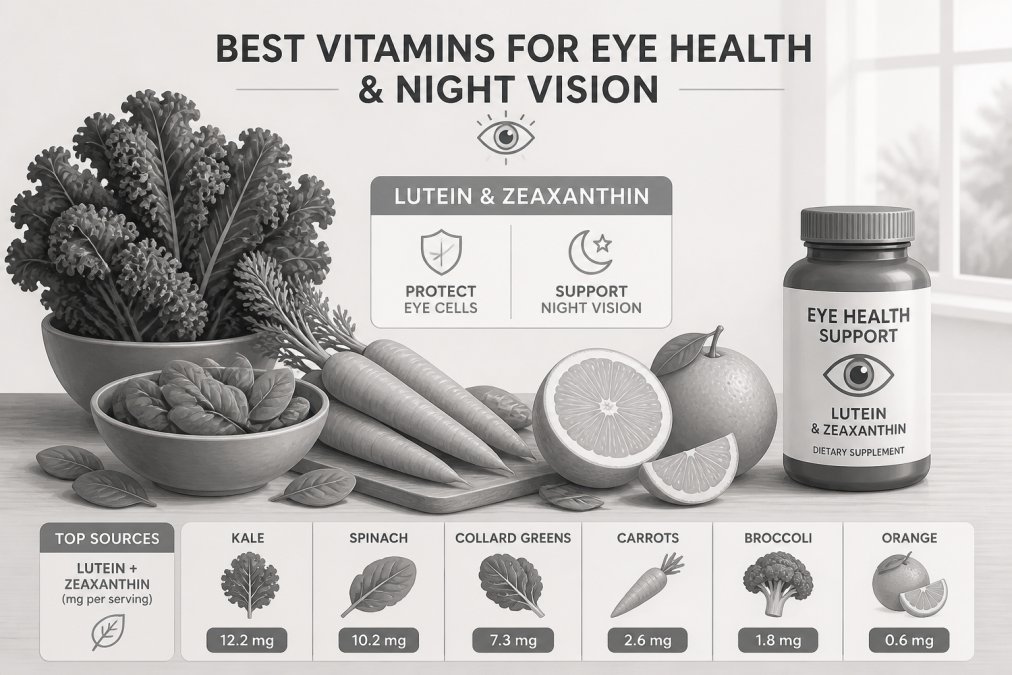
Lutein and zeaxanthin are carotenoid pigments that accumulate in the macula, the central region of your retina responsible for detailed vision. These pigments function as natural antioxidants, protecting photoreceptors from oxidative stress. Research indicates that higher macular pigment density correlates with better contrast sensitivity and reduced glare sensitivity, both critical for night driving. Unlike vitamin A, which your body can produce from beta-carotene, lutein and zeaxanthin cannot be synthesized internally, you must obtain them from food or supplements.
The three nutrients most directly linked to night vision improvement are vitamin A (for rod cell function), lutein (for macular protection and contrast), and zeaxanthin (for glare reduction). All three work synergistically, so supplementing with only one nutrient provides incomplete support.
Supplement Options and Dietary Sources
You can obtain these nutrients through food sources or supplements. Dietary sources include leafy greens like kale and spinach (high in lutein and zeaxanthin), orange vegetables like carrots and sweet potatoes (high in beta-carotene), and eggs (which contain lutein, zeaxanthin, and are more bioavailable than plant sources).
If you choose supplementation, several formulations are available. Performance Lab Vision combines lutein and zeaxanthin with European black currant and bilberry extracts, which contain anthocyanins that support visual adaptation to low light. Most people see measurable changes in contrast sensitivity and glare tolerance within 4-8 weeks of daily supplementation, but optimal effects require 3-6 months of consistent use.
Digital Eye Strain and Blue Light Impact on Night Vision
Prolonged exposure to blue light from screens disrupts both your daytime vision and your night vision adaptation. Blue light has a shorter wavelength than other visible light, which means it scatters more readily in the eye. When you spend hours looking at a smartphone, computer screen, or vehicle dashboard before driving at night, your eyes are exposed to concentrated blue light that fatigues your visual system and reduces contrast sensitivity.
Additionally, blue light suppresses melatonin production, which interferes with your circadian rhythm and your eye’s natural transition to night vision mode. The practical consequence is that you’re more likely to experience difficulty with night driving glare after spending the afternoon on screens.
The solution involves two strategies. First, reduce blue light exposure in the hours before night driving by enabling blue light filters on your devices or wearing blue light blocking glasses while using screens. Second, request blue light filtering in your anti-reflective lens coating. This provides continuous protection throughout the day and evening, reducing the cumulative strain that impairs night vision.
Surgical and Advanced Treatment Options
When conservative approaches don’t sufficiently improve your night vision, surgical and advanced treatment options become relevant.
Cataract Surgery and Refractive Procedures
Cataract surgery is the most common eye surgery performed in the United States. The procedure involves removing your clouded natural lens and replacing it with an artificial intraocular lens (IOL). Modern IOLs offer multiple options beyond simple distance vision correction.
Standard monofocal IOLs correct vision at one distance, typically distance vision for driving. Premium IOLs offer additional capabilities. Multifocal IOLs allow you to see clearly at multiple distances. Toric IOLs correct astigmatism simultaneously with cataract removal. Extended depth of focus (EDOF) IOLs provide a continuous range of clear vision.
For night vision specifically, aspheric IOLs reduce spherical aberration, which improves contrast sensitivity compared to standard spherical designs. This is particularly relevant for night driving because contrast sensitivity allows you to distinguish a pedestrian from the background or spot a pothole in dim light. Recovery from cataract surgery is typically rapid, with most people experiencing improved vision within days and full stabilization within 4-6 weeks.
Laser Vision Correction and Advanced Lens Implants
LASIK (Laser-Assisted In Situ Keratomileusis) reshapes your cornea using an excimer laser to correct refractive errors. For people with myopia, hyperopia, or astigmatism, LASIK can eliminate the need for glasses or contacts, which has obvious benefits for night driving.
However, LASIK has a documented effect on night vision during the immediate post-operative period. The procedure creates a temporary haze in the cornea as it heals, and some patients experience increased glare and halos around lights for several months. This effect typically resolves as the cornea stabilizes.
Refractive Lens Exchange (RLE) is an alternative to LASIK for people over 50 or those with high refractive errors. RLE involves removing your natural lens and replacing it with an artificial IOL, similar to cataract surgery but performed on a lens that isn’t yet clouded. This procedure corrects your refractive error permanently and prevents cataracts from developing in the future.
Clear Vision San Antonio offers both LASIK and advanced lens implant procedures, providing options for patients at different life stages and with different vision correction needs.
LASIK can temporarily worsen night vision during the healing period due to corneal haze and induced higher-order aberrations. If you drive frequently at night, discuss the timing of surgery with your surgeon and plan for a period of reduced night driving immediately post-operatively.
Practical Home and Driving Strategies to Improve Night Vision
Beyond medical interventions, specific behavioral and environmental strategies measurably improve your ability to function in low light.
For home environments, use layered lighting with dimmers that allow you to adjust brightness based on the task. Task lighting prevents the contrast between bright task areas and dark surroundings, which fatigues your visual system. Warm-colored lighting (2700K color temperature) is less disruptive to your circadian rhythm and night vision adaptation than cool white light.
For night driving, maintain proper distance from vehicles ahead. Headlights create glare that’s worse when you’re close to the light source. If oncoming headlights are particularly bothersome, look slightly to the right side of the road rather than directly at the approaching vehicle. Reduce dashboard brightness during night driving to maintain your eyes’ adaptation to the dark road environment. Allow your eyes adequate time to adapt to darkness, scotopic vision requires 20-30 minutes to fully develop as your pupils dilate and your rod cells reach peak sensitivity.
| Strategy | Implementation | Expected Impact |
|---|---|---|
| Prescription update | Schedule comprehensive eye exam, order new glasses if needed | Immediate improvement in clarity and contrast |
| Anti-reflective coating | Add to new glasses or lens upgrade | Reduced glare, improved light transmission |
| Nutritional support | Daily lutein/zeaxanthin supplement or dietary increase | Improved contrast sensitivity within 4-8 weeks |
| Dashboard dimming | Adjust vehicle display settings | Preserved night vision adaptation during driving |
| Increased following distance | Maintain 4+ second gap from vehicles ahead | Reduced glare intensity from headlights |
| Lighting adjustment at home | Install dimmers, use warm-colored bulbs | Improved comfort in evening hours |
When to Schedule a Comprehensive Eye Exam
If your night vision has changed noticeably or is affecting your quality of life, you need professional evaluation. A comprehensive eye exam includes measurement of your refractive error, evaluation of your eye health with specialized imaging, assessment of your tear film and corneal surface, intraocular pressure check, and examination of your retina for signs of disease.
Schedule an exam if you experience difficulty seeing street signs while driving at night, increased sensitivity to oncoming headlights, halos or glare around lights, blurred vision in dim conditions, difficulty adapting when moving from bright to dark environments, or any sudden change in your vision quality.
Clear Vision San Antonio provides comprehensive eye exams with advanced diagnostic technology, allowing your ophthalmologist to identify specific causes of poor night vision and recommend targeted treatment options.
Poor night vision doesn’t have to be a permanent limitation. Whether your challenge stems from refractive error, lens opacity, nutritional deficiency, or digital eye strain, effective solutions exist. The key is identifying the specific cause through professional evaluation, then addressing it with the appropriate combination of optical correction, nutritional support, and lifestyle modification. Clear Vision San Antonio specializes in comprehensive eye care that goes beyond simple vision correction to address the root causes of your vision problems. Request an appointment to discuss your night vision concerns and explore treatment options tailored to your unique visual needs.
Frequently Asked Questions
What is the fastest way to improve night vision?
The fastest improvements come from addressing refractive errors with an updated prescription and anti-reflective lens coatings, which can be obtained within weeks. Nutritional support through vitamins like lutein and zeaxanthin takes 4-12 weeks to show effects. For significant structural issues like cataracts, surgical options such as cataract surgery provide rapid improvement. A comprehensive eye exam determines which approach suits your specific situation.
What are the best vitamins for eye health and night vision?
Lutein and zeaxanthin are the most researched nutrients for improving contrast sensitivity and reducing glare sensitivity. Vitamin A supports rod cell function, which is critical for low-light vision. Zinc, bilberry extract, and astaxanthin provide antioxidant protection against age-related vision decline. These nutrients work best when combined in a comprehensive supplement or obtained through dietary sources like leafy greens, orange vegetables, and berries. Consistent use over several weeks produces the most noticeable results.
Can night blindness (nyctalopia) be permanently corrected?
Correction depends on the underlying cause. Refractive errors and cataracts respond well to surgical or optical correction with lasting results. Nutritional deficiencies improve with sustained supplementation. However, some conditions like retinitis pigmentosa or advanced macular degeneration cannot be permanently cured, though management strategies can slow progression and optimize remaining vision. A qualified eye doctor can diagnose the specific cause and discuss realistic outcomes for your situation.
How does dry eye disease affect night vision?
Dry eye disease reduces corneal clarity and optical quality, making glare more pronounced and contrast sensitivity worse at night. Tears are essential for maintaining a smooth optical surface; without adequate tear film, light scatters and halos appear around lights. Treating dry eye through clinical management, artificial tears, or prescription therapies can noticeably improve night vision quality. This is especially important for patients considering refractive surgery, where dry eye must be addressed beforehand.
This article was written using GrandRanker