

Table of Contents
- What Are Advanced Lens Implants for Cataracts?
- Types of Advanced Lens Implants: Monofocal, Multifocal, Trifocal & Toric
- Premium IOLs vs Standard IOLs: Benefits & Trade-Offs
- Cost of Advanced Cataract Lenses and Insurance Coverage
- Cataract Surgery Recovery Time and Post-Operative Care
- Choosing the Right Advanced Lens Implant for Your Lifestyle
- Conclusion
Advanced Lens Implants for Cataracts: A Complete 2026 Guide
Last Updated: June 27, 2026
Cataracts affect more than 24 million Americans age 40 and older, making cataract surgery one of the most common eye procedures. When surgery becomes necessary, your choice of intraocular lens (IOL) technology dramatically impacts your long-term vision quality and lifestyle satisfaction. This guide breaks down premium IOL options, costs, recovery timelines, and how to choose the right implant for your needs.
What Are Advanced Lens Implants for Cataracts?
An intraocular lens is a tiny artificial lens replacing your clouded natural lens during cataract surgery. Standard IOLs correct distance vision only, leaving patients dependent on reading glasses. Advanced lens implants use premium optical technology to correct multiple focal distances simultaneously, reducing or eliminating the need for glasses after surgery.
How Intraocular Lenses Work
During phacoemulsification surgery, the clouded lens is broken up and removed, leaving the lens capsule intact. The IOL is then inserted into this capsular bag, where it permanently replaces the lens’s focusing function.
The capsular bag acts as a biological anchor for the IOL. A strong, intact capsule leads to better long-term stability and lower risk of IOL repositioning years after surgery.
Standard vs. Premium IOLs: Key Differences
Standard monofocal IOLs cost less and provide excellent distance vision but require reading glasses for near tasks. Most insurance plans cover the cost of a basic monofocal IOL.
Premium IOLs cost $1,500 to $4,000 per eye out-of-pocket and offer multifocal, trifocal, or extended depth-of-focus designs, allowing functional vision at distance, intermediate, and near ranges without glasses. The trade-off is slight reduction in contrast sensitivity and potential for halos or glare around lights at night.
| IOL Type | Focus Range | Glasses Needed | Cost Range | Best For |
|---|---|---|---|---|
| Monofocal (Standard) | Distance only | Yes, for near | Covered by insurance | Budget-conscious patients accepting reading glasses |
| Multifocal (Premium) | Distance + near | Rarely | $1,500-$3,000/eye | Active people wanting independence from glasses |
| Trifocal (Premium) | Distance + intermediate + near | Rarely | $2,500-$4,000/eye | Computer workers and detail-oriented professionals |
| Toric (Premium) | Distance + astigmatism correction | Possibly | $1,500-$3,500/eye | Patients with moderate to high astigmatism |
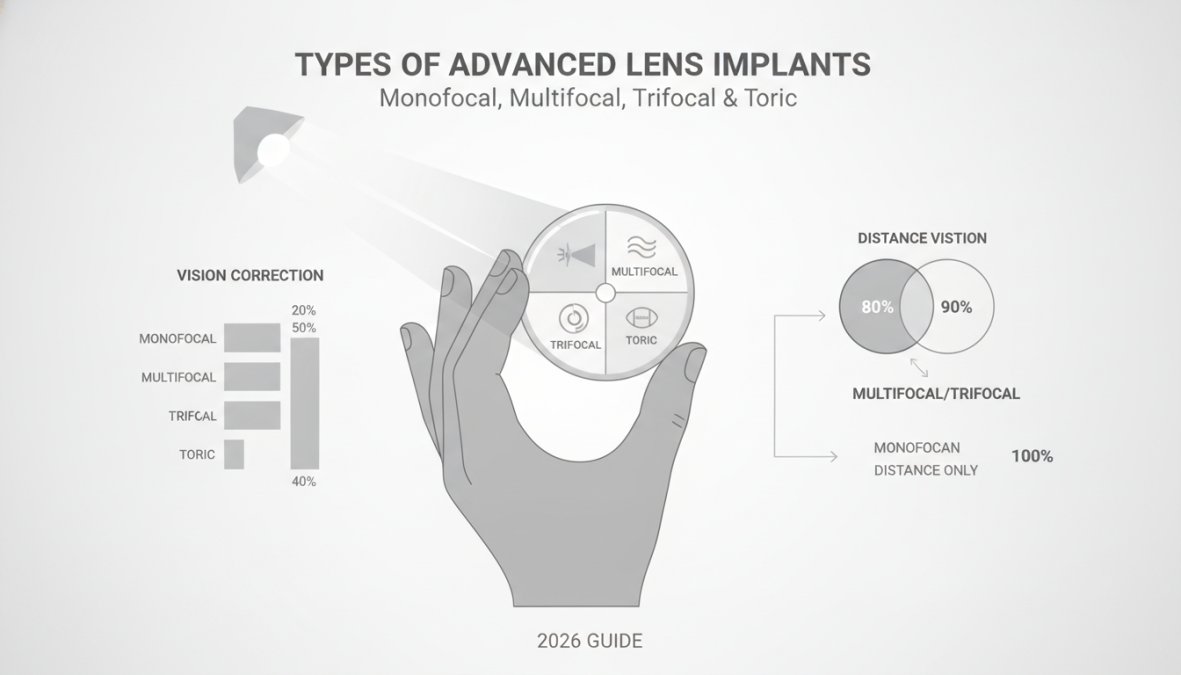
Types of Advanced Lens Implants: Monofocal, Multifocal, Trifocal & Toric
Choosing between IOL types requires understanding how each design works and what visual compromises come with each option.
Monofocal IOLs: Distance Vision Focus
Monofocal IOLs focus light at a single distance, typically set for distance vision. After surgery, patients see clearly at distance but need reading glasses for near work. This design has the longest track record of safety and stability, with the lowest rate of adverse visual phenomena like halos or glare. Most insurance plans, including Medicare, cover the full cost of a monofocal IOL implant.
Multifocal IOLs: Near and Distance Vision
Multifocal IOLs split incoming light into two focal zones: one for distance and one for near vision. The lens uses diffraction technology to bend light rays so both distances come into focus simultaneously on the retina. The brain learns to use the appropriate zone, a process called neuroadaptation.
Multifocal lenses allow many patients to see clearly at distance and near without glasses. Some patients experience halos around lights at night and reduced contrast sensitivity in dim lighting, though these effects often diminish within weeks as the brain adapts.
Neuroadaptation is the brain’s ability to filter out unwanted images and prioritize the correct focal zone. Most patients adapt within 4-6 weeks.
Trifocal IOLs: Three Zones of Clear Vision
Trifocal IOLs add an intermediate focal zone between distance and near, creating three distinct points of focus. This design benefits patients who spend significant time at a computer or working at arm’s length. Distance, computer work, and reading all come into focus without glasses for most patients.
Trifocal lenses provide the broadest range of functional vision without spectacles. However, they carry a slightly higher risk of halos and glare compared to multifocal designs because light is divided among three zones.
Toric Lens Implants for Astigmatism
Astigmatism is a refractive error where the cornea or lens has an irregular shape, causing blurred vision at all distances. Toric IOLs have a special cylindrical correction built into the lens design to correct astigmatism while providing monofocal, multifocal, or trifocal function.
The challenge with toric lenses is rotational stability. The lens must remain precisely aligned to maintain the astigmatism correction. Modern toric IOLs have excellent rotational stability.
Premium IOLs vs Standard IOLs: Benefits & Trade-Offs
The choice between premium and standard IOLs is fundamentally about trading spectacle independence for optical purity and potential side effects. Neither choice is objectively "best"; the right answer depends on your lifestyle and tolerance for minor optical phenomena.
Depth of Focus and Neuroadaptation
Extended depth-of-focus (EDOF) IOLs sit between standard monofocal and traditional multifocal designs. These lenses stretch the focal zone, providing a continuous range of clear vision from distance through intermediate, with acceptable near vision. EDOF lenses reduce halos and glare while providing better intermediate vision than monofocal lenses.
Neuroadaptation is essential for multifocal and trifocal success. Research from the American Society of Cataract Surgeons indicates that approximately 85% of multifocal IOL patients achieve functional vision without glasses after the adaptation period.
Contrast Sensitivity and Halos/Glare
Contrast sensitivity is your eye’s ability to distinguish objects from their background, particularly in dim lighting. Multifocal and trifocal IOLs reduce contrast sensitivity slightly because light is divided among multiple focal zones. This trade-off is typically minor in well-lit environments but becomes noticeable when driving at night.
Halos and glare are optical phenomena where you see rings of light around bright objects, particularly streetlights or car headlights at night. Most patients report that halos diminish significantly within 4-6 weeks as neuroadaptation occurs. A small percentage (5-10%) experience persistent halos long-term.
Patients with dry eye disease may experience worse halos and glare with multifocal lenses because tear film irregularities scatter light. If you have significant dry eye, discuss this with your surgeon before committing to a premium IOL.
Cost of Advanced Cataract Lenses and Insurance Coverage
Insurance covers the surgical procedure and a standard monofocal IOL. Everything else is out-of-pocket. Understanding the cost structure helps you decide whether a premium upgrade fits your budget.
Out-of-Pocket Expenses by IOL Type
A standard monofocal IOL is typically covered by Medicare and most private insurance plans. Upgrading to a multifocal IOL costs an additional $1,500-$3,000 per eye, paid entirely out-of-pocket. Trifocal lenses cost $2,500-$4,000 per eye. Toric versions add $500-$1,500 to the base cost. Many practices offer package pricing for both eyes, reducing per-eye costs by 10-15%.
Some employers offer vision insurance plans that partially cover premium IOL upgrades, typically $500-$1,000 per eye. Health Savings Accounts (HSAs) can be used to pay for IOL upgrades.
What Insurance Covers
Medicare covers cataract surgery and a standard monofocal IOL but not premium IOL upgrades. Private insurance plans vary, with most covering the surgical procedure and a standard IOL but not premium upgrades. Vision insurance plans rarely cover IOL costs but may offer discounts on premium IOL upgrades, typically 10-15% off the surgeon’s standard pricing.
Cataract Surgery Recovery Time and Post-Operative Care
Recovery from cataract surgery is relatively fast, but achieving stable, final vision takes time.
Timeline to Visual Stability
Most patients notice improved vision within 24-48 hours after surgery. By one week, many patients can see well enough for basic activities. By four weeks, vision stabilizes significantly for most patients. Final visual stability, where vision plateaus and remains consistent, typically occurs by 8-12 weeks after surgery.
If you’re having both eyes done, surgeons typically space the procedures 1-3 weeks apart. This allows the first eye to stabilize while the second eye heals, giving you functional vision throughout recovery.
Long-Term Outcomes and Secondary Procedures
IOLs are designed to last a lifetime. However, the lens capsule can become cloudy months or years after surgery, a condition called posterior capsular opacification (PCO). PCO occurs in 20-40% of cataract surgery patients over 5-10 years and is easily treated with a laser procedure called YAG capsulotomy.
Some patients develop residual refractive error that was not fully corrected by the IOL. This can be addressed with glasses, contact lenses, or refractive surgery like LASIK or PRK. Long-term studies show that 90%+ of cataract surgery patients are satisfied with their visual outcomes 10+ years after surgery.
Choosing the Right Advanced Lens Implant for Your Lifestyle
Matching your IOL choice to your actual lifestyle and visual priorities is key to satisfaction. Use this framework to guide your decision.
Lifestyle-Based Lens Matching Framework
Start by identifying your visual priorities. Do you spend more time on a computer than reading? Are you a night driver? Do you play golf or tennis? Your answers shape which IOL will serve you best.
Distance-focused lifestyle (outdoor activities, sports, driving): A monofocal IOL set for distance, or an EDOF lens, minimizes halos and glare while providing excellent distance vision. You’ll need reading glasses for near work.
Balanced lifestyle (mix of distance, computer, and reading): A trifocal IOL provides the broadest range of functional vision. You’ll see clearly at distance, at your computer screen, and when reading without glasses.
Near-focused lifestyle (reading, detail work, hobbies): A multifocal IOL provides excellent near and distance vision. Intermediate vision is adequate but not perfect.
Astigmatism + any lifestyle: A toric IOL corrects astigmatism while providing the focal distance benefit you choose. If you have significant astigmatism (0.75 D or higher), a toric lens prevents residual astigmatism-related blur.
| Lifestyle Pattern | Best IOL Choice | Why | Trade-Offs |
|---|---|---|---|
| Outdoor activities, night driving | Monofocal or EDOF | Excellent distance vision, minimal halos | Reading glasses required |
| Balanced (distance, computer, reading) | Trifocal | Three zones of clear vision | Slight halos, reduced contrast sensitivity |
| Reading, detail work focus | Multifocal | Excellent near and distance vision | Intermediate vision less sharp |
| Significant astigmatism | Toric (any type) | Corrects astigmatism + focal distance | Rotation risk, higher cost |
Questions to Ask Your Ophthalmologist
Before committing to an IOL choice, ask your surgeon these questions to ensure the recommendation aligns with your needs.
About your specific eye health: "Are there any retinal conditions or other eye diseases that might affect my visual outcome with a multifocal lens?"
About realistic expectations: "What percentage of your patients achieve functional vision without glasses with a multifocal lens?" "What percentage experience persistent halos or glare?"
About your lifestyle fit: "Based on how I use my eyes, which IOL would you choose for yourself?"
About secondary procedures: "If I’m unhappy with my multifocal lens, can it be exchanged?" "How often do you perform YAG capsulotomy in your patients?"
About cost and insurance: "What’s included in the quoted price?" "Can I finance the premium IOL upgrade?"
Choosing an intraocular lens is one of the most important decisions you’ll make for your long-term vision. The difference between a standard monofocal lens and an advanced multifocal or trifocal implant can mean the difference between needing glasses for reading or enjoying clear vision at all distances without correction. Clear Vision San Antonio offers comprehensive IOL consultations with experienced ophthalmologists who specialize in premium lens selection. Our team takes time to understand your specific visual needs and matches you with the technology that delivers the best outcome for how you actually live. Request an appointment today to discuss which advanced lens implant is right for you.
Additional Resources
For more information on cataract surgery and IOL options, consult these authoritative sources:
According to the American Academy of Ophthalmology’s cataract surgery guidelines, patient education and realistic expectation-setting are critical factors in surgical satisfaction.
Research from the Journal of Cataract & Refractive Surgery demonstrates that multifocal IOL satisfaction rates exceed 85% when patients are carefully selected and counseled on realistic outcomes.
The FDA’s guidance on intraocular lens safety and effectiveness provides detailed information on approved IOL types, clinical trial data, and long-term safety profiles.
Frequently Asked Questions
What are the different types of advanced lens implants for cataracts?
Advanced lens implants include monofocal IOLs (single-distance focus), multifocal IOLs (near and distance vision), trifocal IOLs (three focal zones for near, intermediate, and distance), and toric IOLs (astigmatism correction). Each type corrects refractive errors differently, with premium options offering greater visual acuity across multiple distances compared to standard monofocal lenses.
Are premium IOLs worth the extra cost for cataract surgery?
Premium IOLs often reduce dependence on glasses for near and distance vision, improving quality of life for many patients. However, they carry higher out-of-pocket expenses since insurance typically covers only standard monofocal lenses. The value depends on your lifestyle, visual demands, and budget. Patients with active lifestyles or those who dislike wearing glasses often find premium options worthwhile.
How long does cataract surgery recovery take with advanced lens implants?
Most patients achieve functional vision within 1-2 weeks after phacoemulsification surgery. Full visual stabilization typically occurs within 4-6 weeks. Advanced IOLs follow the same recovery timeline as standard lenses. Post-operative care includes prescribed eye drops and activity restrictions during the first two weeks to ensure proper capsular bag healing.
Can toric lens implants fully correct astigmatism without glasses?
Toric IOLs significantly reduce astigmatism by correcting corneal curvature errors, allowing many patients to achieve clear distance vision without glasses. However, residual astigmatism or presbyopia may still require reading glasses for near vision tasks. Your ophthalmologist can assess your specific refractive error to determine if a toric lens implant will eliminate your need for corrective lenses.
This article was written using GrandRanker