

Table of Contents
- Cataract Surgery Recovery Tips: First Two Weeks
- Understanding Your Cataract Surgery Recovery Timeline
- Activities to Avoid After Cataract Surgery
- Cataract Surgery Eye Drops Schedule and Medication
- Cataract Surgery Complications Symptoms and Warning Signs
- Protecting Your Eye Shield and Surgical Site
- Driving Restrictions and Post-Op Transportation
- Mental Health and Emotional Recovery
Last Updated: June 22, 2026
Good cataract surgery recovery tips can mean the difference between smooth healing and frustrating setbacks that delay clear vision. At Clear Vision San Antonio, we work with patients daily who have questions about what to expect, what to avoid, and how to protect their results. The post-operative period requires discipline but is not complicated. Below, we cover everything you need to know from your first hours after surgery through final stabilization of your new intraocular lens.
Cataract Surgery Recovery Tips: First Two Weeks
The first two weeks after cataract surgery are the most critical phase. Your ophthalmologist has made a small corneal incision, removed the clouded lens, and implanted an intraocular lens. The surgical site needs time to seal, and your eye needs protection from pressure, contamination, and trauma.
What to Expect Immediately After Surgery
Immediately after surgery, most patients experience blurred vision, mild light sensitivity, and a gritty sensation. These are normal. Your vision will not be sharp right away; the intraocular lens takes time to settle and the cornea needs to recover.
Expect 30 to 60 minutes in recovery before going home. You cannot drive yourself, so arrange transportation in advance. Many patients notice colors appear brighter and more vivid almost immediately, a welcome side effect of replacing a yellowed, clouded lens.
Photophobia (light sensitivity) is common in the first 24 to 48 hours. Wearing sunglasses outdoors, even on overcast days, reduces discomfort significantly.
Prepare your home before surgery day. Stock preservative-free artificial tears, set up a reading chair with good lighting, and charge devices for entertainment. You will not feel like running errands on day one.
Managing Discomfort and Pain
Post-operative discomfort is generally mild, most patients describe a scratchy or foreign-body sensation rather than sharp pain. Over-the-counter acetaminophen typically suffices, but follow your surgeon’s specific guidance.
Sharp or sudden eye pain is not normal. If you experience significant pain, sudden vision loss, or increasing redness within the first week, contact your ophthalmologist immediately. These can signal elevated intraocular pressure or infection.
Understanding Your Cataract Surgery Recovery Timeline
Cataract surgery recovery unfolds in predictable stages. Understanding the timeline helps you set realistic expectations and stay compliant with post-operative instructions.
| Recovery Phase | Timeframe | What to Expect | Key Actions |
|---|---|---|---|
| Initial Healing | Days 1-7 | Blurred vision, light sensitivity, mild discomfort | Use eye drops, wear shield at night |
| Progressive Improvement | Weeks 2-4 | Vision sharpening, reduced photophobia | Gradual return to light activity |
| Final Stabilization | Weeks 5-8 | Full visual acuity, incision sealed | Follow-up appointment, glasses update |
Week 1: Initial Healing Phase
The first seven days are about protection. Your incision is still sealing and your eye is vulnerable to infection and pressure changes. Stick to your eye drops schedule without exception. Avoid bending over at the waist, lifting anything over ten pounds, or any activity that causes straining.
Vision during this phase is often inconsistent, with fluctuations throughout the day. This is normal and resolves as the cornea stabilizes.
Weeks 2-4: Progressive Vision Improvement
Most patients see meaningful improvement in visual clarity between days seven and fourteen. Blurred vision sharpens and light sensitivity decreases noticeably. This is when many patients feel tempted to return to normal activity too quickly.
Resist that temptation. The incision may feel healed, but internal healing continues. Your ophthalmologist will confirm at your follow-up appointment whether it is safe to resume specific activities. Continue anti-inflammatory eye drops through this phase.
Weeks 5-8: Final Stabilization
By weeks five through eight, your intraocular lens has fully settled and your cornea has healed. Your ophthalmologist can now accurately measure your vision and determine whether you need updated glasses or contact lenses. According to the American Academy of Ophthalmology’s patient education resources, most patients achieve their best corrected vision within four to six weeks after cataract surgery.
Activities to Avoid After Cataract Surgery
Every restriction exists to protect the surgical site, prevent elevated intraocular pressure, or reduce infection risk. Understanding the reason behind each restriction makes compliance far easier.
Strenuous Activity and Heavy Lifting
Strenuous activity and heavy lifting are off-limits for at least two weeks. Straining, lifting, coughing hard, or bearing down all temporarily spike intraocular pressure. At a healing surgical site, that pressure spike can disrupt the incision or stress the newly placed lens.
Most surgeons use ten pounds as the threshold. Do not lift anything heavier during initial recovery, this includes groceries, pets, young children, and gym equipment.
Bending Over and Head Positioning
Bending over at the waist creates the same pressure problem as heavy lifting. When you bend forward, blood rushes to the head and intraocular pressure rises temporarily. To pick something up, bend at the knees and keep your head upright instead.
This restriction is particularly important in the first week. By week three or four, most patients can resume normal bending with surgeon approval.
Water Exposure and Eye Protection
Water is one of the most significant infection risks after cataract surgery. Tap water, pool water, hot tub water, and even shower water can carry bacteria that cause serious infection.
Avoid swimming, hot tubs, and submerging your face for at least four weeks. When showering, keep your face away from the direct stream and avoid letting soapy water run into your eye.
Endophthalmitis is a rare but serious complication. Symptoms include sudden vision loss, severe pain, and increasing redness. If any appear within the first two weeks, contact your ophthalmologist or go to an emergency eye clinic immediately.
Cataract Surgery Eye Drops Schedule and Medication
The eye drops schedule is the single most important thing you control during recovery. Missing doses or stopping drops too early is a leading cause of preventable complications.
Antibiotic and Anti-Inflammatory Drops
Your post-operative regimen typically includes antibiotic drops to prevent infection and anti-inflammatory drops (often a steroid or NSAID) to reduce swelling and support healing. Some patients also receive drops to manage intraocular pressure.
Most schedules begin with drops four times daily and taper over four to six weeks. Your ophthalmologist will provide a specific schedule tailored to your procedure. Do not adjust frequency on your own, even if your eye feels fine.
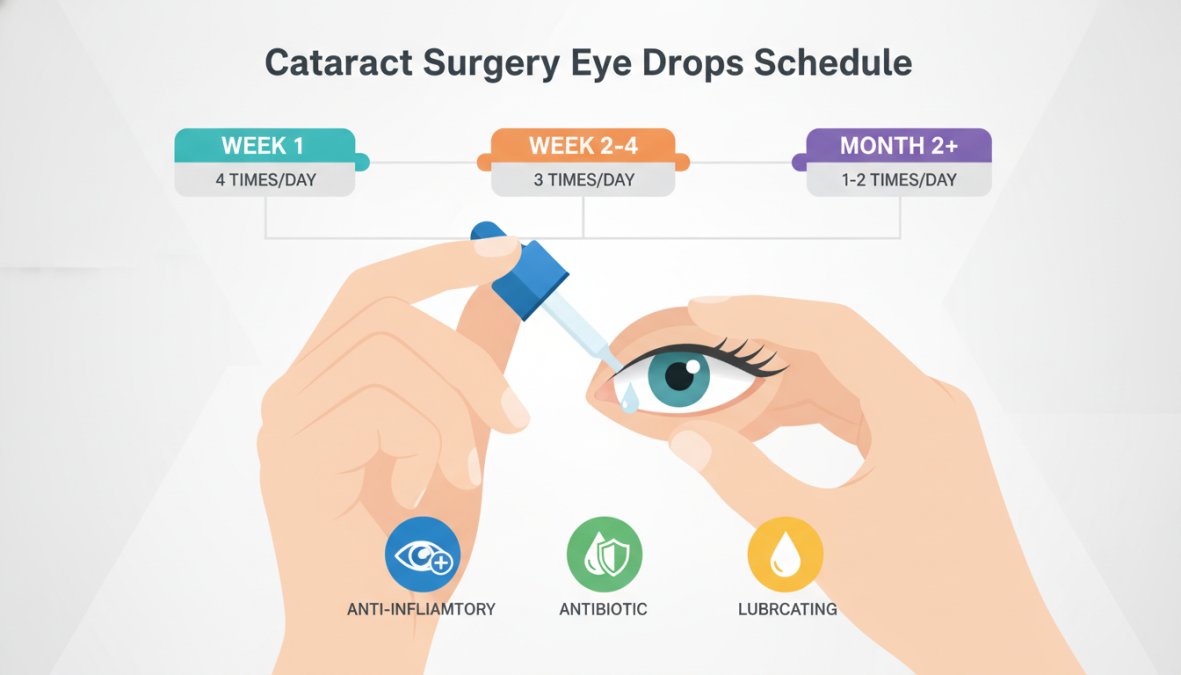
How to Administer Eye Drops Correctly
Correct administration prevents contamination and ensures the drop reaches the eye:
- Wash your hands thoroughly with soap and water.
- Tilt your head back or lie down flat.
- Gently pull down your lower eyelid to create a small pocket.
- Hold the dropper above the eye without touching it to your eye, eyelashes, or any surface.
- Squeeze one drop into the lower lid pocket.
- Close your eye gently and press the inner corner (tear duct area) with a clean fingertip for 60 seconds to prevent drainage into your throat.
- If using multiple drops, wait at least five minutes between each one.
One drop is the correct dose. Squeezing the bottle too hard simply overflows without improving therapeutic effect.
Cataract Surgery Complications Symptoms and Warning Signs
Knowing which symptoms to watch for allows you to act quickly if something goes wrong. Most complications are treatable when caught early.
Infection Risk and Endophthalmitis
Endophthalmitis is a bacterial infection inside the eye and the most serious post-operative complication. It is rare but moves quickly. The infection can develop within hours to days of surgery.
Warning signs include sudden severe eye pain that worsens, rapid vision loss, increasing redness, eyelid swelling, and worsening light sensitivity. As detailed in clinical guidance from the National Eye Institute, prompt diagnosis and treatment is essential to preserving vision.
When to Call Your Ophthalmologist
Call your ophthalmologist immediately if you experience:
- Pain not controlled by over-the-counter medication
- A sudden increase in floaters or flashes of light
- Any vision loss, even partial
- Increasing redness or discharge
- Nausea or vomiting (which can indicate elevated intraocular pressure)
Do not wait to see if symptoms resolve on their own.
Protecting Your Eye Shield and Surgical Site
Most patients underestimate how important the eye shield is during early recovery. It is not optional.
Sleeping with Your Eye Shield
Wear your protective eye shield every night for at least the first week, ideally two weeks. The purpose is to prevent you from rubbing or pressing on your eye while you sleep. Tape the shield securely so it does not shift during the night. If you sleep on your side, try to sleep on the opposite side from the operated eye.
Avoiding Rubbing and Protecting the Incision
Rubbing your eye is the most common mistake patients make during recovery. The urge is strong, especially when the eye feels irritated or itchy. Rubbing can dislodge the intraocular lens, disrupt the incision, and introduce bacteria.
If your eye feels irritated, use preservative-free artificial tears instead of rubbing.
The eye shield and the no-rubbing rule are non-negotiable. They are the two most protective behaviors you can maintain during the first two weeks of recovery.
Driving Restrictions and Post-Op Transportation
You cannot drive on the day of surgery. The sedation, dilating drops, and blurred vision make driving unsafe and illegal. Arrange a driver in advance.
After that, the timeline depends on your individual visual recovery. Many patients are cleared to drive within one to three days, provided their vision meets the legal standard for driving in their state and they feel confident. Your ophthalmologist will assess this at your first follow-up appointment, typically the day after surgery.
Do not assume clearance based on how your eye feels. Get explicit confirmation from your surgeon.
Mental Health and Emotional Recovery
The emotional side of cataract surgery recovery is often overlooked. Patients frequently feel anxious, frustrated, or unexpectedly emotional during healing. This is normal and worth acknowledging.
The first few days can feel disorienting. Your vision fluctuates, you cannot do many normal activities, and you are relying on others for transportation and basic tasks. For active, independent people, this temporary dependence is genuinely difficult.
Several things help:
- Set realistic expectations before surgery. Knowing week one will be restrictive makes it easier to accept.
- Plan entertainment that does not strain your eye. Audiobooks, podcasts, and music are excellent for the first few days when screen time should be limited.
- Limit screen time intentionally. Extended screen use causes digital eye strain, which feels worse on a healing eye. Take breaks every 20 minutes using the 20-20-20 rule: look at something 20 feet away for 20 seconds.
- Lean on your support network. Ask for help with driving, cooking, and tasks requiring bending or lifting.
Nutrition supports healing. Foods rich in vitamin C, vitamin E, and omega-3 fatty acids support tissue repair and reduce inflammation. Research from the Harvard T.H. Chan School of Public Health on nutrition and eye health highlights the role of antioxidant-rich diets in supporting ocular health and recovery outcomes.
If you feel persistently anxious or low during recovery, talk to your care team. These feelings are valid, and your ophthalmologist or primary care physician can offer support.
Recovering from cataract surgery requires understanding why each guideline exists and committing to the process even when your eye starts to feel better before it is fully healed. Clear Vision San Antonio provides personalized post-operative care supported by advanced technology and a dedicated team of eye doctors who guide patients through every stage of recovery. Request an appointment with Clear Vision San Antonio and take the next step toward lasting visual clarity.
Frequently Asked Questions
How long does it take to recover from cataract surgery?
Most patients experience significant vision improvement within the first week, though the complete cataract surgery recovery timeline typically extends 4-8 weeks. During this period, the cornea heals, intraocular pressure stabilizes, and your new intraocular lens settles into position. Full vision stability may not occur until 8 weeks post-operative, and your ophthalmologist will monitor healing at follow-up appointments to ensure optimal outcomes.
What should I avoid after cataract surgery?
Key activities to avoid include strenuous activity, heavy lifting (anything over 10 pounds), bending over, swimming, hot tubs, and rubbing your eyes. You must also protect your eye from water, soap, and irritants during the healing process. Avoid driving until cleared by your ophthalmologist, typically after 1-2 weeks. These restrictions prevent increased intraocular pressure and infection risk at the surgical site.
When can I drive after cataract surgery?
Driving restrictions typically last 1-2 weeks post-operative, depending on your vision clarity and your ophthalmologist's approval. Blurred vision, light sensitivity, and photophobia are common early on and make safe driving impossible. You'll need a follow-up appointment to confirm that your vision has improved sufficiently and that healing is progressing normally before resuming driving.
What are the signs of complications after cataract surgery?
Contact your ophthalmologist immediately if you experience sudden vision loss, severe eye pain, persistent redness, discharge, flashing lights, or floaters. These may indicate infection, endophthalmitis, or other serious post-operative complications. Mild discomfort, slight blurred vision, and temporary light sensitivity are normal during recovery, but any sudden worsening warrants urgent evaluation to protect your intraocular lens and cornea.
This article was written using GrandRanker