

Table of Contents
- Why Do I Have Chronic Dry Eye Symptoms: Understanding the Root Causes
- Chronic Dry Eye Causes: The Primary Culprits
- Dry Eye Risk Factors: Who Is Most Vulnerable
- Chronic Dry Eye Diagnosis: How Eye Doctors Identify the Problem
- Chronic Dry Eye Treatment Options: From Daily Management to Advanced Care
- When to See an Eye Doctor for Chronic Dry Eye Symptoms
- The Mental Health Impact of Chronic Eye Pain
- Conclusion
Last Updated: July 30, 2026
Why Do I Have Chronic Dry Eye Symptoms: Understanding the Root Causes
If you’re asking "why do I have chronic dry eye symptoms," you’re not alone. Chronic dry eye affects millions of Americans, and most discover that their symptoms stem from multiple overlapping causes rather than a single problem. The frustrating reality is that dry eye isn’t always about insufficient tears, sometimes your tears are chemically imbalanced, evaporate too quickly, or your eyelids aren’t closing properly. Understanding what’s actually happening inside your eyes is the first step toward finding relief that sticks.
Chronic dry eye is not a single disease, it’s a symptom of tear film dysfunction. The cause determines the treatment. Treating the wrong cause wastes time and money.
How Your Tear Film Works
Your tears are a sophisticated three-layer system that keeps your cornea nourished, protected, and clear. The outermost lipid layer is a thin film of oils secreted by your meibomian glands along your eyelid edges. These oils prevent tears from evaporating too quickly. Beneath that sits the aqueous layer, the watery middle section produced by your lacrimal glands, containing proteins, antibodies, and nutrients. The innermost mucin layer touches your cornea directly and helps tears stick to your eye surface instead of sliding off.
All three layers work together. If any one fails, your cornea dries out, even if the other two function normally. This is why a patient with normal tear volume can still have severe dry eye symptoms if their tear film composition is wrong.
Your blink distributes these layers across your eye. People staring at screens blink 66% less than normal. If you spend 8 hours daily on screens, you’re blinking roughly 4 fewer times per minute, a recipe for evaporative dry eye.
When the System Breaks Down
Dry eye happens when tear production declines, tear quality deteriorates, or tears evaporate faster than they’re replaced. The result is hyperosmolarity: tears become too salty and concentrated, damaging the corneal surface and triggering inflammation, which makes tears worse, creating a vicious cycle. The corneal damage causes burning, grittiness, and paradoxically, excessive tearing, your eye produces reflex tears that are mostly water with minimal lipid and mucin, so they don’t help.
Chronic Dry Eye Causes: The Primary Culprits
There are two main categories of chronic dry eye: evaporative dry eye and aqueous-deficient dry eye. Most people have elements of both, but one usually dominates.
Evaporative Dry Eye
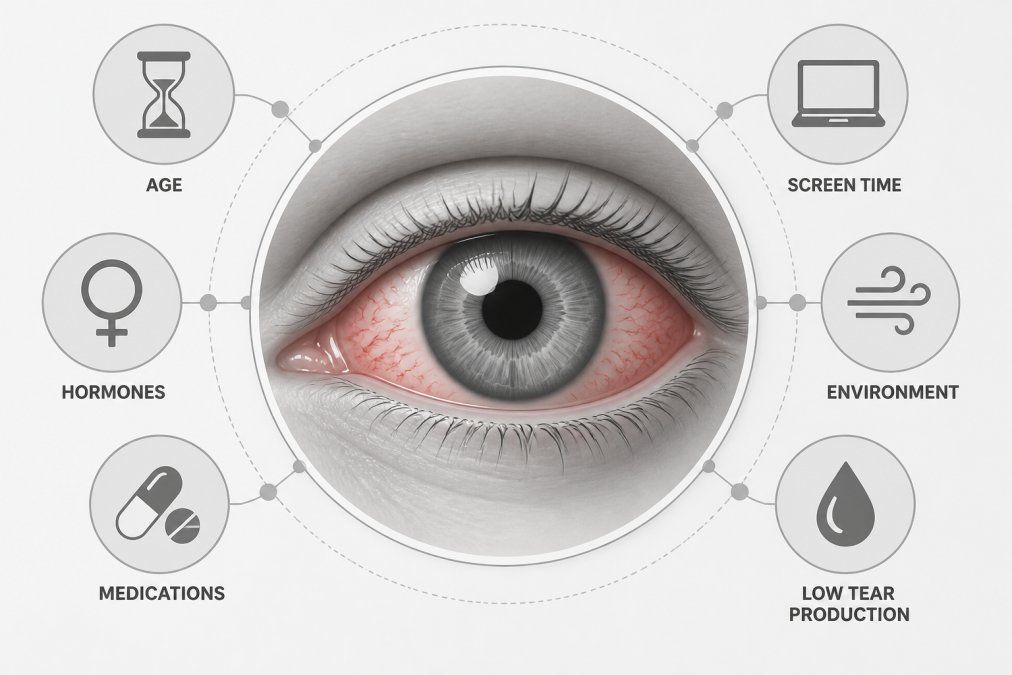
Evaporative dry eye occurs when your tear film evaporates too quickly despite normal tear production. The most common cause is meibomian gland dysfunction (MGD), when these glands become clogged, inflamed, or atrophy, they produce fewer or lower-quality oils, and tears evaporate within seconds instead of minutes. This is especially common in people over 50 but increasingly seen in younger patients due to screen time and low-humidity environments.
Blepharitis, inflammation of the eyelid margins, is another major driver. Bacteria colonize the lid margins and produce biofilms that interfere with gland function, creating crusty deposits along your lash line or persistent grittiness that worsens throughout the day.
Environmental factors accelerate evaporation: dry indoor air, wind, low humidity, heating systems, and air conditioning all pull moisture from your tear film. Screen use deserves special mention, when you focus on a screen, your blink rate drops dramatically and blinks become incomplete, meaning less lipid is distributed and the lower portion of your eye gets minimal tear coverage.
If your dry eye gets worse as the day progresses, particularly by evening, evaporative dry eye is likely your primary problem. Your tear film degrades over the course of the day as environmental exposure accumulates and your lipid layer depletes.
Aqueous-Deficient Dry Eye
Aqueous-deficient dry eye occurs when your lacrimal glands don’t produce enough tears. Sjögren syndrome, an autoimmune disorder attacking the lacrimal and salivary glands, is the classic cause. It’s nine times more common in women and typically develops after age 40. If you have dry eye plus dry mouth, joint pain, or fatigue, Sjögren syndrome should be on your radar.
Other autoimmune conditions cause aqueous-deficient dry eye: rheumatoid arthritis, lupus, and scleroderma all increase risk. Medications are a massive but often-overlooked culprit, antihistamines, decongestants, antidepressants, blood pressure medications, and isotretinoin (Accutane) all reduce tear production. If you started a new medication and your dry eye worsened within weeks, that’s a strong signal.
Radiation therapy to the head or neck can permanently damage lacrimal glands. Hormonal changes matter significantly, estrogen decline during menopause reduces tear production, and hormonal fluctuations during the menstrual cycle can temporarily worsen symptoms.
Dry Eye Risk Factors: Who Is Most Vulnerable
Age and Hormonal Changes
Age is one of the strongest predictors of dry eye. Tear production naturally declines with age, and lacrimal glands atrophy. Women face disproportionate risk, particularly during and after menopause when estrogen influences tear film composition and lacrimal gland function. Men develop dry eye too, but typically later in life and usually less severely.
Systemic Conditions and Medications
Diabetes increases dry eye risk, particularly if blood sugar control is inconsistent. Hypertension, thyroid disorders, and rheumatoid arthritis all correlate with increased risk. Common medication culprits include antihistamines, decongestants, antidepressants, beta-blockers, ACE inhibitors, diuretics, isotretinoin, and antiandrogens. If you’re on any of these and developing dry eye symptoms, discuss alternatives with your doctor.
Patients on multiple medications should ask their pharmacist about dry eye as a side effect. Many don’t realize their symptoms are medication-related and waste time on treatments that can’t fix a drug-induced problem.
Environmental and Lifestyle Factors
Where you live and how you work dramatically influence dry eye risk. People in dry climates or those with winter heating systems experience worse dry eye. Screen time is now one of the top modifiable risk factors, people working 8+ hours daily on computers have significantly higher dry eye rates.
Contact lens wear increases dry eye risk, particularly with 12+ hours daily wear. Smoking accelerates dry eye development, and poor lid hygiene allows bacteria to colonize your eyelid margins, triggering blepharitis.
Chronic Dry Eye Diagnosis: How Eye Doctors Identify the Problem
Diagnosis matters because it determines treatment. An ophthalmologist or optometrist can differentiate between evaporative and aqueous-deficient dry eye using specific tests.
Clinical Tests and Measurements
The Schirmer test measures tear production by placing a thin filter paper strip under your lower eyelid for five minutes. Less than 5mm of wetness indicates aqueous-deficient dry eye.
Tear break-up time (TBUT) measures how long your tear film stays stable before breaking apart. Normal TBUT is 15+ seconds; under 5 seconds suggests evaporative dry eye or poor tear composition.
Meibography images your meibomian glands to assess their structure and function, directly answering whether MGD is present. Osmolarity testing measures the salt concentration of your tears, hyperosmolar tears indicate tear film dysfunction. Corneal topography maps your corneal surface to identify irregularities caused by dry eye damage.
A thorough evaluation includes all these tests plus slit-lamp examination of your eyelids, meibomian glands, and corneal surface.
Distinguishing Dry Eye from Allergies
Many people confuse dry eye with allergies because both cause redness, itching, and tearing. Allergic eye disease is triggered by an allergen and appears suddenly when exposed, with itching as the dominant symptom. Chronic dry eye develops gradually, persists regardless of environment, and features burning or grittiness as the dominant symptom.
Your eye doctor can distinguish these by examining your conjunctiva under magnification. Allergic reactions show specific inflammatory patterns; dry eye shows punctate keratitis, mucus strands, and meibomian gland dysfunction.
Using allergy drops to treat dry eye can backfire. Many allergy medications reduce tear production, worsening underlying dry eye. If you have both conditions, you need separate treatments for each.
Chronic Dry Eye Treatment Options: From Daily Management to Advanced Care
Treatment depends on the underlying cause. Here’s what actually works.
Artificial Tears and Lid Hygiene
For mild evaporative dry eye, preservative-free artificial tears are better than those containing benzalkonium chloride, especially if used more than four times daily. The best artificial tears mimic natural tear composition with lipids, aqueous components, and mucin.
Lid hygiene is foundational for anyone with meibomian gland dysfunction or blepharitis. Warm compresses for 10-15 minutes daily help soften meibomian gland secretions. Gentle lid margin scrubbing removes bacterial biofilms. This simple routine, done consistently, often reduces symptoms significantly. For contact lens wearers, reducing wear time or switching to glasses temporarily helps; daily disposables are better than reusables.
Anti-Inflammatory and Prescription Options
When artificial tears and lid hygiene aren’t enough, cyclosporine (Restasis) or lifitegrast (Xiidra) reduce ocular surface inflammation. Results typically take 4-12 weeks.
Punctal plugs are tiny devices inserted into tear drainage ducts to prevent tears from draining away quickly, particularly helpful for aqueous-deficient dry eye. Meibomian gland expression applies heat and pressure to manually express blocked glands, providing temporary relief. Newer devices like LipiFlow use thermal pulsation for better results.
For severe aqueous-deficient dry eye, autologous serum drops made from your own blood serum contain growth factors that promote corneal healing, though they’re expensive and require ongoing blood draws.
Nutritional and Environmental Modifications
Omega-3 fatty acids reduce inflammation and improve meibomian gland function. Research supports supplementation with fish oil or flaxseed oil at 1000-3000mg daily, with results appearing in 4-8 weeks.
Environmental control is powerful but underrated. A humidifier in a dry environment makes a measurable difference. Positioning your monitor slightly below eye level reduces evaporation. Taking 20-second breaks every 20 minutes to look at something distant reduces screen-related dry eye.
| Intervention | Best For | Timeline | Cost |
|---|---|---|---|
| Artificial tears (preservative-free) | Mild dry eye, temporary relief | Immediate | Low |
| Lid hygiene (warm compress + scrubbing) | Meibomian gland dysfunction | 2-4 weeks | Minimal |
| Cyclosporine or lifitegrast drops | Moderate-to-severe inflammation | 4-12 weeks | Moderate |
| Punctal plugs | Aqueous-deficient dry eye | Immediate | Moderate |
| Omega-3 supplementation | Systemic inflammation, gland health | 4-8 weeks | Low |
| Environmental modifications | Screen-related dry eye | Immediate | Minimal |
When to See an Eye Doctor for Chronic Dry Eye Symptoms
If your symptoms persist longer than two weeks despite using over-the-counter drops, schedule an appointment. If you’re experiencing pain, vision changes, or discharge, see an eye doctor sooner. People with autoimmune conditions, diabetes, or a family history of dry eye should have baseline eye exams. If you’ve tried artificial tears consistently for four weeks without improvement, professional testing is warranted, you might have a problem that over-the-counter drops can’t address.
At Clear Vision San Antonio, we perform full diagnostic testing to identify whether your dry eye is evaporative, aqueous-deficient, or mixed, and develop treatment plans targeting the specific cause. Many patients discover their symptoms have multiple drivers and need combination therapy rather than a single treatment.
The Mental Health Impact of Chronic Eye Pain
Chronic dry eye isn’t just a physical problem, it’s a psychological one. Persistent eye discomfort affects quality of life by reducing screen time, making reading painful, and limiting activities. The unpredictability of symptoms creates anxiety, and sleep disruption is common as dry eye worsens at night.
Depression and anxiety are more common in people with chronic dry eye than in the general population. If you’re experiencing mood changes alongside your dry eye symptoms, mention this to your eye doctor. Some treatments, particularly cyclosporine drops, can improve mood alongside physical symptoms by reducing pain and inflammation.
Chronic dry eye symptoms rarely have a single cause and rarely resolve without identifying what’s actually driving them. Whether your problem is meibomian gland dysfunction, insufficient tear production, autoimmune disease, medications, or environmental factors, the treatment path differs. A comprehensive eye exam that tests tear production, tear film stability, and gland function reveals the truth about what’s happening in your eyes. At Clear Vision San Antonio, our team performs these diagnostic tests and develops personalized treatment plans targeting your specific dry eye mechanism. If you’ve tried over-the-counter drops without relief, it’s time for a professional evaluation. Request an appointment and let’s identify what’s causing your chronic dry eye symptoms and build a treatment strategy that actually works.
Frequently Asked Questions
What is the main cause of chronic dry eye symptoms?
Chronic dry eye symptoms stem from either insufficient tear production or excessive tear evaporation. The tear film, composed of an aqueous layer, lipid layer, and mucin layer, must remain balanced. When meibomian glands fail to produce adequate oils or lacrimal glands reduce tear output, the ocular surface becomes hyperosmolar and irritated. Common triggers include aging, hormonal fluctuations, autoimmune disorders like Sjögren syndrome, and environmental factors such as screen time and dry indoor air.
How is chronic dry eye diagnosed by an ophthalmologist or optometrist?
Eye doctors perform multiple tests to diagnose chronic dry eye. These include measuring tear production with the Schirmer test, assessing tear film quality and stability, examining the corneal surface for damage, and evaluating lid hygiene and meibomian gland function. Imaging technologies may visualize the tear film layers. A detailed patient history regarding symptoms, medications, and systemic conditions helps confirm the diagnosis and distinguish dry eye from allergies or other ocular surface diseases.
Can chronic dry eye treatment options provide lasting relief?
Yes, but relief depends on identifying the underlying cause. Evaporative dry eye responds well to lid hygiene, omega-3 supplements, and anti-inflammatory drops. Aqueous-deficient dry eye may require artificial tears, punctal plugs, or prescription medications. Many patients experience significant symptom improvement with consistent management. However, chronic dry eye is a long-term condition requiring ongoing care. Personalized clinical management, tailored to your specific tear film deficiency, offers the best chance of sustained comfort and protection of the corneal surface.
Why do my eyes water excessively if I have dry eye symptoms?
Paradoxically, dry eyes can trigger excessive tearing. When the ocular surface becomes irritated from inadequate tear film coverage, sensory nerves signal the lacrimal glands to produce reflex tears. These reflex tears are watery and lack the proper oil and mucin layers, so they don't coat the eye effectively and evaporate quickly. This creates a cycle of dryness and watering. An eye doctor can distinguish reflex tearing from true tear production through clinical testing, which guides appropriate treatment.
This article was written using GrandRanker