

Table of Contents
- What Are Cataracts and How Do They Develop?
- Early Signs of Cataracts: What to Watch For
- Common Symptoms of Cataracts in Adults
- Understanding Cataract Vision Simulation: What You’re Actually Seeing
- When to See a Doctor for Cataracts
- Cataract Treatment Options: From Monitoring to Surgery
- Risk Factors and Prevention Strategies
- The Psychological Impact of Vision Loss from Cataracts
Last Updated: July 20, 2026
What Are Cataracts and How Do They Develop?
A cataract forms when the lens of your eye becomes cloudy, preventing light from passing through clearly to the retina. This happens because proteins in the lens break down and clump together, creating an opaque area that scatters light instead of focusing it properly. Cataracts develop gradually over months or years, beginning with minor cloudiness you might not notice at first. The lens itself doesn’t hurt, cataracts are painless, which is why many people don’t realize they’re developing until symptoms become obvious. Age-related cataracts are most common after age 60, though they can develop earlier depending on risk factors.
Early detection matters. Cataracts caught during routine [eye exams](/managing-diabetic-retinopathy-through-eye-exams/) can be monitored before they require surgery, giving you time to plan treatment on your schedule rather than waiting until vision loss forces your hand.
Early Signs of Cataracts: What to Watch For
Recognizing early signs of cataracts helps you seek treatment before significant vision loss occurs. Early symptoms are often subtle, and many people attribute them to normal aging or needing a new glasses prescription.
Cloudy and Blurred Vision
Cloudy vision is the hallmark symptom of cataracts. You experience a general haziness across your entire field of vision, as if looking through frosted glass. Objects appear less sharp, details fade, and the world takes on a slightly washed-out appearance. Many people initially mistake this for needing stronger glasses. When you visit an eye doctor, they can distinguish between refractive errors (which glasses correct) and lens opacity (which only cataract surgery truly fixes).
Light Sensitivity and Glare
Light sensitivity and glare represent some of the most bothersome early symptoms, even when vision remains relatively clear. You might notice that bright sunlight, streetlights, or oncoming headlights cause discomfort or seem unnaturally harsh. This happens because the cloudy lens scatters light rays instead of focusing them properly. Glare becomes particularly problematic during night driving, where headlights from oncoming cars create halos and starburst patterns that make it difficult to see the road clearly.
Color Fading and Yellowing
Colors appear less vibrant and more yellowed when cataracts develop. This happens because the lens itself takes on a yellow or brownish tint as proteins accumulate. Reds and greens appear duller, blues look greenish, and the entire visual world takes on a warmer, more muted tone. This symptom particularly affects people who work with colors professionally, such as artists or designers.
Common Symptoms of Cataracts in Adults
As cataracts progress beyond the early stages, symptoms become more noticeable and begin affecting daily functioning.
Vision Problems in Dim Lighting and Night Driving
Dim lighting becomes increasingly problematic as cataracts develop. Tasks that once felt natural, reading in soft light, navigating a dimly lit restaurant, or finding your way through a darkened room, suddenly require much brighter illumination. Night driving represents the most dangerous manifestation of this symptom. The combination of dim road lighting, oncoming headlights, and reduced contrast makes driving hazardous, and many people find themselves avoiding night driving entirely.
If you find yourself avoiding night driving or struggling to see in dim lighting, don’t wait for your vision to worsen further. Schedule an [eye exam](/finding-the-best-eye-surgeon-guide/) immediately.
Halos Around Lights and Double Vision
Halos around lights represent a distinctive cataract symptom that many people notice before other vision problems. Streetlights, car headlights, and even indoor light bulbs appear surrounded by rings of light. This occurs because the cloudy lens scatters light rays. Double vision, or diplopia, develops when the cataract creates uneven areas of cloudiness in the lens, causing you to see two overlapping images instead of one clear image.
Difficulty Reading and Loss of Contrast Sensitivity
Reading becomes increasingly difficult as cataracts progress, even with adequate lighting and properly prescribed glasses. Contrast sensitivity, your ability to distinguish objects from their background, deteriorates with cataracts. This affects more than reading, you might struggle to see curbs when walking, have difficulty distinguishing stairs, or find it harder to recognize faces in varied lighting.
Understanding Cataract Vision Simulation: What You’re Actually Seeing
Cataract vision simulation helps people understand exactly what a cataract-affected visual experience feels like, showing the actual visual impact rather than abstract concepts.
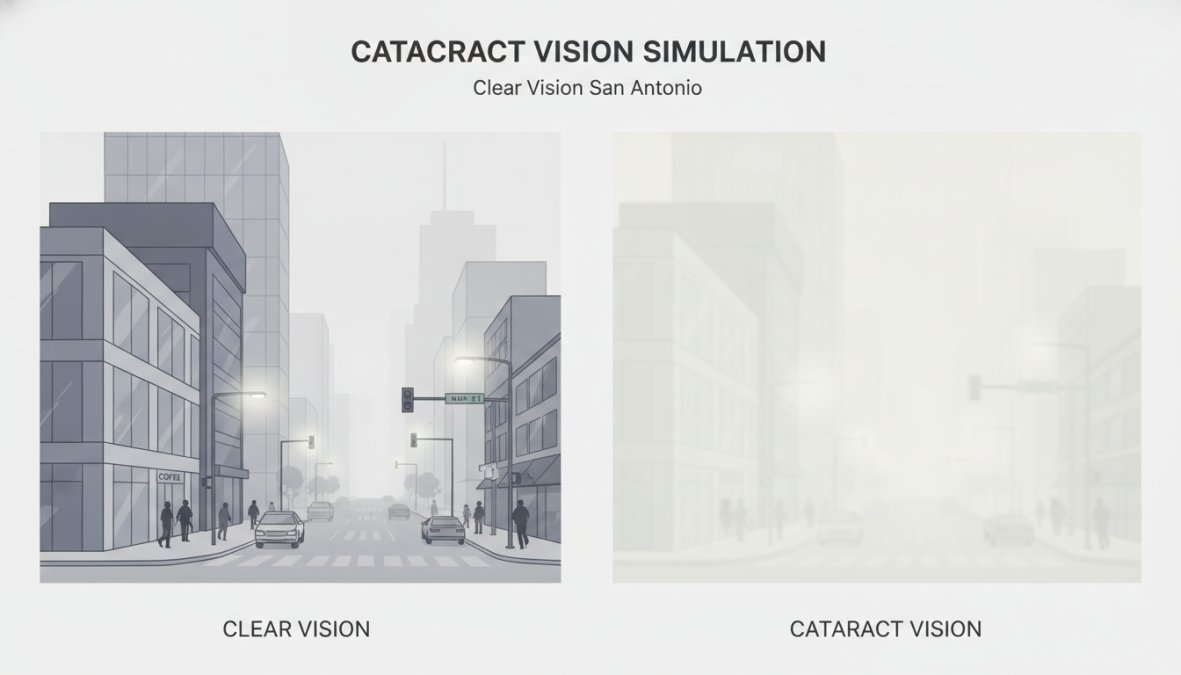
Early-stage simulation shows subtle haziness around the entire visual field with relatively recognizable colors but unsharp edges. Mid-stage simulation reveals more significant cloudiness, yellowing, and decreased contrast. Advanced simulation shows severe vision loss with predominantly yellowed and hazy imagery, significantly reduced contrast, and large halos around bright lights. Seeing these simulations helps patients understand their symptoms in concrete terms and clarifies conversations with eye doctors about when surgery becomes necessary.
When to See a Doctor for Cataracts
Schedule an eye exam if you notice blurred or cloudy vision that doesn’t improve with new glasses, increasing difficulty with night driving, halos around lights, colors appearing duller or more yellowed, or struggling to read despite adequate lighting. You should also see a doctor if you have risk factors for cataracts, such as diabetes, a family history of cataracts, previous eye injury or surgery, or long-term corticosteroid use. Regular screening becomes increasingly important after age 60.
Cataract Diagnosis and Testing
Diagnosing cataracts involves several straightforward tests during a comprehensive eye exam. Visual acuity testing measures how clearly you can see at various distances. Slit lamp examination, the primary diagnostic tool, uses a specialized microscope with a thin beam of light to examine your lens in detail, revealing exactly where cloudiness exists and how dense it is. Dilated eye examination allows better visualization of your lens and retina and ensures that vision problems aren’t caused by other retinal conditions. Contrast sensitivity testing measures your ability to distinguish objects from their backgrounds under various lighting conditions.
Self-Assessment: Do You Need an Eye Exam?
| Symptom or Concern | Assessment |
|---|---|
| Blurred or cloudy vision that doesn’t improve with glasses | Schedule exam soon |
| Difficulty driving at night or avoiding night driving | Schedule exam immediately |
| Halos around lights or glare from bright sources | Schedule exam within 1-2 weeks |
| Colors appearing duller or more yellowed | Schedule exam within 1-2 weeks |
| Difficulty reading despite adequate lighting | Schedule exam within 2-3 weeks |
| Increased squinting or eye strain | Schedule eye exam |
| Family history of cataracts | Schedule routine exam |
| Age over 60 without recent eye exam | Schedule routine exam |
| Diabetes or corticosteroid use | Schedule annual eye exam |
| No symptoms but last eye exam over 2 years ago | Schedule routine exam |
If you’ve checked multiple items in the "schedule exam soon" or "immediately" categories, don’t delay. Early evaluation allows your doctor to monitor cataract development and discuss treatment options before vision loss becomes severe.
Cataract Treatment Options: From Monitoring to Surgery
Treatment for cataracts ranges from simple monitoring to surgical intervention, depending on how much the cataract affects your vision and daily functioning.
Lifestyle Changes and Monitoring
In early stages, when cataracts cause minimal vision problems, monitoring often represents the appropriate approach. Your eye doctor may recommend regular follow-up exams to track cataract progression. Lifestyle modifications can help you adapt: increased lighting for reading, anti-glare sunglasses to reduce halos, and avoiding night driving when possible. The decision to move from monitoring to treatment depends on how much the cataract affects your daily life.
The goal of monitoring is to have surgery at the right time, when the benefits clearly outweigh the risks and recovery time. There’s no benefit to having surgery before a cataract significantly impacts your vision, but waiting too long creates unnecessary limitations on your independence and quality of life.
Surgical Intervention and Recovery
Cataract surgery represents the only definitive treatment for cataracts. The procedure involves removing your cloudy lens and replacing it with an artificial intraocular lens (IOL). Phacoemulsification, the most common surgical technique, uses ultrasound energy to break up the cloudy lens into tiny fragments, which are then gently removed. The process takes about 15 minutes per eye, and the small incision typically doesn’t require stitches.
The artificial lens implanted during surgery corrects your vision by focusing light directly onto your retina. Advanced lens options now available allow correction for multiple focal distances, reducing your dependence on glasses after surgery. Clear Vision San Antonio offers several premium lens options, including multifocal lenses that provide clear vision at near, far, and intermediate distances.
Recovery from cataract surgery is relatively quick. Most people notice vision improvement within a few days, though complete healing takes about 4-6 weeks. During recovery, you’ll use prescribed eye drops to prevent infection and reduce inflammation. Your doctor will restrict certain activities, no heavy lifting, no swimming, no rubbing your eyes, to protect the healing incision. Complications from cataract surgery are rare but possible, though these respond well to treatment when caught early.
Risk Factors and Prevention Strategies
Age represents the most significant risk factor, with cataracts becoming increasingly common after age 60. Diabetes significantly increases cataract risk through high blood sugar damage to lens proteins. Smoking dramatically increases cataract risk, with smokers developing cataracts earlier and more severely than non-smokers. Excessive sun exposure without protection contributes to cataract development through UV radiation damage.
Prevention strategies focus on modifiable risk factors: maintain good blood sugar control if you have diabetes, quit smoking or never start, wear UV-protective sunglasses and hats outdoors, eat a diet rich in antioxidants and vitamins C and E, and manage other eye conditions according to your doctor’s recommendations.
The Psychological Impact of Vision Loss from Cataracts
While medical literature focuses on physical symptoms, the emotional and psychological impact deserves equal attention. Vision loss from cataracts affects far more than your ability to see, it impacts your independence, social life, emotional well-being, and sense of identity. Many people experience grief when cataracts begin limiting their activities, and depression and anxiety commonly accompany progressive vision loss.
Recognizing the psychological impact helps you address it proactively. Talking with family and friends about how cataracts affect you emotionally validates your experience. Many people find that connecting with others experiencing similar vision loss reduces the sense of isolation. The good news is that cataract surgery often resolves both the physical and psychological impacts, with most people experiencing remarkable emotional improvement after surgery.
If you’re experiencing symptoms of cataracts in adults, the next step is scheduling a comprehensive eye exam with an experienced ophthalmologist. At Clear Vision San Antonio, our team specializes in cataract diagnosis and treatment, using advanced surgical techniques and premium lens implants to help you achieve clear vision. We understand both the medical and emotional aspects of vision loss, and we’re committed to personalized care that addresses your specific needs and goals. Request an appointment with Clear Vision San Antonio today to discuss your cataract concerns and explore your treatment options.
Frequently Asked Questions
What are the very first signs of cataracts in adults?
The earliest signs of cataracts often include subtle blurred vision, slight light sensitivity, and a gradual yellowing of the lens that may cause colors to appear faded or dull. Many people notice they need better lighting for reading or that their prescription glasses have changed. These early symptoms of cataracts in adults may develop so gradually that you don't immediately realize your vision is declining. If you notice any changes in your visual clarity, scheduling an eye exam with an ophthalmologist is the best first step.
How is cataract vision simulation helpful in understanding my symptoms?
Cataract vision simulation tools allow you to see what the world looks like through eyes affected by cataracts, showing cloudy vision, halos around lights, and reduced contrast sensitivity. This visual representation helps you understand whether your symptoms match cataract development and emphasizes the importance of seeking professional diagnosis. Seeing a simulation can also help you communicate your vision problems more clearly to your eye doctor, enabling better assessment and treatment planning.
When should I see a doctor about symptoms of cataracts in adults?
You should schedule an eye exam if you experience blurred or cloudy vision, increased light sensitivity, difficulty driving at night, faded colors, or halos around lights. Even if symptoms are mild, an ophthalmologist can perform diagnostic testing to confirm cataracts and monitor their progression. Early detection allows you to plan cataract treatment options before vision significantly impacts your daily activities. Don't wait until cataracts severely affect your quality of life, professional evaluation ensures you receive appropriate care at the right time.
What cataract treatment options are available, and how do I know which is right for me?
Cataract treatment options range from monitoring with updated eyeglass prescriptions in early stages to surgical intervention when cataracts significantly impair vision. Phacoemulsification surgery with intraocular lens implants is the standard procedure, offering excellent outcomes and fast recovery. Your ophthalmologist will discuss whether surgery is appropriate based on your symptoms, visual acuity, overall eye health, and how cataracts affect your daily activities. Many patients find surgery transformative, restoring clear vision and improving quality of life significantly.
This article was written using GrandRanker