

Table of Contents
- Understanding Cataracts and Vision Changes
- 10 Key Signs You Need Cataract Surgery
- When Is It Time for Cataract Surgery?
- How Cataracts Affect Daily Life and Quality of Life
- Cataract Surgery Recovery Time and What to Expect
- Preparing for Cataract Surgery: Steps and Considerations
- Cataract Surgery Risks and Complications: What You Should Know
- Cataracts vs. Other Age-Related Eye Conditions
Last Updated: June 24, 2026
Recognizing the signs you need cataract surgery is not always straightforward, and that delay costs people years of clear, confident vision. The lens inside your eye can cloud so gradually that many patients adapt without realizing how much they have lost. At Clear Vision San Antonio, our team of ophthalmologists sees this pattern constantly: patients who arrive thinking their prescription glasses just need updating, only to discover that a cataract has been quietly reshaping their world for years.
According to National Eye Institute cataract resources, cataracts are the leading cause of vision impairment worldwide, and surgical correction remains the only proven treatment once lens opacity reaches a functional threshold.
Understanding Cataracts and Vision Changes
What Are Cataracts?
A cataract is a clouding of the eye’s natural crystalline lens that reduces the clarity of light reaching the retina. When proteins within the lens clump and break down, they scatter incoming light rather than focusing it cleanly, resulting in blurred vision, reduced contrast sensitivity, and progressive decline in visual acuity that no prescription glasses can fully correct.
How Lens Opacity Develops Over Time
Lens opacity develops slowly over months or years. Age-related cataracts are most common, though UV exposure, diabetes, steroid use, and prior eye trauma can accelerate the process. Early cloudiness may affect only a small portion of the lens. As opacity expands toward the center, its impact on daily activities grows substantially. Annual eye exams with pupil dilation catch changes before they become functionally limiting.
If your vision seems sharper in dim light than in bright sunlight, that is a classic early sign of a nuclear cataract. The pupil dilates in low light, allowing you to see around the central opacity.
10 Key Signs You Need Cataract Surgery
Identifying these signs early gives you and your ophthalmologist the most options for intervention.
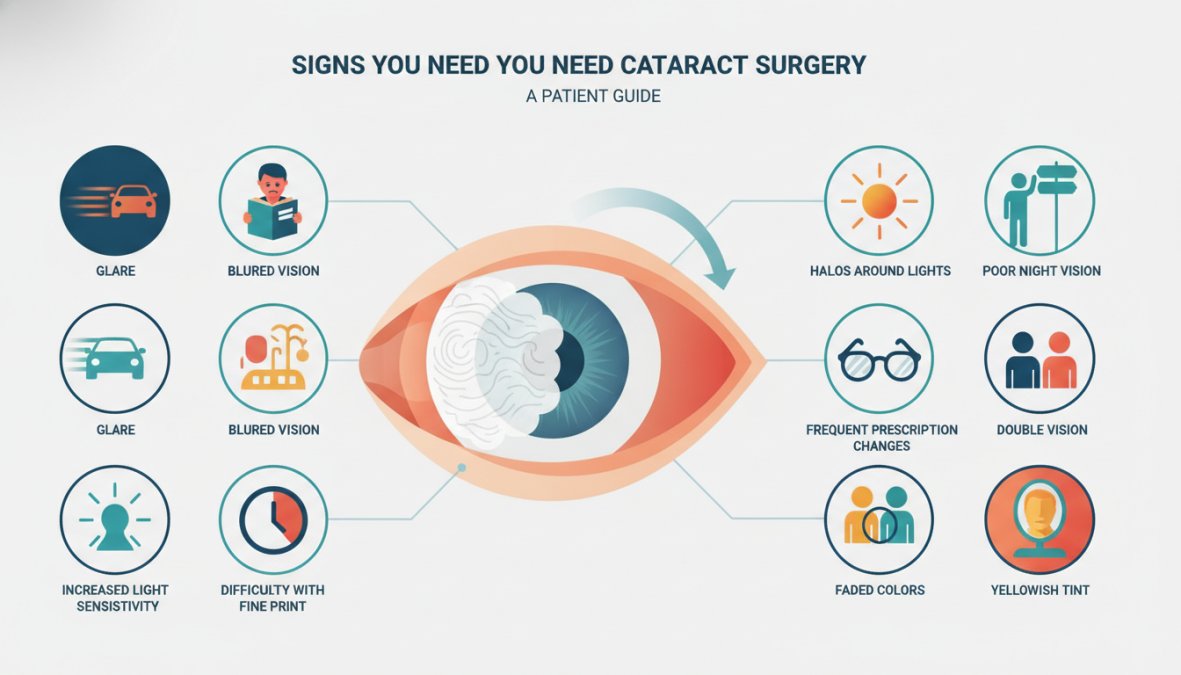
Cloudy or Blurred Vision
Persistent cloudy or blurred vision that does not sharpen with a new prescription is the hallmark symptom. Unlike refractive error, which corrects cleanly with glasses, cataract-related blur is caused by physical changes in the lens itself. Patients describe it as looking through a frosted window.
Difficulty Driving at Night and Headlight Glare
Headlight glare is one of the most functionally dangerous signs. Oncoming headlights scatter inside a clouded lens and produce blinding halos or starbursts that make night driving hazardous. Many patients self-restrict driving to daylight hours before connecting the symptom to cataracts.
Light Sensitivity and Sunlight Glare
Posterior subcapsular cataracts are especially associated with light sensitivity and sunlight glare. Bright outdoor environments, reflective surfaces, and overhead fluorescent lighting trigger significant discomfort. Specialized eyewear offers temporary relief but does not address the underlying lens opacity.
Halos Around Lights and Double Vision
Halos around lights and monocular double vision (persisting even when one eye is closed) indicate that light is being scattered by irregular areas within the lens. When halos and double vision appear together with blurred vision, the case for surgical intervention strengthens considerably.
Faded Colors and Contrast Sensitivity Loss
As a cataract matures, it develops a yellowish or brownish tint that filters out blue wavelengths, causing colors to appear washed out. Many patients notice this only after surgery, when they describe the world as suddenly vivid again. Reduced contrast sensitivity also accompanies lens opacity and contributes to difficulty reading and recognizing faces.
Frequent Prescription Changes
Needing a new prescription every few months without a stable refractive error is a specific warning sign. A maturing cataract changes the refractive index of the lens, creating "myopic shift." Prescription instability itself signals structural lens changes.
Reading Difficulty and Near Vision Problems
Reading difficulty is often attributed to presbyopia, but cataracts compound the problem significantly. Patients need increasingly bright light to read, hold text farther away, or experience eye strain and headaches with extended reading. When near vision problems persist despite updated reading glasses, cataracts deserve serious consideration.
Depth Perception Issues
Depth perception relies on clear, consistent input from both eyes. When one or both lenses are clouded, the brain receives degraded signals, compromising the ability to judge distances accurately. Falls in older adults are a documented consequence of unaddressed vision impairment.
When Is It Time for Cataract Surgery?
The right time for cataract surgery is when vision impairment meaningfully interferes with daily activities or safety, and when non-surgical options no longer provide adequate correction.
Visual Acuity Testing and Eye Exam Findings
During a comprehensive eye exam, your ophthalmologist measures visual acuity using a standardized chart and assesses lens opacity through slit-lamp examination with pupil dilation. A visual acuity reading of 20/40 or worse is a commonly used clinical benchmark, but contrast sensitivity and glare testing provide a more complete picture of functional impairment.
Impact on Day-to-Day Activities
The clinical community increasingly uses functional impact as the primary surgical criterion. If cataracts prevent you from driving safely, reading comfortably, recognizing faces, or performing your occupation, surgery is warranted. The American Academy of Ophthalmology preferred practice guidelines support this patient-centered approach, emphasizing that the decision should be guided by the patient’s functional needs and goals.
How Cataracts Affect Daily Life and Quality of Life
The full burden of cataracts extends well beyond clinical measurements. Vision impairment reshapes how people work, socialize, and maintain independence.
Using Quality of Life Assessment Tools
Validated quality of life assessment tools such as the Visual Function Questionnaire-25 (VFQ-25) and the Catquest-9SF questionnaire give both patients and clinicians a structured way to measure how vision impairment affects specific activities. These tools ask about driving, reading, watching television, recognizing faces, and emotional wellbeing.
Formal quality-of-life assessment tools like the VFQ-25 are the most objective way to communicate your functional impairment to your eye care team. Ask for one specifically before your consultation if your clinic does not offer it.
Vision Impairment and Functional Limitations
Functional limitations imposed by cataracts tend to compound. Difficulty reading leads to reduced mental engagement. Avoiding night driving leads to social isolation. Poor depth perception increases fall risk. Patients who address these signs promptly typically report substantial improvements in confidence, independence, and overall wellbeing after surgery.
Cataract Surgery Recovery Time and What to Expect
Cataract surgery recovery is faster than most patients expect. The procedure typically takes under 30 minutes per eye, and most patients notice meaningful visual improvement within 24 to 48 hours.
Timeline for Visual Improvement
Most patients achieve functional vision within one to three days, though full stabilization of visual acuity takes four to six weeks as the eye heals and adapts to the new intraocular lens (IOL). Some mild blurriness, light sensitivity, and watering are normal in the first week. Strenuous activity, swimming, and rubbing the eye should be avoided during initial recovery. Follow-up appointments occur the day after surgery, at one week, and at one month.
Post-Surgery Lifestyle Expectations
Your vision after cataract surgery is substantially determined by the IOL you select before the procedure. Monofocal IOLs correct vision at one distance, typically distance, meaning reading glasses will still be needed for near tasks. Premium multifocal and extended depth-of-focus IOLs can reduce or eliminate the need for glasses at multiple distances.
Do not assume that cataract surgery eliminates all need for glasses. The IOL type you select directly determines your post-operative dependence on prescription glasses.
Preparing for Cataract Surgery: Steps and Considerations
Preparing for cataract surgery well reduces anxiety, improves outcomes, and ensures you are matched with the right IOL for your visual goals.
| Preparation Step | Timing | Purpose |
|---|---|---|
| Initial consultation and eye exam | 4-6 weeks before surgery | Confirm diagnosis, assess IOL options |
| Pre-operative biometry measurements | 2-4 weeks before surgery | Calculate IOL power for accurate vision correction |
| Medical clearance (if needed) | 2-3 weeks before surgery | Ensure fitness for outpatient procedure |
| Stop blood-thinning medications | Per physician guidance | Reduce bleeding risk |
| Arrange transportation | Day of surgery | Anesthesia prevents driving post-procedure |
| Begin pre-op eye drops | Per surgeon’s instructions | Reduce infection and inflammation risk |
Consultation With Your Ophthalmologist
The consultation is where the signs you need cataract surgery translate into a concrete surgical plan. Your ophthalmologist will review your ocular history, measure corneal curvature and axial length for IOL calculation, and discuss your lifestyle priorities. Be specific about what you want to see clearly without glasses: distance driving, computer screens, or reading fine print.
Choosing Your Intraocular Lens (IOL)
IOL selection is the most consequential decision in the entire process. Monofocal IOLs offer excellent distance or near correction at a single focal point. Toric IOLs correct astigmatism. Multifocal and extended depth-of-focus IOLs address vision at multiple distances. Premium IOLs typically involve additional out-of-pocket cost beyond standard insurance coverage.
Pre-Operative Testing and Pupil Dilation
Pre-operative testing includes biometry to calculate precise IOL power, corneal topography to map the eye’s surface, and pupil dilation to allow complete lens visualization. These measurements must be taken before using contact lenses for a prescribed period, as contacts temporarily alter corneal shape and can skew calculations.
Cataract Surgery Risks and Complications: What You Should Know
Cataract surgery is among the safest and most frequently performed surgical procedures in medicine, but understanding the risks is part of making an informed decision.
Common Complications and How They’re Managed
The most common complication is posterior capsule opacification (PCO), sometimes called a "secondary cataract," which occurs when the membrane behind the IOL becomes cloudy weeks to months after surgery. PCO is treated quickly and painlessly with a laser procedure called YAG capsulotomy, typically performed in the office. Other possible complications include infection, elevated intraocular pressure, IOL displacement, and retinal detachment, all uncommon but warranting prompt attention if symptoms arise. According to MedlinePlus surgical eye care resources, the overall rate of serious complications from modern cataract extraction is very low when performed by an experienced surgeon.
Minimizing Risk Through Proper Preparation
Patients can meaningfully reduce complication risk by disclosing all medications and supplements, following pre-operative eye drop regimens precisely, attending all post-operative appointments, and reporting any sudden changes in vision, pain, or redness immediately.
Cataracts vs. Other Age-Related Eye Conditions
One of the most important things an ophthalmologist does during your evaluation is confirm that cataracts are actually the source of your symptoms. Several other age-related conditions produce overlapping visual symptoms, and treatment pathways are entirely different.
Distinguishing Cataracts From Presbyopia and Refractive Error
Presbyopia is the normal age-related loss of the lens’s ability to focus at near distances, correctable with reading glasses. Cataracts produce a broader pattern of symptoms including cloudy vision, contrast sensitivity loss, and glare that prescription glasses cannot fully address. Refractive error is correctable with glasses but does not involve lens opacity. The key diagnostic distinction is that cataracts cause vision changes that cannot be fully corrected with any optical prescription.
Age-related macular degeneration (AMD) and glaucoma can co-exist with cataracts, complicating both diagnosis and surgical planning. AMD affects central vision and is not corrected by cataract surgery. Glaucoma involves optic nerve damage and elevated intraocular pressure. A thorough eye exam, including imaging of the optic nerve and macula, is essential before attributing all symptoms to cataracts alone.
Why Professional Diagnosis Matters
Self-assessment tools, including AI-powered apps, can prompt people to seek care sooner but are not a substitute for clinical diagnosis. The only way to confirm lens opacity, rule out co-existing conditions, and plan an appropriate surgical approach is through a comprehensive examination with an ophthalmologist using slit-lamp biomicroscopy and dilated fundus evaluation.
If you are unsure whether your symptoms are cataracts, presbyopia, or something else, a single comprehensive eye exam with pupil dilation answers all three questions simultaneously.
Cataract surgery is covered by Medicare and most private insurers when it meets medical necessity criteria, while some premium IOL upgrades involve out-of-pocket costs. For detailed guidance on Medicare coverage, the Medicare official coverage information outlines what is included under Part B.
Recognizing the signs you need cataract surgery is the first step, but translating that recognition into a clear vision plan requires expert guidance and advanced diagnostic tools. Clear Vision San Antonio offers comprehensive cataract evaluations, advanced technology lens implants, and a highly personalized approach that matches each patient’s IOL choice to their specific lifestyle and visual goals. Request an appointment with Clear Vision San Antonio and take the first step toward clear, confident vision for life.
Frequently Asked Questions
What are the early warning signs of cataracts?
Early signs you need cataract surgery often include cloudy or blurred vision, increased light sensitivity, and difficulty with night driving due to headlight glare. You may also notice faded colors, halos around lights, or frequent changes in your eyeglass prescription. These symptoms develop gradually as lens opacity increases. If you experience any of these vision changes, schedule an eye exam with an ophthalmologist to assess your visual acuity and determine if cataract extraction is appropriate for your situation.
At what stage of cataracts is surgery recommended?
Cataract surgery is recommended when the cloudy lens significantly impacts your day-to-day activities and quality of life. Your ophthalmologist will evaluate your visual acuity, contrast sensitivity, and how cataracts affect your ability to read, drive, or perform routine tasks. Surgery isn't based solely on age or cataract density, it's about functional impairment. Some people benefit from surgical intervention early if symptoms severely limit their lifestyle, while others wait longer if vision loss is minimal. A professional eye exam and patient consultation are essential for determining the right timing.
How do I know if my cataracts are getting worse?
Monitor changes in your vision quality by noting increased difficulty with reading, night driving, or recognizing faces. Worsening cataracts often cause progressive blurred vision, greater light sensitivity, and more pronounced halos around lights. Frequent prescription changes are another indicator that lens opacity is advancing. Keep track of how vision impairment affects your daily activities. Schedule regular eye exams with your ophthalmologist, they use visual acuity testing and pupil dilation to measure changes in lens opacity and assess whether cataract extraction would improve your functional vision and quality of life.
What should I expect during cataract surgery recovery time?
Most patients experience significant vision improvement within days to weeks after cataract extraction and intraocular lens (IOL) implantation. Initial healing takes about 4-6 weeks, though full visual stabilization may take 8-12 weeks. You'll use prescribed eye drops to prevent infection and manage inflammation during recovery. Vision quality improves as the eye heals and adjusts to the new IOL. Post-surgery lifestyle expectations include temporary activity restrictions and careful adherence to medication schedules. Your ophthalmologist will schedule follow-up visits to monitor healing and ensure your new lens provides the clear vision you need for routine eye care and daily activities.
This article was written using GrandRanker