

Table of Contents
- LASIK vs ICL for High Myopia: A Side-by-Side Overview
- LASIK Eligibility for High Prescriptions: Who Qualifies and Who Doesn’t
- Key Differences Between LASIK and ICL for High Myopia Patients
- Is ICL Reversible? Reversibility and Future-Proofing Your Vision
- ICL Surgery Recovery Time: What to Expect After the Procedure
- LASIK vs ICL Cost Comparison: Long-Term Value Beyond the Sticker Price
- Risks, Surgical Outcomes, and the Psychological Impact of Vision Correction
- Conclusion: Choosing the Right Refractive Surgery for Your Eyes
Last Updated: June 11, 2026
LASIK vs ICL for High Myopia: A Side-by-Side Overview
Choosing between lasik vs icl for high myopia is one of the most consequential decisions a visually impaired patient can make. At Clear Vision San Antonio, we work with high-myopia patients who arrive assuming LASIK is the default and ICL is the backup. That framing gets it backwards for a significant portion of this population. Both procedures correct refractive error, but through fundamentally different mechanisms, with different risk profiles and different patient anatomies in mind.
LASIK is a refractive surgery procedure that permanently reshapes the cornea using laser energy to correct myopia, hyperopia, and astigmatism by altering how light focuses on the retina.
ICL (Implantable Collamer Lens) is an additive, reversible refractive surgery in which a biocompatible lens is surgically placed in the posterior chamber of the eye, between the natural lens and the iris, without removing any corneal tissue.
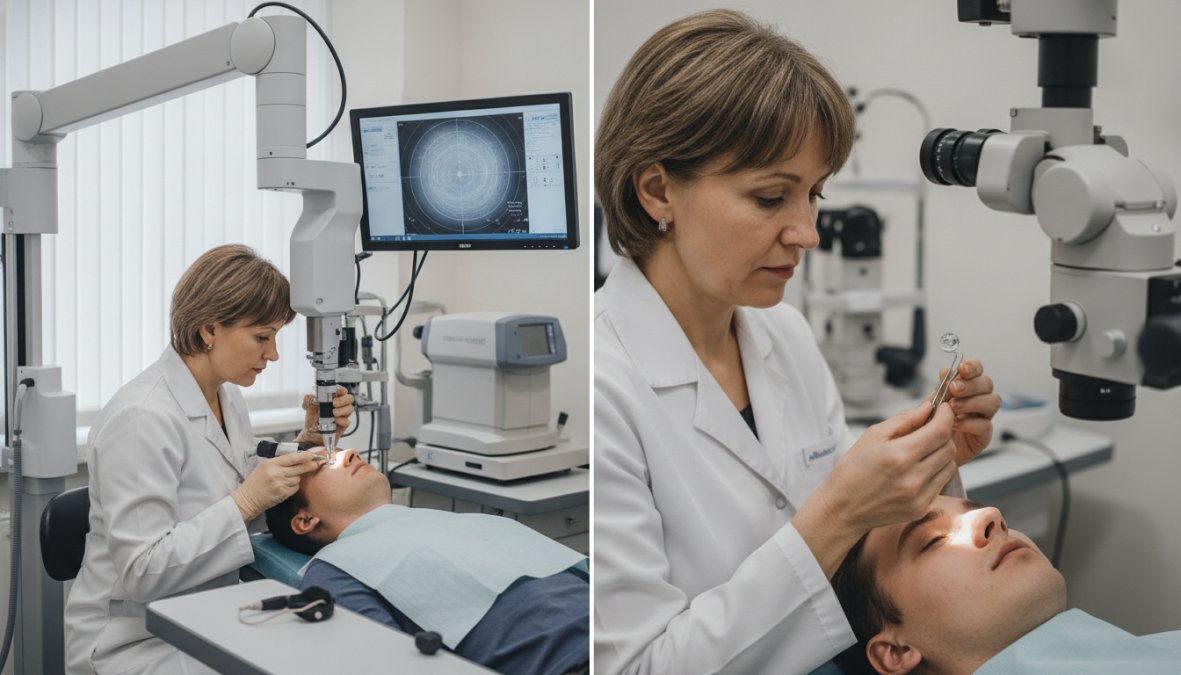
The core tension between these two procedures comes down to one clinical reality: high myopia often disqualifies patients from LASIK, while ICL was specifically designed for exactly that population.
How LASIK Works: Corneal Reshaping with Femtosecond and Excimer Lasers
LASIK corrects myopia by removing precise amounts of corneal tissue to flatten the cornea’s curvature. A femtosecond laser first creates a thin corneal flap; an excimer laser then reshapes the tissue beneath it. The flap is repositioned and heals without sutures.
Modern platforms have made this significantly more precise. The WaveLight Plus InnovEyes system from Alcon uses ray-tracing technology to build a 3D "Digital Eye Twin" guiding the ablation profile. The Johnson & Johnson iDESIGN Refractive Studio captures five biometric measurements in a single sequence, creating an optical fingerprint of the entire visual pathway. Most patients achieve functional visual acuity within 24 hours and return to normal activity within days.
How EVO ICL Works: Additive Lens Implantation in the Posterior Chamber
The EVO Visian ICL takes a completely different approach. A small, flexible lens made from Collamer, a biocompatible material containing collagen, is implanted directly into the posterior chamber, sitting between the iris and the natural crystalline lens without touching either structure. No corneal tissue is removed and no flap is created.
The EVO version includes a central port called the KS-AquaPORT, which allows natural aqueous humor to flow without obstruction, eliminating the pre-operative laser iridotomy that older ICL models required. This additive approach is what makes ICL the preferred option for patients with high myopia who lack sufficient corneal thickness for LASIK ablation.
LASIK Eligibility for High Prescriptions: Who Qualifies and Who Doesn’t
Most patients assume LASIK is available to anyone who wants it. The clinical reality is more restrictive, and high-myopia patients face the most significant barriers.
Corneal Thickness, Diopter Limits, and Keratoconus Risk
LASIK eligibility depends on a precise calculation: enough corneal tissue must remain after ablation to maintain structural integrity. The general clinical threshold is a residual stromal bed of at least 250 microns after the flap and ablation are accounted for. The diopter range for LASIK typically caps around -8.00 to -10.00 diopters; patients above that range are often poor candidates regardless of corneal thickness because the required tissue removal would compromise corneal biomechanics.
Keratoconus represents an absolute contraindication for LASIK. Patients with subclinical keratoconus are at elevated risk of post-LASIK ectasia, progressive corneal distortion that can require rigid contact lenses or corneal transplantation to manage. Corneal topography screening is essential before any LASIK candidacy determination.
Patients with borderline corneal thickness who proceed with LASIK anyway face a real risk of post-operative ectasia. This is not a minor inconvenience. Screening is non-negotiable.
The WaveLight and iDESIGN platforms improve precision, but they cannot overcome the fundamental anatomical limits of corneal thickness. If the tissue isn’t there, no laser system changes that calculation.
Key Differences Between LASIK and ICL for High Myopia Patients
Here’s where the comparison gets clinically meaningful. The table below summarizes the most decision-relevant differences for high-myopia patients.
| Feature | LASIK | EVO ICL |
|---|---|---|
| Mechanism | Corneal reshaping (tissue removal) | Additive lens implant (no tissue removal) |
| Prescription range | Typically up to -8 to -10 D | Up to -20 D (FDA-approved range) |
| Corneal thickness required | Yes, significant | Not a factor |
| Reversibility | Permanent (irreversible) | Fully reversible |
| Dry eye risk | Elevated post-operatively | Minimal to none |
| Night vision quality | Variable; halo and glare possible | Generally excellent |
| Visual acuity potential | Good to excellent | Excellent, often high-definition |
| Recovery time | 24-48 hours functional | 1-7 days to full recovery |
| FDA-approved | Yes | Yes |
Dry Eye Syndrome, Night Vision, and Halo and Glare Compared
Dry eye syndrome is the most commonly underreported complication of LASIK. The femtosecond laser severs corneal nerves, reducing the eye’s ability to sense dryness and trigger tear production. Many patients experience symptoms for months; a smaller subset develops chronic dry eye requiring ongoing management. ICL surgery does not involve corneal nerve disruption, leaving the corneal nerve architecture intact. Patients who already experience dry eye, or those in dry climates like San Antonio, often find ICL significantly more comfortable long-term.
Night vision differences are also clinically relevant. LASIK patients with large pupils relative to their optical zone can experience halo and glare around lights at night. Modern wavefront-guided platforms have reduced but not eliminated this. ICL patients generally report superior night vision and high-definition visual quality because the procedure introduces fewer optical aberrations.
Patients who drive frequently at night, work in low-light environments, or have large pupils should specifically ask their surgeon about optical zone size and night vision outcomes before committing to LASIK.
Is ICL Reversible? Reversibility and Future-Proofing Your Vision
ICL surgery is fully reversible. The implanted lens can be removed or exchanged if the patient’s prescription changes significantly, if they develop a cataract, or if any other clinical reason warrants it. LASIK permanently alters corneal tissue, the ablation cannot be undone. For younger patients whose prescriptions may continue to evolve, the reversibility of ICL represents genuine long-term optionality.
Future-proofing matters for cataract surgery as well. An ICL can be removed before cataract surgery proceeds, giving surgeons full flexibility in selecting an intraocular lens. LASIK patients undergoing cataract surgery require additional biometric calculations to account for the altered corneal curvature, introducing additional complexity.
According to the American Academy of Ophthalmology’s clinical guidance on refractive surgery, the reversibility of phakic IOLs like ICL makes them particularly appropriate for younger patients with high myopia who may face additional refractive changes over time.
ICL Surgery Recovery Time: What to Expect After the Procedure
ICL surgery recovery is faster than many patients expect. Most notice significant visual improvement within 24 hours; full stabilization typically occurs within one to seven days. The procedure itself takes approximately 20-30 minutes per eye under topical anesthesia. Patients go home the same day, with a follow-up examination the next day to confirm lens position and intraocular pressure.

Post-Operative Lifestyle Restrictions for LASIK vs ICL
Post-operative restrictions differ meaningfully between the two procedures.
After LASIK:
- Avoid rubbing the eyes for at least one month (flap displacement risk)
- No swimming or contact sports for two to four weeks
- Avoid dusty or smoky environments during initial healing
- Screen use typically limited for the first 24-48 hours
- Driving restricted until visual acuity is confirmed by the surgeon
After ICL:
- Avoid rubbing the eyes for one to two weeks
- No swimming or contact sports for one to two weeks
- Strenuous physical activity limited for approximately one week
- Eye drops (antibiotic and anti-inflammatory) required for several weeks post-operatively
- More frequent follow-up visits in the first month to monitor intraocular pressure
Most patients with desk jobs return to work within one to three days. Patients in physically demanding roles should plan for a slightly longer restriction period.
ICL recovery is generally straightforward and brief, but the post-operative eye drop regimen requires consistency. Missing doses increases infection risk and can affect healing outcomes. Set reminders.
LASIK vs ICL Cost Comparison: Long-Term Value Beyond the Sticker Price
ICL surgery typically carries a higher upfront cost than LASIK, reflecting the implant cost, surgical complexity, and follow-up schedule. However, the long-term picture shifts when you account for several factors:
- Dry eye management: LASIK patients who develop chronic dry eye may spend significantly on prescription drops, punctal plugs, or other treatments over years.
- Enhancement procedures: Some LASIK patients require enhancement surgery if their prescription shifts, consuming additional corneal tissue at additional cost.
- Contact lens elimination: Both procedures eliminate ongoing contact lens costs, for high-myopia patients often specialty lenses at premium prices, representing substantial savings over 10-20 years.
- Future cataract surgery complexity: LASIK patients require additional diagnostic steps during cataract surgery planning, adding cost and complexity.
The reversibility of ICL also has financial implications: if a patient’s prescription changes substantially, the lens can be exchanged rather than requiring an entirely new surgical approach.
As noted in the FDA’s patient information resource on refractive surgery, both LASIK and ICL are elective procedures not typically covered by standard insurance plans, making the total long-term cost calculation an important part of the patient decision process.
Risks, Surgical Outcomes, and the Psychological Impact of Vision Correction
Both procedures carry surgical risks that any honest comparison must address directly.
LASIK risks include:
- Dry eye syndrome (most common, often temporary but sometimes chronic)
- Halo and glare around lights, particularly at night
- Undercorrection or overcorrection requiring enhancement
- Corneal ectasia (rare but serious, particularly with thin corneas or undetected keratoconus)
- Flap complications during or after surgery
ICL risks include:
- Elevated intraocular pressure in the early post-operative period
- Small risk of cataract development over time
- Pupillary block if aqueous humor flow is obstructed (the EVO KS-AquaPORT design specifically addresses this)
- Rotation or displacement of the lens (rare with modern surgical technique)
Surgical outcomes for both procedures are generally excellent for appropriate candidates. LASIK outcomes deteriorate when performed on patients who were not ideal candidates; ICL outcomes are consistently strong across the high-myopia range precisely because the procedure was designed for that population.
The psychological dimension is real and consistently underreported. Patients with high myopia have often spent decades dependent on thick glasses or specialty contact lenses, and the impact of waking up with clear, unaided vision is significant. That said, managing expectations matters, the goal is excellent functional vision, not optical perfection in every condition.
According to clinical literature on patient-reported outcomes in refractive surgery, patient satisfaction rates for ICL surgery are consistently high, particularly among patients previously considered poor LASIK candidates due to high myopia or thin corneas.
Conclusion: Choosing the Right Refractive Surgery for Your Eyes
For patients with mild-to-moderate myopia and adequate corneal thickness, LASIK remains a proven, efficient option. For patients with high myopia, thin corneas, large pupils, or a history of dry eye, ICL is not the fallback, it is often the better option. The reversibility, corneal tissue preservation, superior night vision outcomes, and extended prescription range make it the more appropriate choice for a large portion of the high-myopia population.
The decision between lasik vs icl for high myopia should be based on a thorough pre-operative evaluation including corneal topography, pachymetry, pupil size measurement, and a detailed discussion of your lifestyle, prescription history, and long-term vision goals, never on cost alone or on what someone else had done.
Deciding without a comprehensive eye evaluation is the most common mistake high-myopia patients make. Clear Vision San Antonio provides thorough, individualized assessment combining advanced diagnostic technology with expert ophthalmological care. Our team offers both LASIK and ICL procedures, along with advanced lens implants and cataract surgery, so recommendations are based on your eyes, not on which procedure happens to be available. Request an appointment with Clear Vision San Antonio and get a clear answer about which path to permanent vision correction is right for you.
Frequently Asked Questions
Is ICL better than LASIK for high myopia?
For patients with high myopia, typically beyond -6.00 diopters, EVO ICL is often the stronger choice. Because it does not require corneal tissue removal, it preserves corneal thickness and avoids the risk of corneal thinning. LASIK can be effective for moderate myopia, but patients with very high prescriptions or thin corneas may not qualify. A vision correction consultation with an ophthalmologist is the only way to determine which procedure is right for your specific refractive error.
What is the maximum prescription for LASIK?
LASIK is generally FDA-approved for myopia up to approximately -12.00 diopters, but in practice many surgeons set a conservative limit closer to -8.00 to -10.00 diopters depending on corneal thickness. Beyond these ranges, the amount of corneal reshaping required may leave the cornea too thin for safe outcomes. Patients with high myopia near or beyond these limits are frequently redirected to EVO ICL as a safer alternative for permanent vision correction.
Does ICL last forever, and is the procedure reversible?
The EVO ICL is designed to be a long-term, permanent vision correction solution, and clinical data suggests it can remain effective indefinitely. Unlike LASIK, which permanently reshapes the cornea, the ICL is a reversible procedure, the implantable collamer lens can be removed or exchanged by a qualified ophthalmologist if vision changes or a new treatment becomes available. This reversibility makes it an appealing option for patients who want effective correction while keeping future options open.
How much does ICL cost compared to LASIK, and is it worth it?
ICL surgery typically costs more than LASIK upfront due to the specialized implantable collamer lens and the complexity of the procedure. However, a long-term cost-benefit analysis often favors ICL for high myopia patients who would otherwise need repeated enhancements or face complications from LASIK. When factoring in the reduced risk of dry eye syndrome, superior night vision outcomes, and the reversibility of the procedure, many patients find the higher initial investment in ICL to be justified over a lifetime of clear vision.
How long is recovery after ICL surgery compared to LASIK?
ICL surgery recovery time is generally rapid. Most patients notice significantly improved visual acuity within 24 to 48 hours, with full visual recovery often achieved within one to two weeks. LASIK recovery is similarly quick, with many patients returning to normal activities the day after surgery. Both procedures require avoiding strenuous activity, swimming, and rubbing the eyes for a short period post-operatively, though your ophthalmologist will provide specific post-operative lifestyle restrictions tailored to your situation.
Am I a candidate for ICL if I have high myopia and thin corneas?
Yes, thin corneas are one of the primary reasons patients with high myopia are referred to EVO ICL over LASIK. Because ICL is an additive procedure that implants a lens in the posterior chamber without removing corneal tissue, corneal thickness is not a limiting factor. Ideal ICL candidates are typically between 21 and 45 years old with a stable refractive error and sufficient anterior chamber depth. A comprehensive patient candidacy evaluation at a qualified ophthalmology practice will confirm your eligibility.
This article was written using GrandRanker