

Table of Contents
- Why San Antonio Patients Choose LASIK Eye Surgery
- LASIK Eye Surgery Eligibility: Are You a Candidate?
- PRK vs LASIK vs SMILE vs EVO ICL: Choosing the Right Procedure
- LASIK Cost in San Antonio: Pricing and Financing Options
- Advanced Technology and Equipment Behind Custom Vision Correction
- LASIK Recovery Time: What to Expect Week by Week
- Your Complimentary Consultation at Clear Vision San Antonio
- Conclusion
Last Updated: June 9, 2026
Deciding to ditch glasses or contacts is one of the most consequential vision decisions you’ll make. Patients researching lasik eye surgery san antonio often arrive with the same core questions: Am I a candidate? What will it cost? Which procedure is right for me? At Clear Vision San Antonio, we’ve guided hundreds of patients through these questions. Below is a full breakdown of procedure options, candidacy criteria, real costs, and a week-by-week recovery guide.
The short version: most healthy adults with stable prescriptions qualify for some form of refractive surgery, even if traditional LASIK isn’t the right fit.
Why San Antonio Patients Choose LASIK Eye Surgery
Refractive surgery has become one of the most performed elective procedures in ophthalmology, and San Antonio patients have access to some of the most advanced surgical technology available. Laser-assisted in situ keratomileusis (LASIK) offers a same-day outpatient procedure with rapid visual recovery and long-term freedom from corrective lenses.
What most guides won’t tell you upfront: the decision isn’t just about LASIK. It’s about finding the right vision correction procedure for your specific corneal anatomy, lifestyle, and prescription. San Antonio’s mix of military personnel, outdoor enthusiasts, and professionals creates high demand for procedures that support active, contact-free lifestyles. According to the American Refractive Surgery Council’s patient education resources, the vast majority of LASIK patients report satisfaction with their outcomes and would recommend the procedure to others.
What LASIK (Laser-Assisted In Situ Keratomileusis) Actually Does
Laser-assisted in situ keratomileusis reshapes the cornea with an excimer laser to correct how light focuses on the retina. The surgeon creates a thin corneal flap, lifts it, applies the laser to reshape the underlying tissue, then repositions the flap, which adheres without sutures. The entire procedure takes roughly 10-15 minutes per eye, with the laser active for less than a minute. Most patients notice dramatically improved acuity within 24 hours.
Conditions LASIK Can Correct: Nearsightedness, Farsightedness, and Astigmatism
LASIK corrects three primary refractive errors:
- Nearsightedness (myopia): The cornea is too steep; the laser flattens the central cornea.
- Farsightedness (hyperopia): The cornea is too flat; the laser steepens the central zone.
- Astigmatism: Irregular curvature creates distortion; the laser creates a more uniform surface.
Presbyopia, the age-related near vision loss that hits most people in their 40s, is a separate condition. Standard LASIK does not address it, though monovision LASIK and advanced lens procedures can.
LASIK Eye Surgery Eligibility: Are You a Candidate?
Candidacy for lasik eye surgery san antonio exists on a spectrum, and a thorough diagnostic evaluation is the only way to know where you fall.
Vision Stabilization and Prescription Requirements
Your prescription must have remained stable for at least one to two years before surgery. Performing LASIK on a shifting prescription produces suboptimal results because the corneal reshaping is calibrated to a fixed target. Very high prescriptions may require alternative procedures; your surgeon will review your refraction during diagnostic testing.
Patients under 21 are generally not LASIK candidates, even with stable vision. The eye continues developing into early adulthood, and proceeding too early increases the risk of regression.
Corneal Thickness, Retina Health, and Diagnostic Testing
Corneal thickness is the most critical anatomical requirement. Creating the flap and removing tissue both reduce corneal depth; if your cornea is too thin to safely accommodate both steps while leaving adequate residual stromal bed, LASIK is contraindicated.
Diagnostic testing at a qualified center includes:
- Corneal topography and tomography (maps front and back corneal surfaces)
- Wavefront analysis (identifies higher-order aberrations)
- Pachymetry (precise corneal thickness measurement)
- Pupil dilation and retina examination
- Dry eye assessment
Dry eye is evaluated carefully because LASIK can temporarily worsen dryness; significant pre-existing dry eye may indicate PRK or another procedure as a better option.
PRK vs LASIK vs SMILE vs EVO ICL: Choosing the Right Procedure
The real decision framework requires understanding not just what each procedure does, but which anatomical and lifestyle factors make one a clearly better fit.
| Procedure | Flap Created | Corneal Tissue Removed | Recovery Timeline | Best Candidate |
|---|---|---|---|---|
| LASIK | Yes | Yes | 1-2 days | Adequate corneal thickness, stable Rx |
| PRK | No | Yes (surface) | 5-7 days | Thin corneas, active contact sports |
| SMILE | No | Yes (lenticule) | 2-4 days | Moderate-high myopia, dry eye concerns |
| EVO ICL | No | No | 1-3 days | High Rx, thin corneas, any age 21-45 |
According to the FDA’s LASIK consumer information resources, understanding procedural differences and candidacy criteria is essential before committing to any refractive surgery.
When PRK or SMILE May Be a Better Fit Than LASIK
PRK (photorefractive keratectomy) is preferred for patients with thin corneas, those in high-impact contact sports where a flap could be dislodged, and military or law enforcement personnel with specific vision requirements. The tradeoff is recovery: PRK removes the corneal epithelium directly, so the surface must regenerate over several days and visual acuity improves over one to two weeks rather than overnight. The final outcome is equivalent to LASIK.
SMILE (small incision lenticule extraction) creates a disc-shaped lenticule within the cornea extracted through a small incision, no flap required. This preserves more corneal nerves and may reduce post-operative dry eye. SMILE currently treats myopia and myopic astigmatism, making it less versatile than LASIK for hyperopia correction.
Patients who’ve had issues with contact lens-related dry eye often find SMILE produces fewer dry eye symptoms post-operatively compared to LASIK. Raise this history explicitly during your consultation.
EVO ICL: The Implantable Option for Patients Who Don’t Qualify for LASIK
EVO ICL (implantable collamer lens) implants a thin biocompatible lens between the iris and the natural crystalline lens, no corneal tissue is removed. This makes it the best option for patients with prescriptions too high for safe laser correction, corneas too thin for LASIK or PRK, significant dry eye disease, or ages roughly 21-45 who want a reversible option. If your prescription changes significantly, the lens can be replaced. For the right patient, EVO ICL often delivers superior visual quality compared to laser procedures, particularly at higher prescriptions.
LASIK Cost in San Antonio: Pricing and Financing Options
Price transparency is the area where the refractive surgery industry has the most room to improve. The advertised per-eye figure rarely tells the complete story.
What’s Included, and What’s Often Not (Hidden Costs to Know)
The LASIK cost San Antonio patients see advertised often reflects a base price using older technology, without wavefront-guided or topography-guided customization. A realistic cost breakdown for lasik eye surgery san antonio includes:
- Pre-operative diagnostic testing: Sometimes bundled, sometimes billed separately
- The procedure itself: Varies by technology tier (standard vs. wavefront-guided vs. topography-guided)
- Post-operative visits: Typically included for a defined period (confirm the timeframe)
- Enhancement procedures: If a touch-up is needed within a defined window, is it covered?
- Dry eye treatment: If pre-existing dryness requires treatment before surgery, that’s an additional cost
The difference between a "budget" and a "premium" quote often comes down to whether wavefront technology and lifetime enhancement policies are included. Choosing purely on sticker price without understanding what’s bundled is a common and costly mistake.
Insurance, FSA/HSA, and Flexible Financing Plans
Standard vision and medical insurance does not cover LASIK, as it’s classified as elective. However, several financial pathways make the procedure accessible:
- FSA/HSA funds: LASIK qualifies as a medical expense under IRS guidelines, making pre-tax dollars fully applicable
- Financing plans: Many practices offer 12-24 month financing, often with promotional interest-free periods
- Military discounts: San Antonio’s large military community often has access to specific pricing arrangements
According to IRS Publication 502 on medical and dental expenses, laser eye surgery is explicitly listed as a qualifying medical expense for FSA and HSA reimbursement.
Advanced Technology and Equipment Behind Custom Vision Correction
The gap between practices isn’t primarily in surgeon skill, it’s in diagnostic and surgical technology. Custom vision correction using wavefront-guided or topography-guided treatment maps the unique imperfections of your individual cornea, not just your standard prescription.
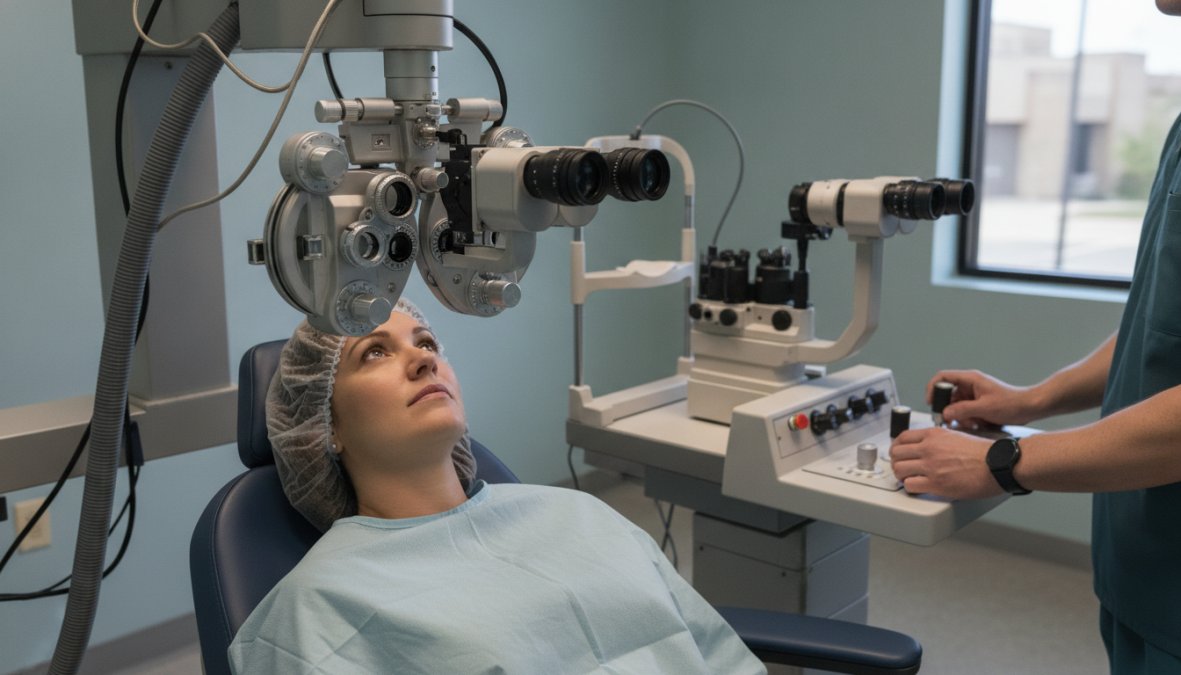
The excimer laser uses ultraviolet light to ablate corneal tissue in increments measured in fractions of a micron. Modern platforms incorporate eye-tracking technology that follows involuntary eye movements, automatically pausing or adjusting the laser to maintain precision. Wavefront technology creates a three-dimensional map of how light travels through your entire optical system, capturing higher-order aberrations that affect night glare, contrast sensitivity, and overall visual quality. Topography-guided treatment goes further, using corneal surface maps to guide ablation, particularly valuable for patients with irregular astigmatism or previous eye surgery.
Wavefront-guided and topography-guided LASIK consistently produce better outcomes for patients with higher-order aberrations compared to standard treatments. Ask specifically which platform your surgeon uses and whether it incorporates eye-tracking.
LASIK Recovery Time: What to Expect Week by Week
LASIK recovery time is faster than most patients expect, but the timeline has distinct phases that matter for planning.
Week 1: Visual acuity improves dramatically within 24-48 hours. Most patients can drive and return to desk work within two to three days. Expect some fluctuation, light sensitivity, and mild dryness. Protective eye shields are worn during sleep.
Weeks 2-4: Vision continues stabilizing. Dryness typically peaks in this window before improving. Avoid rubbing your eyes. Most contact sports and swimming remain restricted.
Months 1-3: Full vision stabilization occurs for most patients. Night glare and halos, common in the first weeks, typically resolve as the cornea heals. Follow-up visits confirm your refractive outcome.

Post-Operative Lifestyle Guide: Activities, Restrictions, and Night Glare
Specific timelines for specific activities:
- Driving: Cleared once visual acuity meets legal requirements, typically 24-72 hours post-op
- Screen use: Permitted quickly, but use lubricating drops frequently and take breaks
- Exercise (non-contact): Light cardio cleared within one week; avoid sweat in eyes
- Swimming and hot tubs: Restricted for at least four weeks due to infection risk
- Contact sports: Typically restricted for four to six weeks; longer for martial arts and boxing
- Eye makeup: Avoid for at least one week; mascara and eyeliner carry contamination risk
Night glare and halos stem from the healing corneal surface and, in some patients, from the edge of the treatment zone. For most patients these symptoms resolve within three months. Patients with large pupils in low light are at higher baseline risk, which is why pupil size is assessed during pre-operative testing.
A common mistake is discontinuing prescribed lubricating drops too early. Dry eye is the leading cause of suboptimal LASIK outcomes; consistent use of preservative-free artificial tears for the first three to six months supports corneal healing and visual quality.
Your Complimentary Consultation at Clear Vision San Antonio
The only way to know definitively whether you’re a candidate for lasik eye surgery san antonio is a thorough diagnostic evaluation. Clear Vision San Antonio offers a complimentary consultation that includes the full suite of pre-operative testing: corneal mapping, wavefront analysis, pachymetry, and a comprehensive examination by a board-certified ophthalmologist.
The consultation is a clinical evaluation, not a sales appointment. If LASIK isn’t right for your anatomy, you’ll leave knowing which alternatives, PRK, SMILE, or EVO ICL, are appropriate for your case. The team brings expertise across the full spectrum of refractive surgery and advanced lens implants, including cataract surgery integration for patients whose natural lens is contributing to their refractive error. FSA/HSA options and flexible payment plans can also be reviewed during the visit. According to the American Academy of Ophthalmology’s refractive surgery patient resources, a thorough pre-operative evaluation is the single most important factor in achieving optimal refractive surgery outcomes.
Request an appointment online or by phone to schedule your evaluation.
Choosing the right refractive procedure requires more than a quick Google search and a price comparison. The variables, corneal thickness, prescription stability, lifestyle demands, dry eye history, all interact in ways that only a proper diagnostic workup can resolve. Clear Vision San Antonio combines advanced wavefront and topography-guided technology with board-certified ophthalmological expertise and a personalized approach to care. Request an appointment with Clear Vision San Antonio and take the first step toward clear vision for life.
Frequently Asked Questions
How much does LASIK eye surgery cost in San Antonio?
LASIK cost in San Antonio typically ranges from around $2,000 to $3,000 per eye, depending on the technology used, the surgeon's experience, and your prescription complexity. Custom wavefront-guided LASIK generally costs more than standard procedures. Many practices offer financing plans, and FSA or HSA funds can often be applied. Be sure to ask what post-operative care visits are included, as some quoted prices exclude follow-up appointments.
What is the recovery time for LASIK eye surgery?
Most LASIK patients notice significantly improved visual acuity within 24 to 48 hours. Mild dryness, light sensitivity, and minor night glare are common in the first one to two weeks. Full vision stabilization typically occurs within one to three months. Patients are usually advised to avoid swimming, contact sports, and eye makeup for two to four weeks post-operatively. Your surgeon will provide a personalized post-operative care schedule at your consultation.
How do I know if I'm eligible for LASIK eye surgery?
LASIK eye surgery eligibility depends on several factors: your prescription must be stable for at least one to two years, your cornea must meet minimum thickness requirements, and you should be free of conditions like severe dry eye or keratoconus. Age (typically 18 or older), overall eye health, and retina condition also factor in. A complimentary consultation with diagnostic testing is the only reliable way to confirm candidacy for laser-assisted in situ keratomileusis.
What is the difference between PRK and LASIK?
Both PRK and LASIK use an excimer laser to reshape the cornea and correct refractive errors like nearsightedness, farsightedness, and astigmatism. The key difference is that LASIK creates a thin corneal flap first, resulting in faster recovery, while PRK removes the outer corneal layer entirely, making it preferable for patients with thinner corneas or active lifestyles. PRK recovery takes longer, typically one to two weeks for clear vision, but long-term patient outcomes are comparable to LASIK.
Does insurance cover LASIK eye surgery in San Antonio?
Most standard health insurance plans classify LASIK as an elective refractive surgery and do not cover it. However, some vision insurance plans offer discounts through partner providers. FSA and HSA accounts can typically be used to pay for LASIK, PRK, or EVO ICL procedures. Many San Antonio ophthalmology practices also offer third-party financing options with low monthly payments, making vision correction accessible regardless of insurance coverage.
Is LASIK surgery permanent?
LASIK produces permanent changes to the cornea's shape, so the correction itself does not wear off. However, natural age-related changes, particularly presbyopia, which affects near vision after age 40, can alter your vision over time regardless of prior LASIK. Some patients may require an enhancement procedure years later. Discussing long-term visual goals with a board-certified ophthalmologist during your consultation helps set realistic expectations for lifetime vision correction.
This article was written using GrandRanker