

Last Updated: November 5, 2026
Quick Summary
Long term vision stability after ICL surgery means your spherical equivalent stays within a narrow band over successive visits, with the six-month refraction serving as the reference point for future annual exams. Vision typically settles over the first few months, and stability is confirmed by measurement rather than how clear your vision feels.
- Vision typically improves within days, but the eye continues settling for months after ICL surgery.
- The six-month refraction becomes the baseline against which every future annual exam is compared.
- Higher preoperative prescriptions can carry a greater chance of small residual refractive error.
- Annual screening includes refraction, intraocular pressure, vault measurement, and a dilated retinal exam.
- Skipping follow-up visits because vision feels fine is the most common way patients miss early changes.
Table of Contents
- What Long Term Vision Stability After ICL Surgery Really Means
- How the Implantable Collamer Lens Works in the Eye
- Visual Acuity, Spherical Equivalent, and What Stability Measures
- ICL Surgery Recovery Timeline: From Week One to Month Six
- Factors Affecting Vision Stability After Refractive Surgery
- Myopia Regression and Age-Related Changes: Telling Them Apart
- Long-Term Eye Health Monitoring After ICL
- Risks, Complications, and Revision Surgery Pathways
- The Psychological Side of Vision Shifts After ICL
- Request an Appointment to Protect Your Long-Term Vision
- Frequently Asked Questions
What Long Term Vision Stability After ICL Surgery Really Means
Long term vision stability after ICL surgery means the eye holds a consistent, predictable prescription over years, not just months.
That distinction matters because “stable” is not the same as “perfect.” Visual acuity typically settles over the first few months after surgery. Stability is measured in diopters, the unit used to describe refractive error. Larger shifts over time deserve a closer look with your eye doctor.
Below, we break down what stability actually measures, the recovery timeline, the factors that influence it, and how to protect your result over decades.
How the Implantable Collamer Lens Works in the Eye
The lens is made of a collagen-based material. It sits in the posterior chamber, held in place by its haptic arms, and works with your natural lens to focus light on the retina.
A key measurement is lens vault: the gap between the implant and your natural lens. Vault that is too shallow or too deep can affect both safety and visual quality, so your surgeon sizes the lens to your anterior segment anatomy before surgery.
Visual Acuity, Spherical Equivalent, and What Stability Measures
Visual acuity is sharpness of sight on a chart. Spherical equivalent combines sphere and cylinder into one number that summarizes your refractive error.
Stability also covers visual quality: glare, halos, and night vision. Many patients notice mild halos early on that fade as the healing period progresses. Refractive predictability, or how close the outcome lands to the target, is assessed at each clinical follow-up and compared against your post-surgical outcomes over time.
ICL Surgery Recovery Timeline: From Week One to Month Six
Vision typically improves within days, but the eye continues settling for months. The timeline below reflects the general arc described for this type of surgery, with the clinical focus shifting at each stage from wound safety to refractive accuracy to long-term surveillance.
| Timeframe | What Most Patients Notice | Clinical Focus | What You Should Do |
|---|---|---|---|
| Day 1 | Hazy, foggy vision; mild foreign-body sensation | Wound integrity, intraocular pressure, implant position | Rest, use prescribed drops on schedule, no rubbing |
| Week 1 | Blurriness, mild glare, fluctuating focus | Wound check, intraocular pressure, early vault assessment | Avoid eye makeup, swimming, and strenuous lifting |
| Month 1 | Sharper vision, fewer halos | Vault assessment, refraction, endothelial check | Resume most normal activity; keep follow-up appointment |
| Month 3 | Vision largely settled | Spherical equivalent check, astigmatism review | Report any persistent fluctuation rather than waiting |
| Month 6 | Prescription stable for most | Baseline refraction for long-term monitoring | Establish annual exam cadence |
When Vision Settles and What Fluctuation Is Normal
Fluctuation in the first weeks is expected. Dryness, healing, and the eye’s adjustment to the implant all affect clarity. A common pattern is sharper vision in the morning that softens by evening during the first month, driven by tear film changes and mild corneal edema from the surgical incisions.
What is not routine: a sudden drop in visual acuity, new flashes or floaters, pain, or a red eye with reduced vision. Those warrant a call to your surgeon rather than a wait-and-see approach.
Why the Timeline Matters for Long-Term Stability
The six-month visit is the anchor for everything that follows. That refraction becomes the reference point against which every future annual exam is compared. If your spherical equivalent at month six is, say, -0.50 diopters and it holds within a quarter diopter at years one, two, and three, that is the definition of stability.
Attending scheduled follow-up visits helps establish the baseline that makes later comparison meaningful. Stability is confirmed by measurement, not by how clear the morning looks.
Factors Affecting Vision Stability After Refractive Surgery
Several variables shape how steady your result stays. The biggest are the degree of high myopia corrected, lens vault, and rotational stability of the implant. A lens that rotates slightly can shift the astigmatism correction; a vault that changes over time can alter the effective prescription.
High Myopia, Lens Vault, and Rotational Stability
Higher preoperative prescriptions can carry a greater chance of small residual refractive error, which is one reason outcomes are discussed carefully before surgery. Vault is commonly monitored at follow-up visits because it helps show how the implant sits inside the anterior segment.
Lifestyle Factors That Influence Long-Term Outcomes
Habits matter more than most patients expect. Consistent follow-up, managing dry eye, protecting eyes from trauma during contact sports, and managing conditions such as diabetes with your doctor are generally discussed as part of long-term eye care. If you are weighing ICL against laser surgery, our guide to LASIK vs ICL for high myopia compares the two directly.
Myopia Regression and Age-Related Changes: Telling Them Apart
Myopia regression is a genuine increase in the eye’s nearsightedness after surgery. Age-related change is different: after 40, the natural lens loses flexibility, producing presbyopia, and later cataracts can cloud vision. Both change what you see, but only one is a surgical outcome issue.
The practical test is the pattern. A slow, symmetric shift in near focus after 40 is often related to the natural lens rather than the implant. Our guide to why vision changes after forty walks through the age-related side in detail.
Long-Term Eye Health Monitoring After ICL
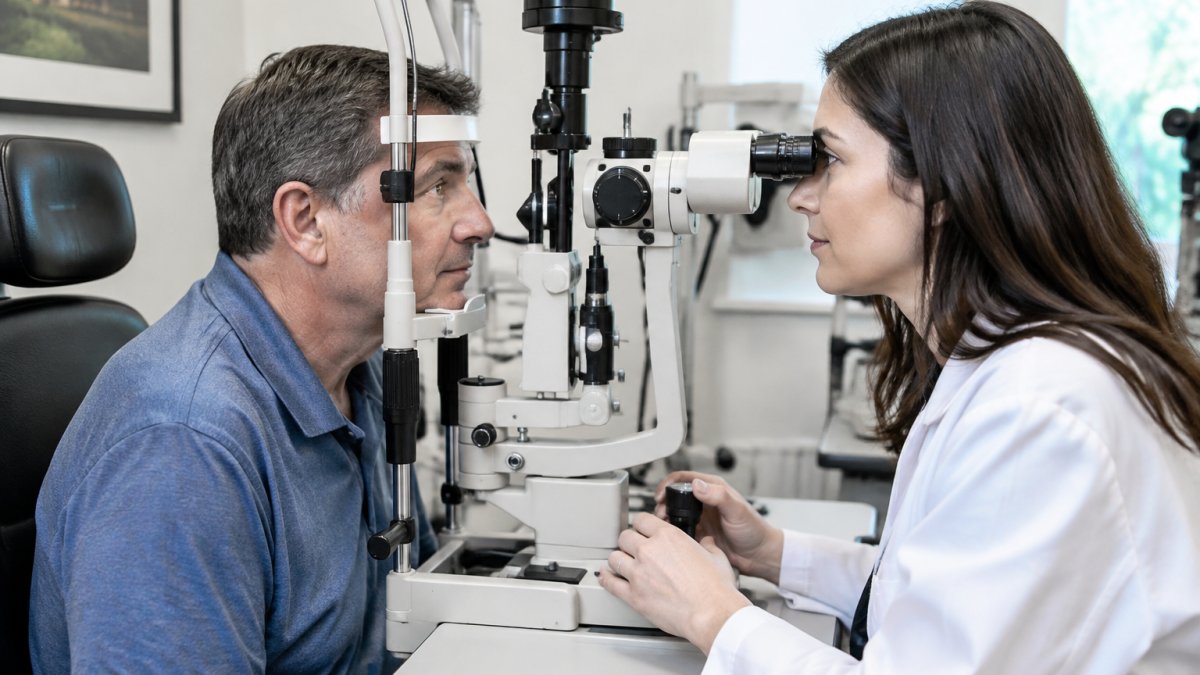
Long-term eye health monitoring after ICL is important because it helps detect changes early. Annual screening commonly includes a refraction and visual acuity check, intraocular pressure measurement, a slit-lamp exam of the anterior segment with vault assessment, and a dilated retinal exam, which is particularly relevant for patients with high myopia.
What Annual Screening Should Include
- Refraction and best-corrected visual acuity
- Intraocular pressure check
- Slit-lamp exam with lens vault measurement
- Corneal endothelium assessment
- Dilated retinal exam
- Review of any new glare, halos, or fluctuation
Cataract formation is a common age-related process, and eyes with an implant are monitored as part of long-term follow-up. Our article on the benefits of annual comprehensive eye exams explains what a full exam covers.
Risks, Complications, and Revision Surgery Pathways
No surgical procedure is risk-free, and it is important to understand the uncommon risks as well as the common ones. The risks most discussed in ICL consent conversations are infection, raised intraocular pressure, cataract development earlier than might otherwise occur, and the need for a lens exchange or adjustment. Less common but worth knowing: endothelial cell loss over time, pigment dispersion, and implant rotation that shifts astigmatism correction.
What Revision Surgery Actually Involves
Many patients never need a second procedure, but the pathway exists and is worth understanding before surgery. A common pattern unfolds in stages:
- Detection. A refraction at an annual exam shows a shift outside the expected band, or vault measurement falls outside the target range. Your surgeon reviews the trend across visits, not a single reading.
- Evaluation. The surgeon determines whether the change is refractive (the implant needs exchanging for a different power), positional (the implant has rotated or the vault has changed), or natural (the eye itself has progressed). Each points to a different response.
- Exchange or adjustment. An ICL exchange generally means removing the existing implant and placing a new one of a different power or size. It is a separate procedure, with its own recovery that may differ from the original surgery.
- Removal without replacement. In some cases the right move is to remove the implant and manage the prescription with glasses or contacts, particularly if the eye’s natural lens is changing.
- Cataract surgery later in life. The implant can typically remain in place while cataract surgery is performed, though the surgeon plans the cataract procedure with the implant’s presence in mind.
What to Ask Before You Ever Need This
At the consultation stage, it can help to ask your surgeon about revision options: what might prompt a revision recommendation, how long after surgery an exchange can be performed, and how costs for a clinically indicated revision are handled. Getting answers to those questions early can make later decisions easier.
Watch out: skipping follow-up visits because vision feels fine is the most common way patients miss early, correctable changes. A shift caught at an annual exam is a conversation; a shift caught years later can be a more involved procedure.
The Psychological Side of Vision Shifts After ICL
Anxiety about a small fluctuation is common and understandable, especially after years of dependence on glasses. Many people find themselves checking their vision often in the first months. Knowing that mild fluctuation is expected during the healing period reduces that worry considerably, and a clear follow-up schedule gives you a concrete plan instead of guesswork.
If a change does occur, the conversation should be about options, not worst cases. Most shifts are small, measurable, and manageable. For a full explanation of the procedure itself, read our complete guide to ICL surgery.
Request an Appointment to Protect Your Long-Term Vision
Protecting a good result comes down to consistent monitoring and an eye care team that knows your history. At Clear Vision San Antonio, our eye doctors focus on personalized attention and provide care tailored to each person’s eyes and health.
If you are ready to take the next step, our guide on how to prepare for an ICL consultation covers what to bring and what to expect. Request an appointment with Clear Vision San Antonio to build a long-term plan for your vision.
Frequently Asked Questions
How long does it take for vision to stabilize after ICL?
Most patients notice clear vision within days of ICL surgery, but full stability takes longer. Visual acuity often settles over the first few months as the eye heals and the lens vault stabilizes. Some fluctuation in the early weeks is expected. Your surgeon will track spherical equivalent and visual quality at follow-up visits to confirm that your vision stability is progressing as expected. Final refractive results are typically evaluated at follow-up visits after the initial healing period.
Can vision get worse after ICL surgery?
Vision can change after ICL, but the causes vary. Myopia regression, where the refractive error drifts back slightly, is possible, especially in patients with high myopia. Age-related changes like presbyopia or cataract formation are separate from surgical regression and happen naturally over time. Vision fluctuation can also come from dry eye or corneal issues. Regular clinical follow-up and annual screening let your eye doctor identify the cause and discuss options, including revision surgery if appropriate.
How long can an ICL lens last in the eye?
The implantable collamer lens is designed to remain in the eye long term, and its biocompatibility with the eye’s natural structures supports that. The lens is intended to remain in the eye long term. Long-term monitoring matters because changes in your eye, such as cataract formation or shifts in intraocular pressure, may require attention. Your eye doctor will assess lens vault and the anterior segment during annual exams to confirm everything remains stable.
Do I still need regular eye exams after ICL surgery?
Regular follow-up is generally recommended after ICL, even when your vision feels clear. Annual screening should include visual acuity, intraocular pressure, corneal endothelium checks, and a review of lens vault and the anterior segment. These visits catch early signs of cataract formation, myopia regression, or other changes before they affect your visual quality. Schedule a consultation with your eye care team to set up a monitoring plan that fits your eye health history.
