
Last Updated: November 5, 2026
Quick Summary
An eye exam for new glasses in San Antonio starts with a comprehensive exam that includes a refraction step, where your doctor determines your eyeglass prescription. Bring your current glasses, medication list, insurance card, and recent eye records, and confirm the written prescription includes your pupillary distance before ordering.
- A prescription is a snapshot of your vision on a specific day and it expires.
- The refraction step, where the doctor flips lenses in a phoropter, determines your eyeglass prescription.
- A glasses prescription and a contact lens prescription are not interchangeable, even when the numbers look similar.
- Ask whether refraction is bundled into the exam fee or billed as an add-on.
- Confirm the practice is in-network and whether your frame and lens allowance resets on a calendar or plan year.
Table of Contents
- Why You Need a Current Eye Exam Before Buying New Glasses
- Step-by-Step: What Happens During an Eye Exam for Glasses
- How to Read and Use Your Eyeglass Prescription
- Walk-In Eye Exam San Antonio: When Convenience Matters
- Same-Day Glasses San Antonio: From Exam to Frames in One Visit
- Finding a Cheap Eye Exam San Antonio Residents Can Trust
- Choosing an Optometrist San Antonio Patients Recommend
- Request an Appointment at Clear Vision San Antonio
- Frequently Asked Questions
Why You Need a Current Eye Exam Before Buying New Glasses
An eye exam for new glasses in San Antonio starts with a simple fact: a prescription is a snapshot of your vision on a specific day, and that snapshot expires. Vision changes gradually, often without obvious symptoms, so the pair of glasses that worked two years ago may now be the reason you squint at road signs or hold your phone at arm’s length. (Source: the American Academy of Ophthalmology’s guidelines)
Patients often come in convinced they need stronger lenses when the real issue is an outdated measurement. Buying frames online or off a drugstore rack without a current prescription is a common mistake, and it can cost more in the long run because the glasses may need to be remade.
Here is what most buying guides skip: the exam is not a formality before the purchase. It is the purchase’s foundation. Skip it, and every choice you make afterward, from lens type to frame fit, rests on numbers that no longer match your eyes.
Step-by-Step: What Happens During an Eye Exam for Glasses
A comprehensive eye exam for glasses follows a core sequence at most practices. Knowing the steps in advance makes the appointment feel less like a mystery.
- History and symptoms. Your eye doctor asks about blurriness, headaches, screen time, medications, and family history of eye disease.
- Visual acuity test. You read letters from an eye chart to measure sharpness at distance and near.
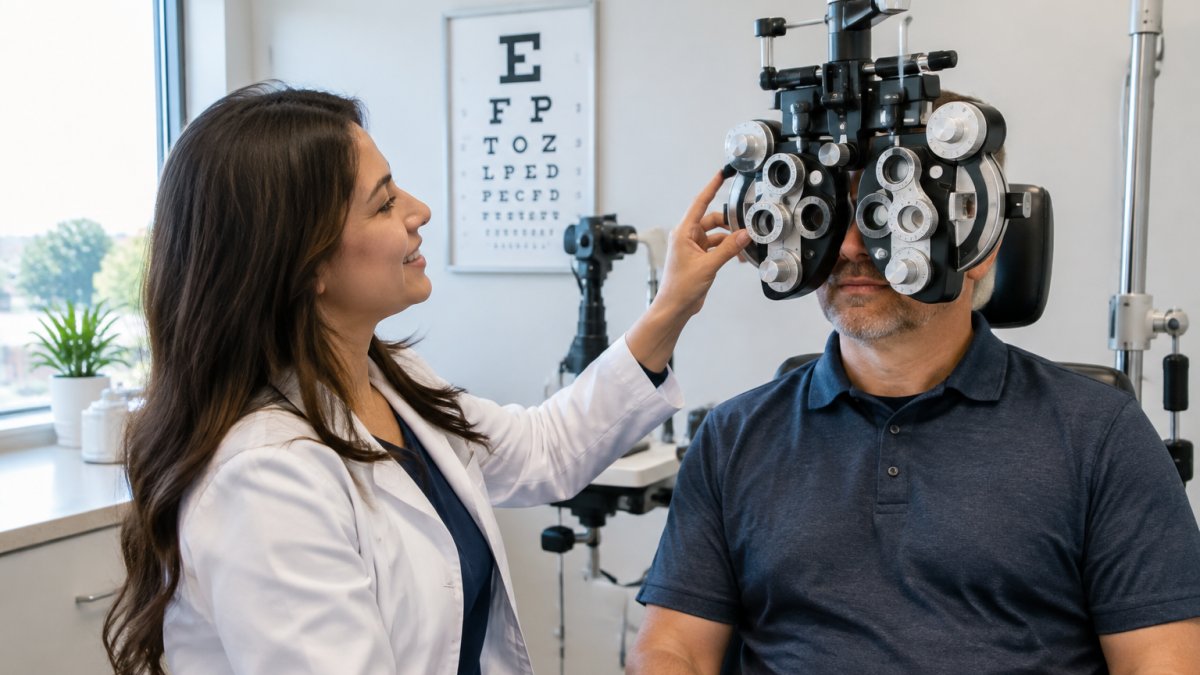
- Refraction. The doctor flips lenses in a phoropter and asks which version looks clearer. This is where your eyeglass prescription is determined.
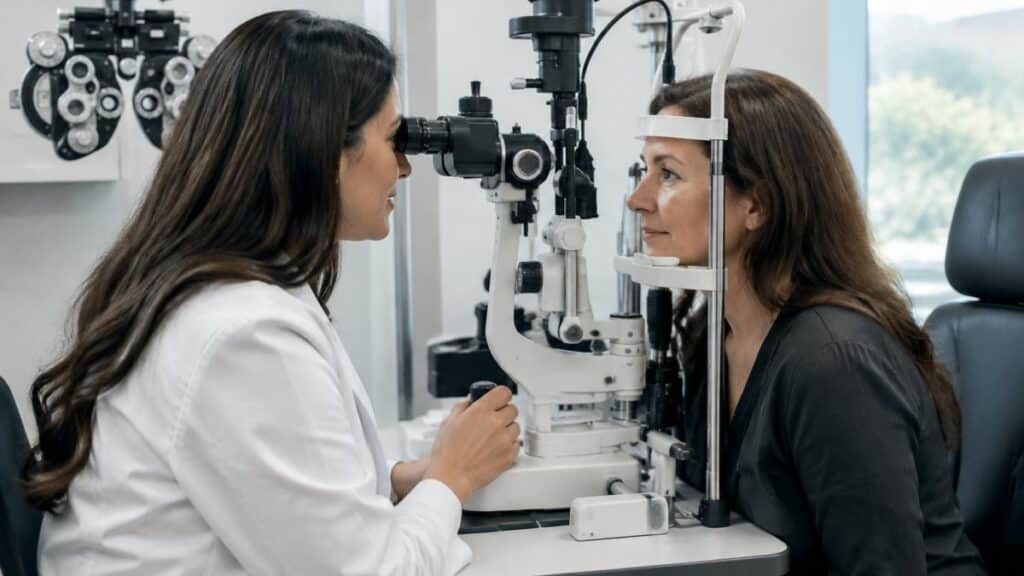
- Eye health check. A slit lamp and often a dilated pupil exam let the doctor look at the retina, optic nerve, and lens for signs of disease.
- Discussion. You review the results, ask questions, and receive your written prescription.
Preparing for Your Appointment: What to Bring
Bring your current glasses or contacts, a list of medications and supplements, your vision insurance card, and any recent eye records. If you work long hours at a screen, note your typical setup. If you drive at night, say so, because it affects how the doctor writes the prescription.
Our guide to preparing for an annual eye exam walks through the full checklist, including how long to stop wearing contact lenses beforehand.
How to Read and Use Your Eyeglass Prescription
An eyeglass prescription is a written record of the lens powers that correct your vision, expressed in numbers your eye doctor measures during refraction. It looks technical, but each line has a plain meaning, and once you can read it, you can order glasses with confidence and catch errors before lenses get cut.
- Sphere (SPH) corrects nearsightedness or farsightedness. A minus sign means you are nearsighted; a plus sign means you are farsighted.
- Cylinder (CYL) and Axis correct astigmatism, an irregular curve in the eye’s surface. Axis is a degree from 1 to 180 that tells the lab where to orient the correction.
- Add is the extra magnification for reading, common after age 40. It appears on multifocal and progressive prescriptions.
- Pupillary distance (PD) is the distance between your pupils in millimeters, and frames cannot be made correctly without it. Some practices measure it during the exam; others measure it when you choose frames.
- Prism appears on some prescriptions to correct double vision or eye alignment, and it must be entered exactly as written.
How to Tell a Glasses Prescription From a Contact Lens Prescription
A glasses prescription and a contact lens prescription are not interchangeable, even when the sphere and cylinder numbers look similar. Contact lens prescriptions include base curve, diameter, and brand, and they are valid only for the lenses specified. A glasses prescription will not have those fields. If you plan to order both, ask for both prescriptions in writing, a glasses Rx cannot be used to order contacts, and a contact Rx cannot be used to order glasses.
How to Confirm the Prescription Is Correct Before You Order
Before you hand the Rx to an optical shop or type it into an online order form, check three things. First, confirm your name and the exam date are on the document. Second, confirm the PD is listed; if it is missing, ask the practice to measure it rather than guessing. Third, read the numbers back against what the doctor told you during the exam, if the doctor said your right eye changed and the right-eye sphere matches the old prescription, ask before ordering.
Watch out: an expired prescription is not a shopping guide. Many practices date an eyeglass prescription for a limited period, so check the date before you order. If the date is older than that, get a new exam before ordering lenses, because the numbers may no longer match your eyes.
If the numbers look confusing, our reading glasses strength chart and guide explains how magnification works and when over-the-counter readers are not enough.
Walk-In Eye Exam San Antonio: When Convenience Matters
Walk-in availability helps when a problem appears suddenly: a broken frame, a lost pair, or a prescription that stopped working before an important event.
Convenience should not come at the cost of a complete exam. A walk-in appointment still needs to include refraction and an eye health check, not just a quick reading test.
Watch out: if you experience sudden vision loss, flashes of light, new floaters, or eye pain, that is not a walk-in errand. Contact an eye doctor immediately or seek urgent care.
Patients near our Stone Oak location can find directions and office details here.
Same-Day Glasses San Antonio: From Exam to Frames in One Visit
Same-day glasses depend on the prescription and lens options you choose. Ask the practice about turnaround time when you schedule.
The practical sequence looks like this:
| Stage | Typical Time | What Happens |
|---|---|---|
| Exam and refraction | 30-45 minutes | Prescription measured and confirmed |
| Frame selection and fitting | 20-30 minutes | Frames adjusted to your face and PD |
| Lens cutting (in-house lab) | Same day, simple scripts | Lenses edged and mounted |
| Final fitting | 10-15 minutes | Alignment checked, adjustments made |
Ask about lens options before you commit. Anti-reflective coatings, photochromic lenses, and blue-light filters each add cost, and not every option is worth it for every wearer.
Finding a Cheap Eye Exam San Antonio Residents Can Trust
A cheap eye exam is not the same as a good value. The lowest advertised fee sometimes covers only a screening, with refraction or a health check billed separately. Value comes from a complete exam at a fair price, not a headline number, and the way to compare fairly is to break the total into its parts.
The Cost Breakdown to Compare
An eye exam for new glasses usually has four cost layers, and practices quote them differently:
- The exam fee. This should include refraction, the test that produces your eyeglass prescription. Ask directly whether refraction is bundled or added on.
- The eye health exam. A dilated retinal exam or imaging may be included, billed separately, or recommended based on your age and risk factors.
- Frames. Frame prices vary widely by brand and material.
- Lenses and add-ons. Lens material, anti-reflective coating, photochromic lenses, progressive lenses, and high-index thinning each add cost. Ask for the lens price before the frame is chosen so the total is not a surprise at checkout.
Insurance Questions That Change the Total
Vision insurance plans differ in how they cover exams, frames, and lenses, and in-network rules vary by plan. Before you book, confirm four things: whether the practice is in-network for your plan, what your exam copay is, what frame and lens allowance applies, and whether the allowance resets on a calendar year or a plan year. If you have not used your allowance this year, using it before it resets can lower your out-of-pocket cost more than any advertised discount.
Questions to Ask When Comparing
- Does the fee include refraction and a written prescription?
- Is a dilated eye health exam included or extra?
- Is the practice an in-network provider for your vision insurance?
- What is covered, and what would you pay out of pocket?
- Is there a separate charge for contact lens fitting if you want both glasses and contacts?
We cannot quote prices here because they vary by visit type, frame choice, lens options, and coverage. Contact our office for current exam fees and to confirm insurance coverage before you book, asking those questions up front is the difference between a low headline price and a low final bill. For patients managing conditions such as diabetes or high blood pressure, discuss your eye exam schedule with your eye doctor.
Choosing an Optometrist San Antonio Patients Recommend
The right optometrist is the one whose exam matches your needs, not simply the closest office.
When comparing practices, look for details such as whether the doctor asks about your screen time and whether staff explain lens options clearly. Customer reviews help, but read them for patterns about thoroughness and wait times rather than star averages alone.
For a broader look at local options, our guide on how to find an optometrist in San Antonio covers what to check, and our roundup of the best eye doctors in San Antonio compares what different practices emphasize.
Request an Appointment at Clear Vision San Antonio
Getting new glasses starts with a current, complete prescription, and the difference between a rushed screening and a thorough exam shows up every time you put the glasses on. Clear Vision San Antonio offers personalized attention and expert eye doctors, and your exam covers how well you see and how healthy your eyes are.
If it has been more than a year since your last visit, or if your vision has shifted, request an appointment with Clear Vision San Antonio and start your next pair of glasses on a prescription you can trust.
Frequently Asked Questions
How much is an eye exam for new glasses?
The cost of an eye exam varies by provider and depends on whether you need a routine vision test or a more comprehensive evaluation. Insurance coverage through vision plans can reduce your out-of-pocket cost. Call Clear Vision San Antonio or check their website for current exam fees and to confirm whether your vision insurance is accepted as an in-network provider.
What should I bring to an eye exam for new glasses?
Bring your current eyeglasses or contact lenses, a list of any medications you take, and your vision insurance card. If you have a recent prescription from another provider, bring that too. Sharing your medical history, including conditions like diabetes or high blood pressure, helps your eye doctor decide what to review.
Do you need an updated eye exam to get new glasses?
Yes, in nearly all cases. An eyeglass prescription does not last indefinitely, so a recent exam is important before you order new lenses. Even if your vision feels unchanged, an exam checks for prescription updates and eye health issues that may not cause obvious symptoms. A comprehensive eye exam is the safest way to confirm your new glasses will actually correct your vision.
Can I get an eye exam and new glasses the same day?
Same-day glasses depend on your prescription and the lens options you choose. Ask about turnaround time when you schedule so you know what to expect.
Your eyes change quietly, and the glasses you loved two years ago may no longer match the eyes you have now. Clear Vision San Antonio offers personalized attention, advanced technology, and expert eye doctors who take the time to get your prescription right. Request an appointment with Clear Vision San Antonio and see clearly at near, far, and intermediate distances.
