
Table of Contents
- Understanding Intraocular Lenses and Your Cataract Surgery Options
- Monofocal vs Multifocal Cataract Lenses: Key Differences
- Extended Depth-of-Focus Lenses: A Middle Ground Option
- Toric Lens for Cataract Surgery: Correcting Astigmatism
- Premium Lens Choices: Benefits and Visual Trade-Offs
- Cataract Surgery Lens Cost: Understanding Your Investment
- Questions to Ask About Cataract Lens Options Before Surgery
- Nonsurgical Approaches and When Surgery Makes Sense
- Frequently Asked Questions
Last Updated: October 16, 2026
Understanding Intraocular Lenses and Your Cataract Surgery Options
When cataracts cloud your vision, cataract surgery replaces your natural lens with an intraocular lens (IOL). But standard monofocal lenses aren’t your only choice.

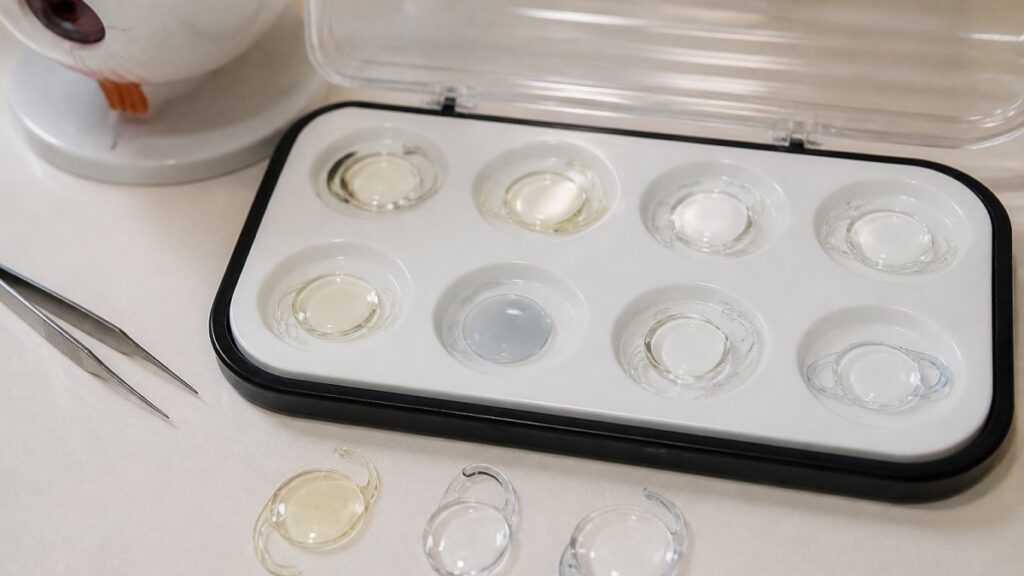
An intraocular lens is an artificial lens implanted during cataract surgery to replace your clouded natural lens. The choice of which IOL you receive shapes your vision for the rest of your life, which is why exploring alternatives to standard lenses matters.
Most patients assume all IOLs work the same way. They don’t. Standard monofocal lenses correct distance vision but require glasses for reading.
The lens you choose affects how you see daily. Will you need glasses after surgery? Can you read without correction?
Monofocal vs Multifocal Cataract Lenses: Key Differences
Monofocal and multifocal lenses sit at opposite ends of the IOL spectrum. A monofocal lens is engineered to sharpen vision at a single focal distance, while a multifocal lens splits incoming light into two or more focal zones so the eye can see at distance and near without glasses. The difference is not cosmetic; it changes how you use your eyes all day.
How Monofocal Lenses Work
A monofocal IOL has one optical power across its entire surface. Your surgeon selects that power before surgery based on your corneal measurements and your target refraction, usually plano (no prescription) for distance. The result is a single, high-contrast focal point.
- Vision range: Excellent at the targeted distance (typically far), functional at intermediate, blurry at near.
- Glasses use: Most patients need reading glasses for close work and may need a light distance prescription for night driving.
- Astigmatism: A standard monofocal does not correct corneal astigmatism; a toric monofocal does.
Monofocal lenses remain the benchmark against which every premium lens is measured. Their contrast sensitivity and low incidence of nighttime visual disturbances are why many surgeons still recommend them for patients who drive at night, work with fine detail, or prioritize optical quality over convenience.
How Multifocal and Trifocal Lenses Correct Multiple Distances
Multifocal and trifocal IOLs use diffractive or refractive optics to create two or three distinct focal points. A bifocal multifocal typically targets distance and near; a trifocal adds an intermediate zone for computer work and dashboard distance. The brain learns to select the appropriate focal point based on the task, a process called neuroadaptation that usually takes several weeks.
- Vision range: Distance plus near (multifocal) or distance, intermediate, and near (trifocal).
- Glasses use: Many patients report little or no glasses use, though a small residual prescription is common for fine print or night driving.
- Candidacy: Best for patients with healthy corneas, a normal macula, and realistic expectations. Not ideal for those with significant dry eye, irregular astigmatism, or occupations that demand peak night vision.
Side-by-Side Comparison
| Feature | Monofocal | Multifocal / Trifocal |
|---|---|---|
| Focal points | One | Two or three |
| Distance vision | Excellent | Very good |
| Intermediate vision | Functional | Good to very good |
| Near vision | Poor without glasses | Good to very good |
| Astigmatism correction | Only with toric version | Only with toric version |
| Glasses dependence | High at near | Low |
| Nighttime halos/glare | Low | Moderate to high |
| Contrast sensitivity | Highest | Reduced |
| Adaptation period | Days | Weeks to months |
| Typical candidacy | Broad | Healthy cornea and macula |
Neither lens is objectively better. A monofocal optimizes optical quality and predictability; a multifocal optimizes convenience and range. The right choice depends on how much you value glasses-free near vision versus the cleanest possible night vision.
Extended Depth-of-Focus Lenses: A Middle Ground Option
Extended depth-of-focus (EDOF) lenses offer a compromise between monofocal and multifocal designs. Instead of creating distinct zones, EDOF lenses stretch the depth of focus, the range of distances you can see clearly.
EDOF lenses reduce halos and glare compared to multifocal designs while still improving near and intermediate vision.
The trade-off is that EDOF lenses don’t correct vision as precisely at extreme near distances as multifocals do.
Toric Lens for Cataract Surgery: Correcting Astigmatism
If you have astigmatism, a common refractive error where your cornea is irregularly shaped, a standard IOL won’t fully correct your vision. A toric lens is specifically designed to correct astigmatism during cataract surgery.
Toric IOLs have different powers in different meridians of the lens, much like a prescription for glasses or contact lenses. This allows a single lens to correct both your cataract and your astigmatism.
Toric lenses come in monofocal, multifocal, and EDOF designs, so you can combine astigmatism correction with whatever distance-vision strategy suits you best.
Premium Lens Choices: Benefits and Visual Trade-Offs
What Premium Lenses Offer
Premium cataract surgery lenses, multifocals, trifocals, EDOF, and toric options, offer benefits standard monofocal lenses cannot. They reduce glasses dependence, correct astigmatism, or improve intermediate vision. For many patients, these benefits justify the additional cost.
Premium lenses also tend to have advanced coatings that reduce glare and reflections.
Our eye doctors discuss each option’s benefits and limitations so you can decide what matters most to you.
Realistic Expectations and Potential Drawbacks
Premium lenses aren’t perfect. Multifocal and trifocal lenses often produce halos around lights at night, especially during the first few months after surgery.
Intermediate vision improvements come with a small trade-off in distance vision sharpness compared to monofocal lenses optimized purely for distance.
Toric lenses require precise alignment during surgery. If the lens rotates after implantation, astigmatism correction diminishes.
Premium lenses also cost more upfront.
Cataract Surgery Lens Cost: Understanding Your Investment
Cost is where lens conversations often stall. Patients hear “premium lens” and assume the whole procedure is expensive, when in fact the surgery itself is usually covered and the only variable is the lens upgrade. Understanding the coverage structure removes most of the confusion.
What Insurance Typically Covers
When cataracts are visually significant, cataract surgery with a standard monofocal IOL is treated as medically necessary. Medicare Part B, most commercial plans, and Medicare Advantage plans generally cover:
- The surgeon’s fee for cataract extraction
- Facility or ambulatory surgery center fees
- Anesthesia
Your out-of-pocket responsibility is usually limited to your deductible, coinsurance, and any unmet plan requirements. Many patients with supplemental coverage pay little to nothing for the standard pathway.
What Triggers a Premium Lens Charge
A premium IOL is not a separate procedure. It is the same surgery with a different implant. The extra charge reflects the difference between the plan’s allowance for a standard lens and the actual cost of the premium lens, plus any additional diagnostics, counseling, or postoperative adjustments the practice bundles in.
Common premium categories include:
- Toric IOLs for astigmatism correction
- Multifocal and trifocal IOLs for distance, intermediate, and near vision
- Extended depth-of-focus (EDOF) IOLs for a continuous range of vision
Because these are considered elective upgrades rather than medically necessary, the difference is typically paid out of pocket. The amount varies by lens type, practice, and region, so no single national figure applies.
How to Estimate Your Exposure
A practical way to frame the decision is to separate the covered and uncovered portions:
- Confirm medical necessity. Ask your plan what documentation it requires to approve cataract surgery.
- Request the standard-lens allowance. This is the amount your insurer credits toward the implant.
- Request the premium-lens quote. The difference between the two is your likely upgrade cost.
- Ask what is bundled. Some practices include preoperative topography, biometry, and postoperative refractive visits in the premium fee; others bill them separately.
- Check for secondary coverage. Some vision plans and flexible spending accounts can be applied to the elective portion.
Coverage rules differ by plan and by state insurance regulation. Always verify benefits directly with your insurer before scheduling, and ask for the quote in writing so the covered and uncovered portions are clearly separated.
Non-Monetary Costs to Weigh
Premium lenses carry trade-offs that do not appear on an invoice: a higher chance of nighttime halos, a longer adaptation period, and the possibility of a refractive surprise that requires glasses or an enhancement.
For a personalized breakdown of what your plan covers and what each lens option would cost, request a benefits review with your eye care team before surgery.
Medicare coverage of cataract surgery
Questions to Ask About Cataract Lens Options Before Surgery
Before surgery, discuss these questions with your eye doctor:
- What is my current refractive error, and how does it affect my lens choice?
- Which lens type best matches my lifestyle and visual needs?
- Will I need glasses after surgery with each lens option?
- What are the risks and side effects specific to each lens?
Your surgeon’s answers reveal their knowledge and whether they’re listening to your goals. A good eye doctor explains trade-offs honestly and helps you choose based on your priorities, not just the most expensive option.
Nonsurgical Approaches and When Surgery Makes Sense
Cataract treatment doesn’t always require surgery immediately. Early cataracts sometimes respond to lifestyle adjustments and medications.
Eye drops and medications cannot reverse cataracts or stop their progression. If your cataracts are mild and your vision is adequate for daily activities, waiting is reasonable.
Cataract surgery is one of the safest and most successful procedures in medicine. Serious complications are rare.
The decision to have cataract surgery is ultimately yours, made with guidance from your eye doctor. Our eye doctors combine advanced technology with personalized attention to ensure your cataract surgery delivers the clear vision you deserve.
Frequently Asked Questions
What lens do most people choose for cataract surgery?
Most patients receive a standard monofocal intraocular lens (IOL) because it provides clear distance vision and is typically covered by insurance. However, the choice depends on your lifestyle and vision priorities. If you spend significant time reading or using computers, or if you have astigmatism, your eye doctor may recommend a multifocal, trifocal, or toric lens instead. Discuss your daily activities and vision goals with your surgeon to determine the best fit.
Is there any way to reduce cataracts without surgery?
No medication or nonsurgical treatment can reverse or stop cataract progression once it begins. Early-stage cataracts may be managed with updated glasses, brighter lighting, and anti-glare sunglasses to improve comfort and function. Eye drops and lifestyle adjustments can help temporarily, but cataract surgery remains the only definitive treatment. If your cataracts are not yet affecting your daily activities, your eye doctor may recommend waiting. Once vision loss interferes with your quality of life, surgery becomes the appropriate next step.
Can toric lenses correct astigmatism during cataract surgery?
Yes. A toric intraocular lens is specifically designed to correct astigmatism at the time of cataract surgery. Unlike a standard monofocal lens, a toric IOL has different powers in different meridians to address the irregular corneal shape that causes astigmatism. This allows you to achieve clearer vision at distance without relying on glasses or contacts to correct the astigmatism. Your eye doctor will measure your astigmatism before surgery to determine if a toric lens is appropriate and which power you need.
Do premium cataract surgery lenses eliminate the need for glasses?
Premium lenses like multifocal, trifocal, and extended depth-of-focus (EDOF) designs reduce dependence on glasses for many patients, but most people still need glasses occasionally. Multifocal and trifocal lenses allow you to see at multiple distances, but some patients experience halos or glare around lights, particularly at night. EDOF lenses provide a continuous range of vision with fewer visual side effects but may not deliver the same near-vision sharpness as multifocal lenses. Your individual results depend on your eye anatomy, lifestyle, and expectations. Discuss realistic outcomes with your eye doctor before choosing a premium lens.
What happens if the wrong lens power is implanted during cataract surgery?
If an incorrect lens power is implanted, you may experience blurred vision at your intended focal distance. Modern cataract surgery allows for lens exchange or adjustment in some cases. If a standard lens is implanted with the wrong power, your surgeon can discuss options such as glasses, contact lenses, or in some cases, a second procedure to replace the lens. This is why accurate measurements and clear communication with your surgeon about your vision goals are essential before surgery.
If cataracts are affecting your vision, the next step is a consultation with an experienced eye doctor who can evaluate your specific situation and discuss which cataract surgery lens is right for you. At Clear Vision San Antonio, we specialize in advanced lens implants and personalized cataract surgery planning. Our team takes time to understand your visual goals and lifestyle so you receive a lens choice that truly improves your daily life. Request an appointment today to explore your options.