

Table of Contents
- Does LASIK Actually Fix Night Driving Glare?
- What Causes Night Glare After LASIK
- Understanding LASIK Night Vision Problems
- How Long Does Night Glare Last After LASIK
- LASIK Alternatives for Night Glare Management
- Practical Tips for Safer Night Driving Post-LASIK
- When to Consult Your Ophthalmologist About Persistent Glare
- Conclusion: Managing Night Vision After LASIK
Does LASIK Fix Night Driving Glare? What You Need to Know
Last Updated: July 17, 2026
Does LASIK Actually Fix Night Driving Glare?
LASIK can improve overall vision clarity, but it can also create temporary glare and halos that typically fade within 3-6 months as your eyes heal and your brain adapts. The honest answer is nuanced: LASIK doesn’t eliminate glare, it reshapes your cornea to correct refractive errors. In doing so, it can inadvertently create optical aberrations that scatter light.
When your pupil dilates at night, it exposes a larger portion of your newly reshaped cornea. If that reshaped area has subtle irregularities, which is normal after LASIK, light scattering increases, producing halos around headlights and starbursts from streetlamps. Below, we’ll explain what causes these disturbances, how long they typically last, and what strategies help manage them.
LASIK improves daytime vision for most patients but can temporarily worsen night driving glare due to pupil dilation exposing newly reshaped corneal tissue. Most symptoms resolve within 3-6 months as neuro-adaptation occurs.
What Causes Night Glare After LASIK
How Pupil Dilation and Corneal Aberrations Create Glare
Your pupil expands to 7-8 millimeters in low-light environments, compared to 2-3 millimeters in daylight. LASIK reshapes only the central 6-7 millimeter zone of your cornea. When your pupil dilates beyond that treated zone at night, light passes through both the corrected central area and the untreated peripheral cornea, creating optical aberrations that scatter light rather than converging sharply on your retina.
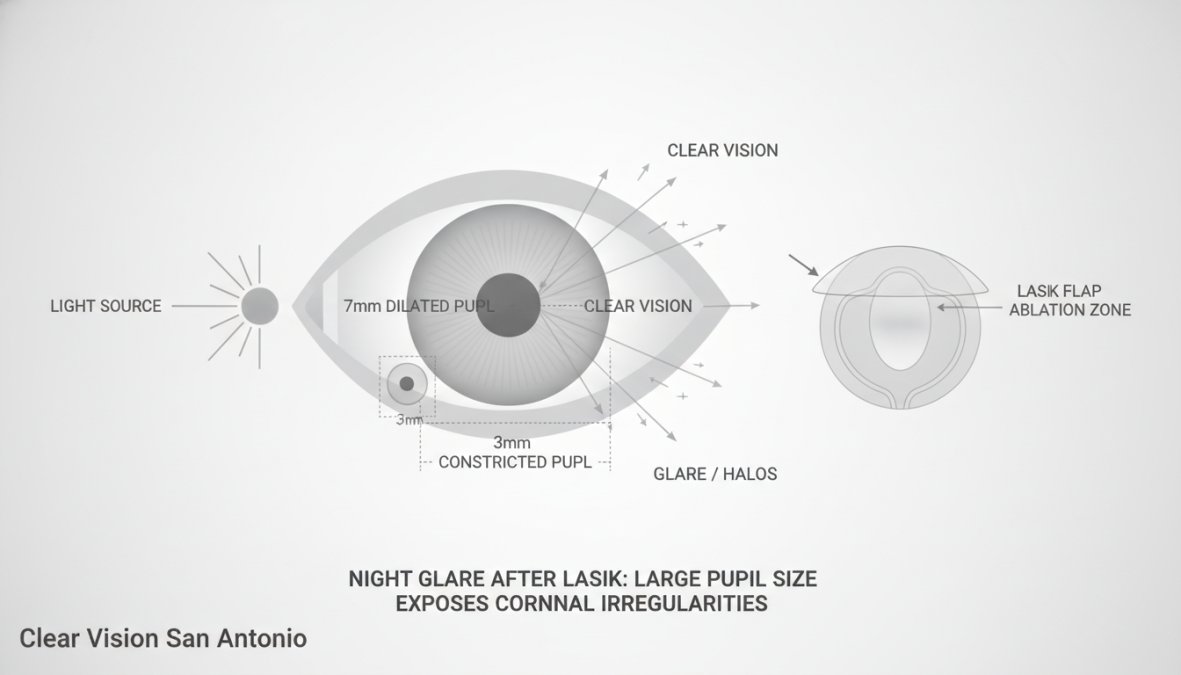
The corneal flap created during LASIK also contributes to this effect. As your cornea heals, microscopic irregularities in the flap interface scatter light. These imperfections are invisible to the naked eye but become apparent when your pupil is large and light is dim.
Wavefront-guided LASIK, which maps your eye’s unique aberrations before surgery, reduces post-operative glare compared to standard LASIK. Discuss this technology with your surgeon if night vision is a concern.
The Role of Light Scattering in Halos and Starbursts
Light scattering is the physical mechanism behind halos and starbursts. When light enters your eye, it should focus precisely on your retina. After LASIK, some light rays scatter due to corneal irregularities, creating the characteristic halo effect around point light sources like headlights.
Starbursts occur when light scatters along the edges of your corneal ablation zone. The transition between treated and untreated cornea acts like a diffraction edge, splitting light into multiple rays. This is particularly noticeable with oncoming traffic at night.
The intensity of these symptoms correlates directly with your pupil size and the contrast between light and darkness. A headlight on a pitch-black road creates a more dramatic effect than the same headlight on a twilight road when your pupil hasn’t dilated as much.
Understanding LASIK Night Vision Problems
Temporary vs. Permanent Visual Symptoms
Most night vision problems after LASIK are temporary. Your eyes undergo significant healing during the first 3-6 months, and your brain undergoes neuro-adaptation, learning to process the new optical input from your reshaped cornea.
Temporary symptoms typically peak around 2-4 weeks post-surgery when corneal swelling is maximum. Many patients report that halos and glare begin improving by week 6-8. By 3 months, the majority experience significant improvement. By 6 months, most temporary symptoms have largely resolved.
Permanent glare is far less common, occurring in roughly 1-3% of LASIK patients. This usually results from higher-order aberrations not detected pre-operatively or from corneal ectasia, a rare complication where the cornea gradually weakens and bulges after surgery.
The critical distinction: if your night glare is improving month-to-month, it’s almost certainly temporary. If it’s remained unchanged after 6 months, schedule a follow-up with your ophthalmologist.
How Contrast Sensitivity Affects Low-Light Vision
Contrast sensitivity is your eye’s ability to distinguish objects from their background in dim lighting. LASIK can temporarily reduce contrast sensitivity, particularly in low-light conditions. You might experience subtle haziness when driving at night, making road markings and pedestrians harder to discern.
This reduced contrast sensitivity typically correlates with the same healing timeline as glare: most improvement occurs within 3-6 months. As your cornea heals and neuro-adaptation progresses, contrast sensitivity improves.
How Long Does Night Glare Last After LASIK
The Neuro-Adaptation Timeline
Neuro-adaptation is your brain’s gradual adjustment to the optical changes created by LASIK. Your visual cortex literally rewires itself to process the new input from your reshaped cornea.
Weeks 1-2: Symptoms are often at their worst. Your cornea is swollen and your brain hasn’t begun adapting. Night driving is generally not recommended during this period.
Weeks 3-8: Improvement typically becomes noticeable. Your cornea swelling decreases and neuro-adaptation accelerates. Halos and glare often diminish noticeably by week 4-6. By week 8, many patients report 50-70% improvement from their peak.
Months 2-3: Continued steady improvement. Most patients experience another 20-30% reduction in symptoms during this window. By 3 months, the majority report that night glare is mild or barely noticeable.
Months 3-6: Gradual refinement. Improvement continues at a slower rate. By month 6, most patients have reached their final visual outcome regarding glare.
Beyond 6 months: If symptoms haven’t improved significantly by this point, they’re unlikely to improve further without intervention.
If your night vision symptoms worsen after initial improvement, or if they persist unchanged after 6 months, contact your eye doctor. This may indicate corneal ectasia or other complications requiring evaluation.
When to Expect Significant Improvement
Most patients experience meaningful improvement, halos and glare mild enough to resume comfortable night driving, between 6-12 weeks post-surgery. However, this timeline varies based on your pre-operative refractive error, corneal healing response, pupil size, and the technology used. Wavefront-guided LASIK and SMILE generally produce fewer aberrations than standard LASIK, resulting in faster improvement in night vision.
LASIK Alternatives for Night Glare Management
PRK vs. SMILE: Comparing Refractive Surgery Options
PRK (Photorefractive Keratectomy) removes the outer corneal layer entirely, then reshapes the underlying stroma. Because no flap is created, there’s no flap interface to cause light scattering. Some studies suggest PRK produces fewer higher-order aberrations than LASIK. However, PRK has a longer recovery period, vision stabilization takes 4-6 weeks compared to 1-2 weeks for LASIK, and is more uncomfortable during healing.
SMILE (Small Incision Lenticule Extraction) uses a femtosecond laser to create a thin lens-shaped piece of corneal tissue inside your cornea, which the surgeon extracts through a tiny 2-3 millimeter incision. SMILE preserves more corneal nerves and creates minimal disruption to the corneal surface. Early studies suggest SMILE produces fewer aberrations and less glare than LASIK, particularly in patients with higher refractive errors. The procedure is newer and more technically demanding, so it’s not available everywhere and typically costs more.
| Surgery Type | Flap Creation | Recovery Speed | Aberration Risk | Best For |
|---|---|---|---|---|
| LASIK | Yes (large) | 1-2 weeks | Moderate | Most patients; fast visual recovery |
| PRK | No flap | 4-6 weeks | Lower | Thin corneas; high refractive error |
| SMILE | No flap (small incision) | 2-3 weeks | Lowest | Night vision priority; high myopia |
Non-Surgical Management Strategies
Specialized eyeglass prescriptions: Anti-glare coatings on glasses reduce light reflection at the lens surface, modestly reducing halos and glare. Some optometrists can prescribe glasses with slight reduction in distance correction, which sometimes reduces aberrations perceived at night.
Contact lenses: Hard contact lenses (RGP or scleral lenses) vault over your cornea and create a smooth optical surface, effectively masking corneal irregularities. Custom scleral lenses can sometimes provide significant relief from persistent post-LASIK glare.
Waiting and adaptation: Many patients with persistent mild glare find that symptoms gradually improve over 12-24 months as neuro-adaptation continues. Your brain becomes increasingly skilled at filtering out optical noise created by aberrations.
Practical Tips for Safer Night Driving Post-LASIK
Immediate Post-Operative Driving Restrictions
First 24-48 hours: Do not drive. Your vision will be blurry and your eyes will be sensitive to light.
First 1-2 weeks: Avoid night driving entirely. This is the period of maximum glare and halos. If you must drive, restrict yourself to daytime, well-lit conditions.
Weeks 2-6: Gradually resume night driving as your vision improves. Start with familiar routes in well-lit areas. Avoid highways or unfamiliar roads in complete darkness until you’re confident.
Weeks 6-12: By this point, most patients can resume normal night driving. Continue monitoring your symptoms.
Your surgeon should provide explicit written guidance on driving restrictions.
Long-Term Strategies to Minimize Headlight Glare
Adjust your headlight angle: Misaligned headlights scatter light in unpredictable directions, amplifying perceived glare. Have your headlights professionally aligned annually.
Use anti-glare driving glasses: Anti-glare coatings reduce reflections. Some optometrists offer specialized "night driving" lenses with yellow or amber tints that enhance contrast in low-light conditions.
Increase following distance: Maintain 4-5 seconds behind other vehicles instead of the standard 2-3 seconds, giving you more reaction time if your vision is compromised.
Reduce your speed on dark roads: Driving slower gives you more time to react to hazards during visual recovery.
Avoid driving when fatigued: Eye fatigue amplifies glare perception. If your eyes feel tired, pull over and rest.
Keep a pair of polarized sunglasses in your car. While not ideal for night driving, they can help during twilight hours when ambient light is moderate but oncoming headlights are still bright.
When to Consult Your Ophthalmologist About Persistent Glare
Contact your surgeon immediately if:
- Your vision suddenly worsens or becomes significantly more blurry after initial improvement
- You develop severe pain, redness, or discharge
- You experience a sudden increase in floaters or flashes of light
- Your vision becomes so distorted that you cannot safely drive
Schedule a follow-up appointment if:
- By 3 months post-surgery, your night glare hasn’t improved noticeably
- By 6 months, your symptoms remain unchanged or have worsened
- Your glare is asymmetrical, much worse in one eye than the other
- You develop new visual symptoms like ghosting or significant astigmatism
During a follow-up visit, your ophthalmologist will perform refraction testing, corneal topography, wavefront analysis, and pupil size measurement to identify the cause. Based on findings, options may include waiting longer, glasses or contact lens correction, enhancement surgery, or corneal cross-linking for specific complications.
Night driving after LASIK doesn’t have to be a source of anxiety. For the vast majority of patients, glare and halos are temporary, a normal part of healing that resolves within weeks or months. If you’re considering LASIK and concerned about night vision, or if you’re currently experiencing post-operative glare, consult with a LASIK specialist who can evaluate your individual situation and provide personalized recommendations.
Frequently Asked Questions
Does LASIK fix night driving glare permanently?
LASIK can improve refractive errors that cause blurred vision, but night glare, including halos and starbursts, often occurs temporarily after surgery due to corneal changes and pupil dilation. Most patients experience significant improvement within 3-6 months as the cornea stabilizes and the brain adapts. However, some individuals may experience persistent mild glare, especially if their pupils are naturally large. Custom wavefront-guided LASIK techniques have reduced this risk compared to earlier methods.
What causes night glare and halos after LASIK surgery?
Night glare occurs because the corneal flap created during LASIK can cause light scattering, and the reshaped corneal tissue may not perfectly align with your pupil size during dilation. When your pupils enlarge in low light, light enters areas of the cornea that weren't treated, creating aberrations. Additionally, the healing process temporarily affects how your cornea refracts light. Anti-reflective coatings and advanced surgical techniques like wavefront-guided LASIK help minimize these effects, but some glare is common in the early recovery period.
How long does night glare last after LASIK?
Most patients notice significant improvement in night glare within 1-3 months, with the majority experiencing substantial resolution by 6 months post-surgery. This timeline reflects both corneal stabilization and neuro-adaptation, your brain's ability to adjust to subtle visual changes. However, healing varies by individual; some people see improvement faster, while others may notice mild glare persisting longer. If glare remains bothersome after 6 months, consult your ophthalmologist to discuss management options or potential enhancements.
What are the best alternatives to LASIK if I'm concerned about night vision?
PRK and SMILE are refractive surgery alternatives that may produce fewer night vision disturbances. PRK removes the corneal epithelium entirely, avoiding a corneal flap, while SMILE uses a minimally invasive approach with a smaller incision. Both can reduce glare risk compared to traditional LASIK. For those preferring non-surgical options, ICL (implantable contact lens) or glasses with anti-glare coatings can manage refractive errors without altering corneal tissue. Discuss your pupil size and visual goals with your ophthalmologist to determine the best option for your needs.
This article was written using GrandRanker