

Table of Contents
- How to Choose an Optometrist in San Antonio
- What to Expect During an Eye Exam in San Antonio
- Optometrist vs Ophthalmologist: Which Provider Do You Need?
- Contact Lens Exams and Fitting
- Scheduling Your Appointment and Booking Online
- Understanding Insurance and Out-of-Pocket Costs
- When to Seek Immediate Eye Care
- Frequently Asked Questions
Last Updated: October 6, 2026
How to Choose an Optometrist in San Antonio
Choosing a [qualified optometrist](/best-eye-doctors-in-san-antonio-a-2026-guide/) san antonio matters, your vision affects everything from work performance to daily safety.
An optometrist is a licensed eye care professional who performs comprehensive eye exams, prescribes glasses and contact lenses, and diagnoses common eye conditions.
Verify credentials and experience
Confirm that any optometrist you’re considering holds a valid license.
Consider whether the optometrist has experience with your specific needs. If you have diabetes, glaucoma, dry eye, or another chronic condition, ask whether they specialize in managing it.
Verify licensing through your state’s optometry board or professional organizations; many practices also list credentials on their websites.
Check insurance acceptance and coverage
Before scheduling, call the office with your insurance plan details and ask whether they’re in-network, what your copay will be, and whether specialized services need a referral.
Plans cover services at different rates, some cover annual exams but charge more for advanced testing. Understanding coverage upfront prevents unexpected bills.
Read patient reviews and ratings
Patient reviews offer real-world insight. Look for mentions of scheduling ease, wait times, exam thoroughness, and whether the provider listened to concerns, consistent themes across multiple reviews are more reliable than individual opinions.
Check Google, Healthgrades, Zocdoc, and the provider’s website, and favor recent feedback over older comments.
What to Expect During an Eye Exam in San Antonio
Knowing what happens during a comprehensive eye exam removes anxiety and helps you prepare. A thorough exam takes 45 to 60 minutes and assesses both vision and eye health.
Comprehensive vision testing
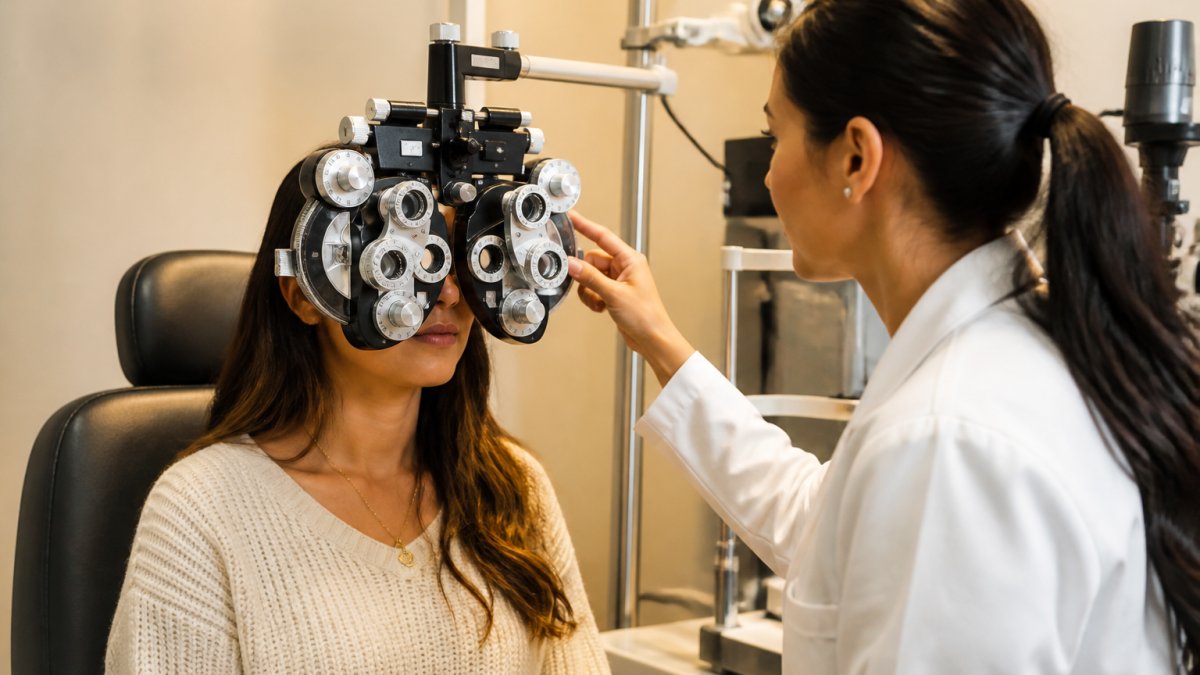
Your optometrist measures your current vision using a chart or digital display, then has you look through a phoropter while showing different lens combinations to determine your glasses or contact lens prescription.
The exam also tests how well your eyes work together and focus at different distances.
Eye health screening and measurements
Beyond vision testing, your optometrist inspects the cornea, lens, and other internal structures with a slit lamp, then dilates your pupils with eye drops for a better view of the retina and optic nerve.
If you have diabetes, hypertension, or other systemic conditions, these measurements matter even more, certain eye changes signal complications, making regular monitoring essential.
Optometrist vs Ophthalmologist: Which Provider Do You Need?
The distinction between optometrists and ophthalmologists matters when choosing your eye care provider: both are eye doctors, but their training, credentials, and scope of practice differ.
When to see an optometrist
An optometrist san antonio is your first choice for routine eye exams, glasses and contact lens prescriptions, and common conditions like dry eye or mild presbyopia. Optometrists can diagnose many eye diseases and prescribe medications, so see one for vision changes, a new prescription, or contact lens options.
Optometrists are often more accessible, with shorter wait times and more flexible scheduling, and provide cost-effective care for stable conditions.
When to see an ophthalmologist
An ophthalmologist is a medical doctor (M.D. or D.O.) trained in eye surgery and complex eye diseases (What Is an Ophthalmologist vs Optometrist?). See one for cataract surgery, LASIK, advanced glaucoma treatment, or serious retinal conditions requiring surgical or intensive medical management.
Clear Vision San Antonio provides expert ophthalmological care, combining advanced medical technology with a commitment to personalized patient attention.
Contact Lens Exams and Fitting
If you wear or want to try contact lenses, a contact lens exam differs from a standard eye exam: your optometrist measures your cornea’s curvature, determines lens size and prescription, and discusses which lens type suits your lifestyle.
The fitting involves trying sample lenses for comfort and clear vision, learning proper insertion, removal, and care techniques, and follow-up appointments to confirm the lenses work well and your eyes stay healthy.
Contact lens exams take longer than standard exams because of the fitting component. Plan for 60 to 90 minutes for your initial fitting appointment.
Scheduling Your Appointment and Booking Online
Booking an eye exam takes about five minutes, but the details you provide determine how smoothly the visit goes. Most offices offer online booking, phone, and walk-in, each suited to a different situation.
Choose the right booking channel
- Online booking is best for routine exams, contact lens follow-ups, and any visit where you already know your insurance and can pick a time two to four weeks out. You will typically be asked whether you are a new or established patient, the reason for the visit, your date of birth, and your insurance information.
- Phone is best for same-week needs, new-patient visits where you have questions about coverage, and anything involving a specific concern like a sudden change in vision, a foreign body, or a broken frame.
- Walk-in works at offices that reserve same-day slots, but availability is unpredictable. Call first to confirm whether walk-ins are being accepted that day.
What to have ready when you book
Have these items in front of you before you start, whether online or on the phone:
- Your vision insurance card and your medical insurance card (both, if you have them).
- Your date of birth and the policyholder’s name if you are on someone else’s plan.
- The name of any optometrist you have seen previously, so records can be requested.
- Your current glasses or contact lens prescription, if you have one.
- A list of medications and any relevant medical history (diabetes, glaucoma in the family, recent eye injury).
If you are a new patient, ask whether the office needs your records transferred before the visit or whether they will request them for you. Records requests can add several days, so starting early avoids a rescheduled exam.
Realistic wait times and how to shorten them
Routine exams at busy offices commonly book one to three weeks out, and Saturday slots fill fastest. New-patient visits and contact lens fittings may be scheduled further out.
For urgent concerns, say so when you call, many offices hold same-day slots for red-flag symptoms like sudden vision loss, eye pain, flashes, or a foreign body.
Confirm these details 24 hours before
A quick confirmation call or portal check the day before prevents most problems:
- Confirm the time, address, and which provider you are seeing.
- Confirm whether your pupils will be dilated, if so, arrange a ride or plan to wait before driving, and bring sunglasses.
- Confirm whether you should stop wearing contact lenses before the exam. Soft lenses are often discontinued 24-48 hours ahead and rigid lenses longer, so ask for the specific instruction for your lens type.
Rescheduling, reminders, and no-show policies
Most offices send reminders by text or email and let you reschedule through a patient portal. If you need to move your appointment, do it as early as possible, the same 24-hour window that triggers a no-show fee is usually the window that lets you reschedule without one.
Book online for routine visits, call for anything urgent or coverage-related, and confirm dilation, contact lens instructions, and the cancellation window the day before. Those three checks eliminate most rescheduled exams.
Understanding Insurance and Out-of-Pocket Costs
Vision coverage surprises most people because vision and medical benefits are separate products with separate cards, networks, and rules. A routine exam is typically billed to your vision plan; a medical problem like an eye infection, a foreign body, or a diabetic retinal exam is often billed to your medical plan.
Read your vision benefit before you call
Pull out your vision plan documents and find these specific line items. They determine almost everything about your final bill:
- Exam copay, a flat dollar amount for a routine comprehensive exam, commonly in the $10-$50 range on employer-sponsored plans.
- Frame allowance, a dollar credit toward frames, often $100-$200, applied once every 12 or 24 months.
- Lens coverage, single vision, bifocal, and progressive lenses may be fully covered or carry a fixed copay.
If you wear contacts and glasses, ask whether your plan lets you split the frame and contact lens allowances. Many do not, and choosing one means forfeiting the other for that benefit period.
Verify in-network status the right way
Asking “do you take my insurance?” isn’t enough. Ask these three questions in order:
- “Are you a participating, in-network provider for [plan name]?”, participation is plan-specific, not insurer-specific. An office can be in-network for one plan and out-of-network for another plan from the same insurer.
- “What is my exam copay, and what is my frame and lens allowance under this plan?”, the front desk can usually quote this from your member ID.
- “Is there anything in a standard exam that would be billed as medical rather than vision?”, dilation, retinal imaging, and visual field testing are the most common items that trigger a separate medical claim.
You can also verify independently through your insurer’s member portal or the member services number on your card, asking the representative to confirm in-network status and read you the exam copay and material allowances on your plan.
Estimate your out-of-pocket cost before the visit
A realistic estimate combines four numbers: exam copay + any medical-billed testing + lens copay + the gap between your frame allowance and the frame you pick. If your allowance is $150 and you choose a $220 frame, you pay $70 at checkout. Progressive lenses, high-index materials, and premium coatings most often push a “covered” visit into real out-of-pocket cost.
If you are uninsured or your plan has no vision benefit, ask the office for its self-pay exam rate and its self-pay pricing on frames and lenses before you book. Self-pay rates are often lower than the list price, and many offices offer a discount when exam and materials are purchased together.
If you have medical insurance but no vision plan
Many medical plans cover an eye exam tied to a medical diagnosis, diabetes, a thyroid condition, a suspected infection, or an eye injury. The visit is then billed to medical insurance with your normal deductible and coinsurance, which may cost more or less than a vision copay.
What to bring and what to keep
Bring your vision card, medical card, photo ID, current glasses or contact lens prescription, and a medication list. After the visit, keep your itemized receipt and explanation of benefits; if a charge looks wrong, call the insurer first, most plans allow 60-180 days to appeal or correct a claim.
When to Seek Immediate Eye Care
Most vision concerns can wait for a scheduled appointment, but sudden vision loss, eye pain, flashing lights, a sudden increase in floaters, or signs of infection (redness, discharge, swelling) require immediate care.
Many optometrists reserve urgent slots for these situations. If you can’t reach your regular provider, visit urgent care or an emergency room, prompt treatment prevents permanent vision damage.
Finding the right optometrist in your area takes research, but the effort pays off in better eye health and clearer vision. When you’re ready to schedule a comprehensive eye exam, Clear Vision San Antonio offers expert ophthalmological care with advanced technology and personalized attention, from routine vision exams to complex procedures like LASIK and cataract surgery.
Frequently Asked Questions
What is the difference between an optometrist and an ophthalmologist?
An optometrist performs comprehensive eye exams, prescribes eyeglasses and contact lenses, and diagnoses common eye conditions. An ophthalmologist is a medical doctor who can do everything an optometrist does, plus perform eye surgery and treat complex eye diseases. For routine exams and prescription updates, an optometrist is often sufficient. For surgical procedures like LASIK or cataract surgery, you’ll need an ophthalmologist. Many patients see both professionals as part of their complete eye care.
How often should I get an eye exam in San Antonio?
Adults aged 18 to 60 without eye problems should have an eye exam every two years. Adults over 60 should have annual exams. If you have diabetes, hypertension, or a family history of eye disease, annual exams are recommended regardless of age. People with existing eye conditions may need exams more frequently. Your eye care provider can recommend the right schedule for your individual needs.
What happens during a comprehensive eye exam?
A comprehensive eye exam includes vision testing to check how clearly you see at different distances, measurement of eye pressure and corneal thickness, examination of the retina and optic nerve, and assessment of how your eyes work together. You’ll also discuss your medical history, current symptoms, and any vision concerns. The entire appointment typically takes 45 minutes to an hour. Your provider will review findings with you and discuss any treatment or correction options.
How do I verify my insurance coverage before my appointment?
Contact your insurance provider directly and ask which eye care services are covered under your plan. Ask about your copay, deductible, and whether you need a referral. When scheduling your appointment, provide your insurance information to the office so they can verify coverage beforehand. Many practices can estimate your out-of-pocket costs once they confirm your benefits. This prevents surprise bills and helps you budget for your visit.