
Table of Contents
- 1. Sudden Vision Loss
- 2. Flashes of Light and Floaters (Signs of Retinal Detachment)
- 3. Severe Eye Pain or Pressure
- 4. Foreign Object in the Eye
- 5. Chemical Exposure or Burns (How to Treat a Chemical Burn in the Eye)
- 6. Physical Trauma or Injury to the Eye
- Urgent Eye Care vs. Emergency Room: When and Where to Seek Help
- Conclusion
Last Updated: August 8, 2026
7 Signs You Need Emergency Eye Care
Eye emergencies demand immediate attention. Sudden vision loss, severe pain, chemical exposure, and physical trauma are clear signals to seek help right away. At Clear Vision San Antonio, we understand that the difference between prompt treatment and delayed care can mean the difference between preserving your sight and permanent vision loss.
This guide covers the seven most critical signs that warrant emergency eye care, how to recognize them, and when to head to urgent care versus the emergency room.
1. Sudden Vision Loss
Sudden vision loss almost always requires immediate medical evaluation. When your vision changes dramatically within minutes or hours, whether complete blackout, significant blurring, or loss of peripheral vision, something serious is happening inside your eye.
Sudden vision loss can stem from retinal detachment (where light-sensitive tissue peels away from supporting layers), central retinal artery occlusion (a stroke of the eye that blocks blood flow), severe inflammation, bleeding inside the eye, or acute angle-closure glaucoma.
The critical window for treatment is narrow. Many causes respond better to intervention within the first few hours. Waiting overnight can result in permanent damage. If you experience sudden vision loss, don’t drive yourself, call 911 or have someone take you to the nearest emergency room immediately.
Pay attention to exactly what you’re experiencing: Is the entire visual field affected or just one area? Did it happen in one eye or both? These details help the emergency team understand the severity and likely cause.
2. Flashes of Light and Floaters (Signs of Retinal Detachment)
Flashes of light and new floaters appearing suddenly in your vision are classic warning signs of retinal detachment, a serious condition where the retina separates from the back of the eye.
Photopsia (light flashes) typically appears as lightning-like streaks in your peripheral vision, especially when you move your eyes or in dim lighting. Floaters look like small dots, cobwebs, or shadows drifting across your field of vision. While a few floaters are normal, a sudden shower of new floaters accompanied by flashes is a red flag.
When the retina starts to detach, it tugs on the vitreous gel inside the eye, triggering these visual phenomena. If the detachment progresses, the affected area of your vision will gradually darken like a spreading shadow.
Retinal detachment is a true emergency because the longer the retina remains detached, the more photoreceptors die and the less vision can be restored. Surgery can reattach the retina, but timing matters enormously. Seek emergency care immediately.
3. Severe Eye Pain or Pressure
Severe eye pain is never normal and warrants urgent evaluation. Unlike minor irritation, true eye pain, especially accompanied by vision changes, redness, or nausea, indicates a potentially serious problem.
Acute angle-closure glaucoma is one of the most dangerous conditions causing severe eye pain. The drainage angle inside the eye suddenly closes, pressure builds rapidly, and the optic nerve can be permanently damaged within hours. Patients typically describe intense pain, blurred vision, halos around lights, redness, and sometimes nausea or vomiting.
Corneal ulcers, infections, uveitis (inflammation inside the eye), and certain injuries also cause severe pain. Don’t assume eye pain will resolve on its own, it signals that tissue damage or dangerous pressure changes are occurring. If you experience sudden severe eye pain, especially with vision changes or redness, go to the emergency room or call 911.
4. Foreign Object in the Eye
A foreign body lodged in your eye requires careful removal by a trained professional. While small dust particles often flush out naturally, larger objects like metal shards, glass, or wood splinters can scratch the cornea or embed themselves, risking infection and vision loss.
Foreign body sensation (the feeling that something is stuck) doesn’t always mean an object is present, but if you saw something enter your eye or felt a sudden impact, assume there’s an object until proven otherwise. Rubbing your eye vigorously can scratch the cornea and worsen the situation.
First aid for a suspected foreign object:
- Don’t rub your eye
- Blink gently several times to see if tears flush it out
- Use clean water or saline solution to rinse gently
- If the object is visible on the white of the eye (not the cornea), try to carefully remove it with a clean, damp cloth
- If the object is embedded, on the cornea, or won’t come out easily, seek emergency care immediately
High-velocity objects (metal shards from grinding, glass from impacts) can penetrate deeper into the eye. Don’t attempt removal, go to the emergency room where specialized equipment can safely extract the object while minimizing corneal damage.
5. Chemical Exposure or Burns (How to Treat a Chemical Burn in the Eye)
Chemical exposure to the eye is a true emergency requiring immediate action. Acids, bases, solvents, and other caustic substances can burn the cornea and internal structures within seconds.
Immediate first aid for chemical exposure:
Rinse immediately. Start flushing with water or saline solution right away.
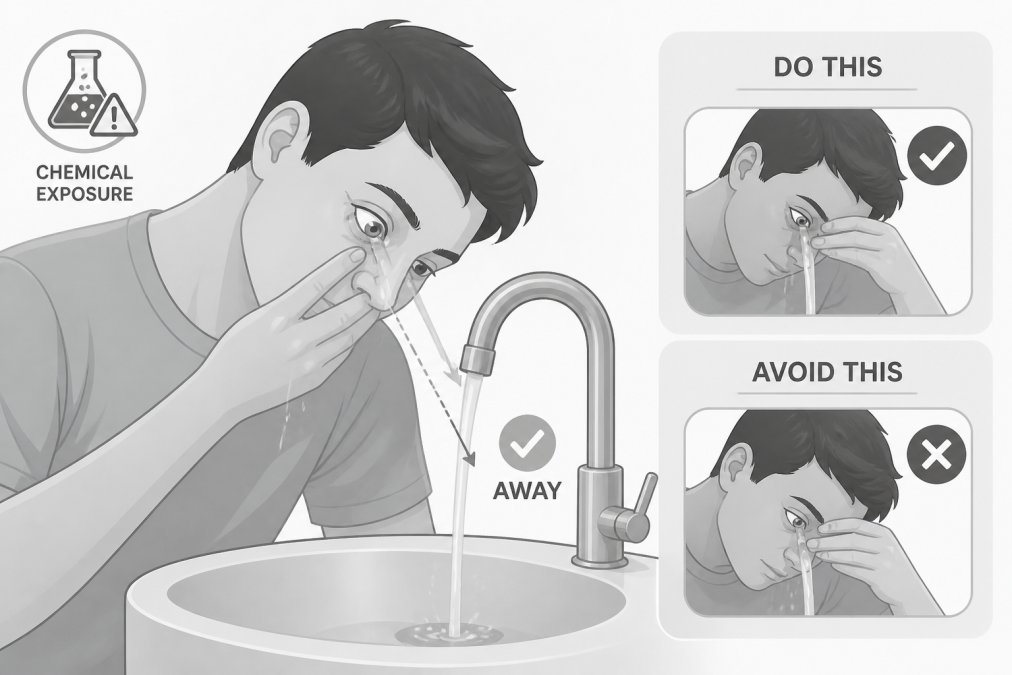
Flush for at least 15-20 minutes. For alkali burns (bases like ammonia or drain cleaner), flush for even longer, up to 30 minutes. Alkali penetrates deeper and causes more damage.
Position your head. Tilt your head so water flows away from your nose and toward your outer eye, preventing the chemical from draining into your other eye.
Use an eyewash station if available. Workplace eyewash stations and portable eyewash kits are designed for rapid flushing.
Remove contact lenses if you’re wearing them. After initial flushing, carefully remove contacts to prevent chemicals from being trapped underneath.
Seek emergency care immediately. Even after flushing, go to the emergency room or call 911. Chemical burns continue to damage tissue for hours after exposure.
Don’t apply ointments, drops, or patches before professional evaluation. The emergency team needs to assess the extent of the burn and determine appropriate treatment. Severe burns can cause permanent vision loss, scarring, and corneal opacity. The prognosis depends heavily on the type and concentration of the chemical and how quickly flushing began.
6. Physical Trauma or Injury to the Eye
Any significant blow or impact to the eye requires professional evaluation, even if vision seems normal immediately afterward. Eye injuries from sports, falls, assaults, or accidents can cause internal bleeding, retinal damage, or structural injury that isn’t immediately obvious.
Hyphema (bleeding inside the eye) may not cause obvious external signs but can lead to serious complications. The blood blocks light from reaching the retina and increases intraocular pressure.
Blunt trauma can also cause corneal abrasion, iritis or uveitis (inflammation inside the eye), lens dislocation, retinal tears or detachment, and orbital fractures.
Signs that trauma requires emergency care:
- Visible blood in the white of the eye
- Severe pain or pressure
- Vision changes or blurred vision
- Swelling or bruising around the eye
- Difficulty moving the eye
- Sensitivity to light
- Discharge or fluid leaking from the eye
Even if you feel fine after an impact, get checked. Some serious injuries develop over hours or days. A comprehensive eye exam can detect damage before it progresses to vision-threatening stages.
Urgent Eye Care vs. Emergency Room: When and Where to Seek Help
Understanding when to visit urgent care versus the emergency room helps you get appropriate care quickly.
Go to the emergency room for:
- Sudden vision loss
- Severe eye pain or pressure
- Chemical or thermal burns
- Physical trauma or penetrating injury
- Flashes of light with floaters (possible retinal detachment)
- Hyphema or visible bleeding
- Loss of eye movement or double vision
- Symptoms suggesting acute angle-closure glaucoma
Emergency rooms have ophthalmologists on call, advanced imaging equipment, and the ability to perform emergency surgery if needed.
Urgent care is appropriate for:
- Corneal abrasion (minor scratches)
- Mild chemical splash (after initial flushing)
- Minor foreign body that’s easily visible
- Moderate eye pain without vision changes
- Conjunctivitis with discharge
- Mild swelling or redness
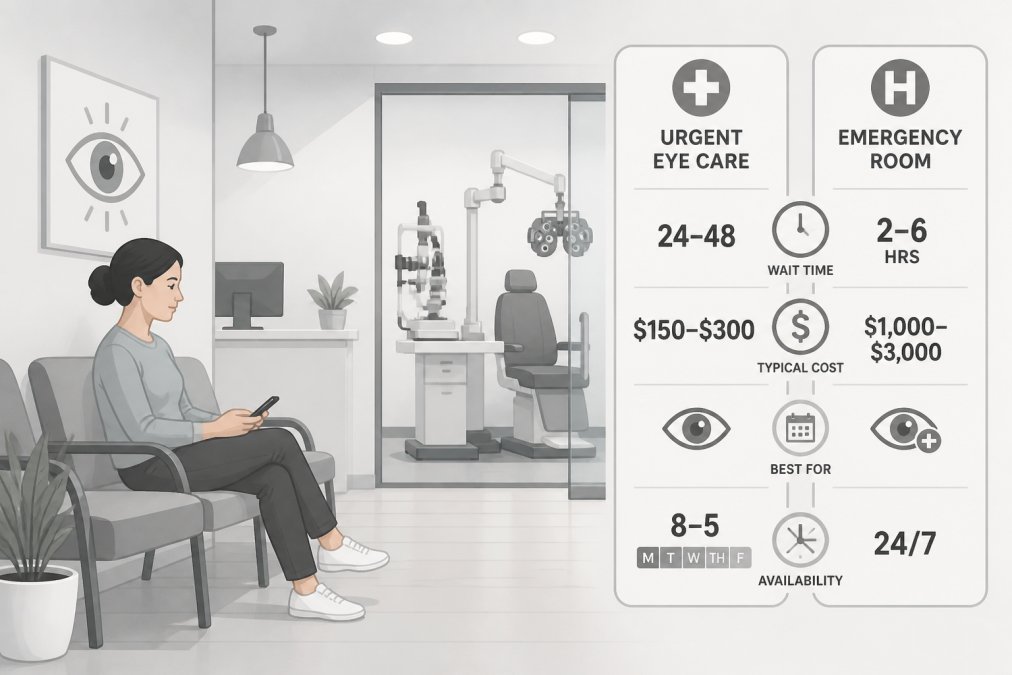
Urgent care centers can handle many common eye problems and often have shorter wait times than emergency rooms. However, they may not have an ophthalmologist available and typically lack surgical capability. If you’re uncertain, call ahead and describe your symptoms.
Clear Vision San Antonio‘s team can help you determine the right level of care. If you call our office with an emergency, our staff will guide you to the appropriate facility.
Triage decision framework:
| Symptom | Urgency Level | Recommended Care |
|---|---|---|
| Sudden complete vision loss | Emergency | Emergency Room |
| Severe eye pain with vision changes | Emergency | Emergency Room |
| Chemical or thermal burn | Emergency | Emergency Room |
| Flashes + new floaters | Emergency | Emergency Room |
| Physical trauma with bleeding | Emergency | Emergency Room |
| Moderate pain, no vision change | Urgent | Urgent Care or Same-Day Appointment |
| Foreign body easily visible | Urgent | Urgent Care |
| Mild redness, discharge, no pain | Non-urgent | Regular Office Visit |
| Dry eye or minor irritation | Non-urgent | Regular Office Visit |
Conclusion
Recognizing the seven signs you need emergency eye care, sudden vision loss, flashes and floaters, severe pain or pressure, foreign objects, chemical exposure, and physical trauma, can be the difference between preserving your sight and permanent vision loss. When in doubt, seek immediate professional evaluation. Clear Vision San Antonio’s expert eye doctors are committed to providing rapid, comprehensive care for eye emergencies. If you experience any of these symptoms, don’t hesitate to call 911, visit the nearest emergency room, or contact our office for guidance. Your vision is too important to wait. Request an Appointment with Clear Vision San Antonio today to ensure you have a trusted eye care partner for both emergencies and routine care.
Frequently Asked Questions
What are the red flags for eye emergencies?
Red flags include sudden vision loss, severe pain, flashes of light with new floaters, eye trauma, chemical or thermal burns, foreign objects you cannot remove, and significant swelling or discharge. These symptoms indicate an ophthalmological emergency requiring immediate medical attention. Do not delay, contact an eye care professional or visit an emergency room right away if you experience any of these warning signs.
When should you go to the ER for an eye injury versus urgent care?
Go to the ER if you have severe trauma, chemical burns, sudden complete vision loss, or signs of retinal detachment. Urgent eye care facilities handle minor foreign objects, mild chemical exposure, and moderate eye pain. The key difference: ER has surgical capability and advanced imaging for complex injuries. When in doubt, call ahead to an ophthalmologist, they can advise whether urgent care or the ER is appropriate for your specific injury.
What should I do if I get a chemical in my eye?
Immediately flush your eye with clean water for at least 15 minutes, holding your eyelid open gently. Use an eyewash station or clean running water, do not use ice or vinegar. Remove contact lenses if present. Seek emergency eye care right away, even if pain subsides. Bring the chemical container or know its name so the eye doctor can assess the specific risk. Chemical burns can worsen over hours, making immediate professional evaluation critical.
Can an optometrist handle eye emergencies?
Most optometrists can manage minor emergencies like small foreign objects or mild irritation, but cannot perform eye surgery or treat severe trauma. Ophthalmologists, medical doctors specializing in eye care, handle complex emergencies, retinal detachment, severe infections, and surgical cases. If you call an optometrist's office with a serious emergency and they cannot see you immediately, ask for an urgent referral to an ophthalmologist or the nearest emergency room.
This article was written using GrandRanker