
Table of Contents
- Immediate First Aid: Flush Your Eye Right Away
- How Long to Flush Your Eye With Saline Solution
- Removing Contact Lenses After a Chemical Splash
- 5 Essential Tools and Solutions for Eye Flushing
- When to Go to the ER for Chemical Eye Exposure
- What to Avoid During Eye Irrigation
- Conclusion
Last Updated: August 9, 2026
Immediate First Aid: Flush Your Eye Right Away
Chemical splashes into the eye demand immediate action. Start irrigation within seconds of contact using lukewarm tap water or sterile saline solution.
Position yourself at a sink or shower and tilt your head so the affected eye is lower than the unaffected one, preventing contaminated water from flowing across your good eye. Gently hold your eyelid open or have someone else do this while you keep still. Direct the water stream gently across the eye surface rather than at the cornea, letting water pool and overflow naturally to carry away debris.
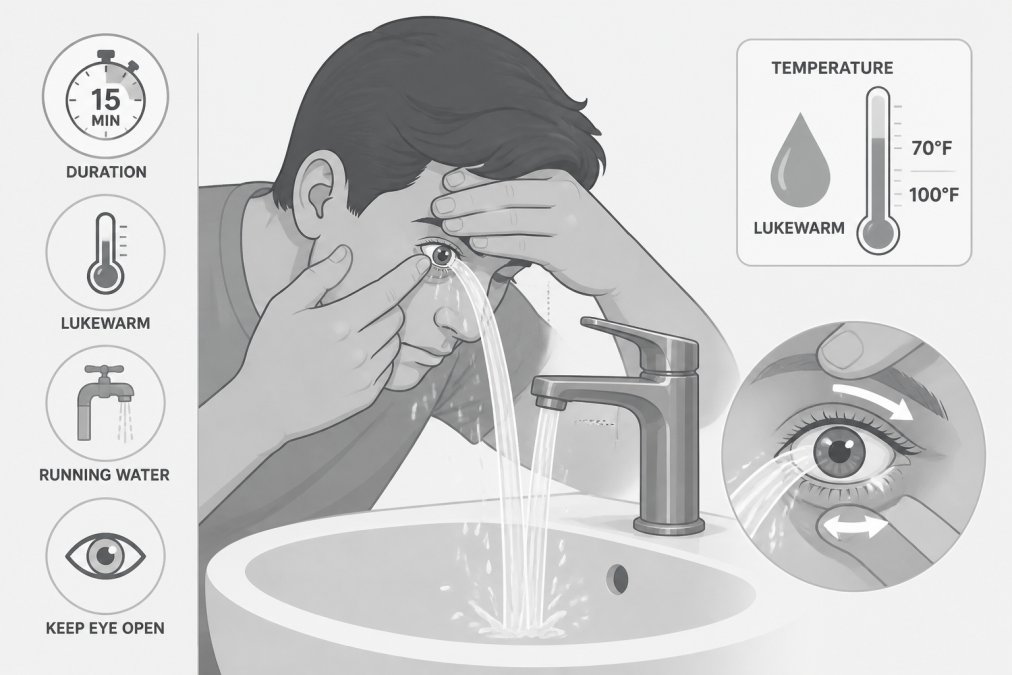
Use lukewarm tap water or sterile saline solution. Lukewarm water is immediately available and effective for most chemical splashes. Avoid ice-cold water, which intensifies irritation, and hot water, which damages delicate eye structures. Sterile saline is gentler than plain water while effectively removing chemical residue.
Do not rub the eye under any circumstances. Rubbing drives chemical particles deeper into eye tissue and causes additional damage. Keep your hands away from the eye except to hold the eyelid open during flushing.
How Long to Flush Your Eye With Saline Solution
The minimum flush duration for chemical splashes is 15 minutes of continuous irrigation. This standard comes from occupational safety protocols and emergency medicine guidelines.
Duration depends partly on the chemical involved. Acids typically cause immediate, sharp pain that drives people to seek help quickly. Alkali substances like ammonia, cement dust, or lime penetrate deeper into eye tissue and continue causing damage even after the initial splash. If exposed to an alkaline chemical, extend flushing to 20 minutes or longer. When in doubt, flush longer rather than stopping too early.
Signs you’ve flushed long enough include reduced eye pain, clearing of visible debris, and stable vision. However, these subjective measures can be misleading. The safest approach is to set a timer and complete the full 15-minute minimum, then seek professional evaluation. A medical professional can use specialized equipment to confirm all chemical particles have been removed and assess whether corneal damage has occurred.
If using a portable eyewash bottle or station, check the product specifications for flow rate and duration. ANSI-compliant eyewash stations deliver at least 0.4 gallons per minute and are designed to provide 15 minutes of continuous flow.
After flushing, do not assume the eye is safe. Continue to blink frequently and allow tears to flow naturally for several hours. If pain, blurred vision, or redness persists beyond 30 minutes post-flush, seek emergency medical evaluation. Delayed corneal damage can develop hours after chemical exposure.
Removing Contact Lenses After a Chemical Splash
Remove contact lenses before or immediately during irrigation if you’re wearing them at the time of chemical exposure. Contact lenses trap chemicals against the eye surface, preventing effective flushing and concentrating the chemical’s damaging effects.
If you can remove your lenses before starting irrigation, do so. Gently pull down your lower eyelid, look upward, and slide the lens down onto the white of your eye. Pinch it gently to remove it. If your hands are contaminated with the chemical, go straight to water and begin flushing first, then remove the lens during irrigation.
If you cannot remove the lens before flushing begins, remove it during the flushing process. Continue rinsing while you work the lens out. Once the lens is out, continue flushing for the full 15-minute duration. Do not reinsert the lens until you’ve been evaluated by an eye care professional and cleared to do so.
After removing the lens, dispose of it. Do not attempt to clean it or reuse it after chemical exposure. The lens material may have absorbed chemical residue. Replace it with a fresh lens only after professional evaluation confirms your eye has fully recovered.
5 Essential Tools and Solutions for Eye Flushing
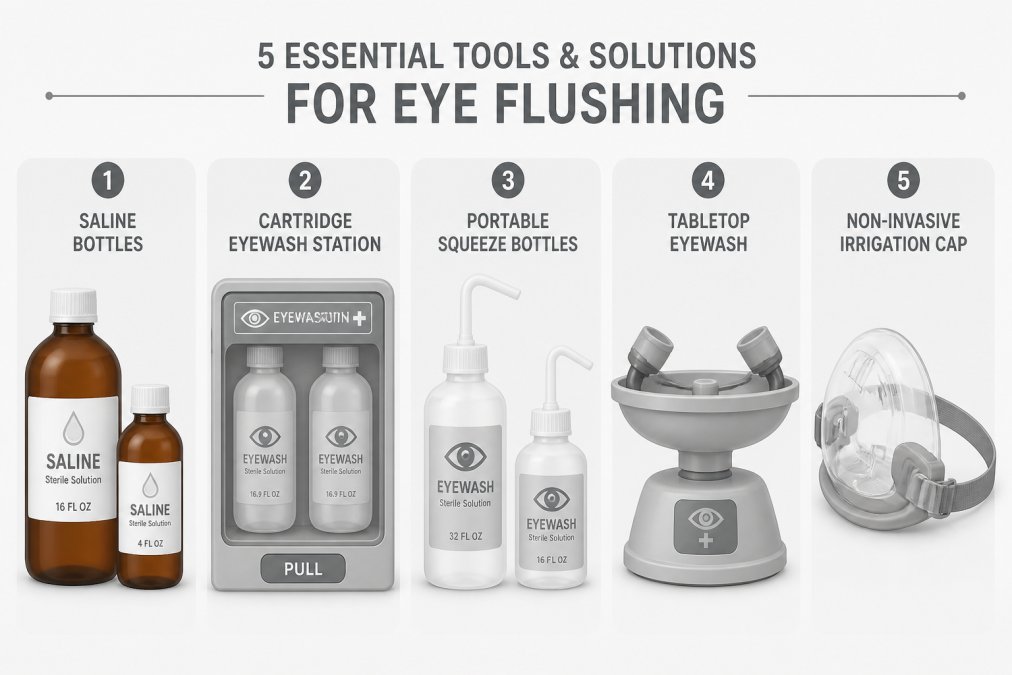
Having the right equipment within immediate reach transforms a chemical eye emergency into a controlled response.
1. Cederroth Eye Wash: pH-Neutralizing Solution
Cederroth Eye Wash actively neutralizes chemicals rather than just diluting them. The buffered solution counteracts both acidic and alkaline splashes, reducing the eye’s exposure to harmful pH extremes. This pH-neutralizing approach is particularly valuable for workplace environments where multiple chemical types are present.
The 500ml bottles feature an integrated eye cup for effective flushing without additional equipment. The solution remains sterile for up to 4.5 years, making it practical for first aid stations that may go unused for extended periods. Cederroth is especially effective for calcium-containing substances like cement dust or lime, which cause severe alkaline burns. The phosphate-free formula prevents chemical reactions that could worsen damage. The tradeoff is cost, at approximately $29.40 per 500ml bottle.
2. Honeywell Fendall 2000: Sealed-Cartridge Eyewash Station
The Honeywell Fendall 2000 delivers 15 minutes of sterile, pH-balanced saline solution in a hands-free format, meeting ANSI Z358.1-2009 standards. Because the solution is pre-sealed, it remains uncontaminated for up to 24 months.
This station is ideal for remote job sites, construction environments, and industrial facilities where water lines are unavailable. The gravity-fed system requires no electricity or complex installation. The practical limitation is cartridge replacement. After use, you must replace the cartridge to restore operational status. The cost is approximately $555.00 for the station.
3. PhysiciansCare Eye Wash Bottle: Portable Saline Solution
PhysiciansCare Eye Wash Bottles offer maximum portability. Available in 4oz, 8oz, 16oz, and 32oz sizes, these sterile isotonic buffered saline bottles fit into first aid kits, vehicle glove compartments, and backpacks. At approximately $3.50 for a 4oz bottle, they’re affordable to stock multiple locations.
The significant limitation is volume. A single 4oz bottle provides only a few minutes of continuous flushing, far short of the 15-minute standard. These bottles are best used as an immediate first-response tool to begin flushing, after which you must transition to a larger water source or eyewash station.
4. Bradley S19-210: Pedestal Mount Station for Workplaces
The Bradley S19-210 is engineered for industrial environments. This pedestal-mounted, plumbed eyewash station features dual spray heads delivering water flow exceeding ANSI Z358.1 minimum requirements of 0.4 gallons per minute at 30 PSI. The bright yellow safety coating makes it unmissable in an emergency.
Installation requires professional plumbing, which limits flexibility but ensures reliable, continuous water supply. For manufacturing plants, chemical handling facilities, and large workplaces, this is the standard choice. The cost is approximately $448.00 for the plastic bowl version.
5. EyeCap: Non-Invasive Irrigation Device
EyeCap addresses the blinking reflex by creating a "pool" of irrigation fluid that allows the eye to remain open and fully irrigated. The device attaches to standard Baxter irrigation bottles. The orthogonal spray nozzle creates a gentle, pooling effect rather than a forceful stream, particularly valuable for pediatric use.
EyeCap is lightweight and portable, suitable for emergency medical services, clinics, and home use. The non-invasive approach eliminates risk of corneal scratching from aggressive flushing techniques. The practical requirement is that you must have a compatible irrigation bottle on hand. The cost is approximately $20.00.
When to Go to the ER for Chemical Eye Exposure
Seek emergency medical care immediately if you experience severe symptoms after chemical exposure. Severe pain that does not improve after 15 minutes of flushing, significant vision loss, inability to open the eye, or visible damage to the eyelid or eye surface all warrant emergency evaluation.
Chemical-specific warning signs require immediate ER evaluation. If exposed to alkaline substances like ammonia, drain cleaner, or cement dust, go to the emergency room even if pain has subsided. Alkali penetrates deeply into eye tissue and can cause progressive damage hours after the initial exposure. Acidic chemicals typically cause immediate, severe pain, which itself is a sign to seek emergency care.
Persistent blurred vision, light sensitivity, or a sensation of something in the eye after thorough flushing all indicate corneal involvement. An ophthalmologist or emergency medicine physician can examine the eye with specialized equipment to identify corneal abrasion, chemical burn depth, and tissue involvement.
Some of the most damaging chemical eye injuries cause minimal initial pain. Alkali burns, in particular, can progress silently for hours. Professional evaluation is essential after chemical eye exposure to confirm that your eye is truly safe and to document the injury for medical records.
What to Avoid During Eye Irrigation
Do not use ice-cold or hot water. Cold water causes vasoconstriction and intensifies pain and tissue damage. Hot water damages delicate eye structures. Room-temperature or lukewarm water is correct.
Do not attempt to neutralize the chemical with a different chemical. These reactions can generate heat and cause additional damage. Water and saline are the only appropriate flushing solutions for immediate first aid.
Do not use eye drops, ointments, or medications before professional evaluation. These can interact with chemical residue or trap chemicals against the eye surface.
Do not cover or patch the eye during flushing. An open eye allows water to flow freely across the surface.
Do not delay seeking professional help. Chemical eye injuries can permanently damage vision.
Do not reuse contact lenses after chemical exposure. Even if the lens appears undamaged, it may have absorbed chemical residue.
Chemical eye emergencies demand speed and the right approach. The critical window is the first 60 seconds, getting water or saline flowing across the eye immediately minimizes damage. The 15-minute flushing standard, proper positioning, and quick removal of contact lenses form the foundation of effective first aid.
Having eyewash solutions and stations within immediate reach transforms panic into action. Whether you choose a pH-neutralizing solution like Cederroth for chemical-heavy workplaces, a portable bottle like PhysiciansCare for personal first aid kits, or a permanent station like the Bradley S19-210 for industrial facilities, the key is accessibility.
After flushing and initial first aid, professional evaluation is essential. Chemical eye injuries carry significant risk of delayed corneal damage and vision loss. An eye care professional can assess the full extent of injury, monitor for complications, and guide your recovery. If you’re in the San Antonio area and experience chemical eye exposure, Clear Vision San Antonio provides emergency eye evaluations and specialized care for chemical injuries. Request an appointment immediately after flushing, or go to the nearest emergency room if symptoms are severe.
For workplace safety, consult OSHA’s guidelines on eyewash station placement and maintenance to ensure your facility meets regulatory requirements. Regular training on eyewash station use and chemical handling reduces both the frequency and severity of eye injuries. For more information on preventing chemical eye injuries, the National Institute for Occupational Safety and Health provides detailed chemical safety resources for employers and workers.
Frequently Asked Questions
How do you flush chemicals out of your eyes?
Flush chemicals from your eye immediately by rinsing with lukewarm tap water or sterile saline solution for at least 15 minutes. Hold your eyelids open and direct the fluid across the entire eye surface. Position your head so water flows away from your nose toward the outside of your face. Remove contact lenses if present. For alkaline or acidic chemical splashes, use a pH-neutralizing saline solution when available. Continue flushing even if your eye feels better, as some chemicals cause delayed damage.
How long should you flush your eye with saline after a chemical splash?
Flush for a minimum of 15 minutes continuously. This duration is the standard for chemical eye injuries and allows the irrigation fluid to dilute and remove chemical residue effectively. For alkaline chemicals (such as cement or lime), extend flushing to 20-30 minutes or longer, as these substances penetrate deeper into eye tissue. Continue flushing until your eye feels more comfortable and any visible debris is gone. If symptoms persist after flushing, seek emergency medical care immediately.
What should you do about contact lenses after a chemical splash?
Remove contact lenses immediately before or during irrigation, as they can trap chemicals against your eye and worsen damage. If you cannot remove lenses easily, flush your eye first with saline solution for 1-2 minutes, which may help loosen them. After removal, continue flushing for the full 15-minute duration. Do not reinsert lenses until a medical professional confirms your eye has recovered. Contaminated lenses should be discarded; do not attempt to clean and reuse them.
When should you go to the emergency room for chemical eye exposure?
Seek emergency medical care immediately if you experience severe pain, vision loss, persistent redness, or chemical burns after flushing. Go to the ER if the chemical was alkaline (lime, cement, ammonia) or strong acid, as these cause rapid corneal damage. Also seek emergency care if you cannot remove the chemical completely, if your eye remains irritated after 15 minutes of flushing, or if you have any doubt about the substance involved. Do not delay, chemical eye injuries require urgent professional evaluation to prevent permanent vision loss.
This article was written using GrandRanker