
Table of Contents
- Is Laser Cataract Surgery Worth the Extra Cost? A Financial Reality Check
- Laser Cataract Surgery vs Traditional Cataract Surgery Cost Comparison
- Benefits of Laser Cataract Surgery: What You Actually Get for the Premium
- Laser Cataract Surgery Recovery Time: Does Speed Matter?
- Laser Cataract Surgery Success Rate: Clinical Evidence and Long-Term Outcomes
- Who Should Choose Laser-Assisted Cataract Surgery?
- Insurance, Billing, and Hidden Costs: What You Need to Know
- The Psychological and Experience Factor: Beyond Clinical Metrics
Last Updated: July 22, 2026
Is Laser Cataract Surgery Worth the Extra Cost? A Financial Reality Check
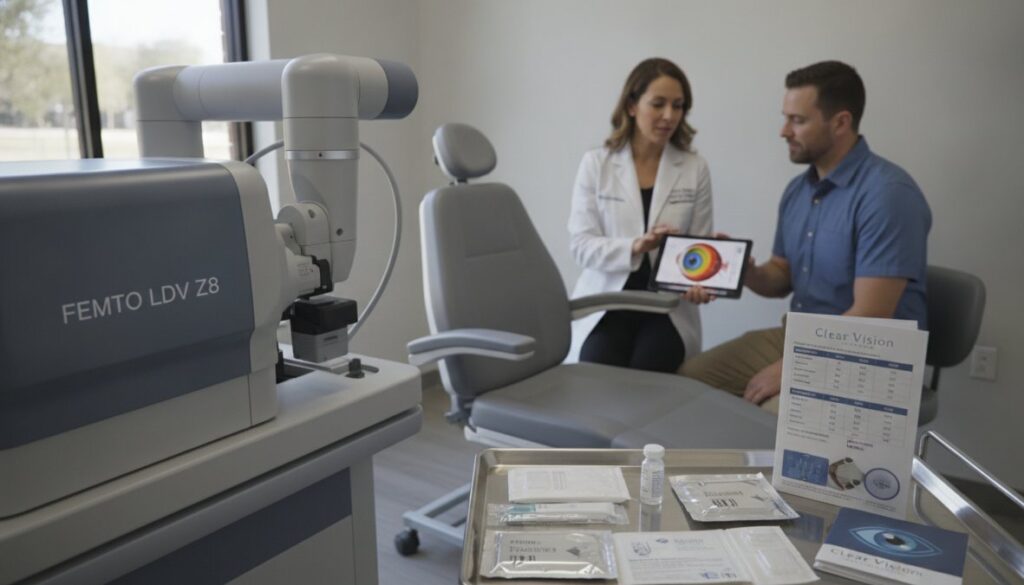
When you ask "is laser cataract surgery worth the extra cost," you’re asking whether precision justifies premium pricing. Clear Vision San Antonio has worked with hundreds of cataract patients navigating this question, and the answer depends on your vision needs, insurance coverage, and visual goals, not just the price tag.
Femtosecond laser technology creates incisions with micrometer-level precision and performs automated capsulotomies that traditional phacoemulsification cannot match. However, precision alone doesn’t guarantee better outcomes for every patient. Some see dramatic improvements in visual acuity and recovery speed; others experience minimal difference compared to standard surgery.
Understanding exactly what you’re paying for, who benefits most, and whether your insurance covers any portion determines whether laser cataract surgery is right for you.
The Price Premium Explained
Laser cataract surgery typically costs between $1,500 and $2,000 per eye beyond standard cataract surgery. The Alcon LenSx system charges approximately $1,500 per eye, while the Johnson & Johnson Catalys system runs closer to $2,000 per eye. Exact costs vary by facility and location.
Standard cataract surgery remains significantly less expensive. Medicare and most insurance plans cover the basics of cataract removal and IOL implantation, but the laser component is almost never covered, the entire premium becomes your responsibility.
Ask your surgeon’s office for an itemized quote separating the laser fee from IOL cost and facility charges. Many patients confuse premium IOL pricing with laser costs.
When Extra Cost Translates to Real Value
The premium makes sense for specific patients. If you have moderate to dense cataracts, the laser’s superior fragmentation reduces ultrasound energy absorption during surgery, potentially speeding visual recovery and lowering inflammation risk.
Patients with significant corneal astigmatism benefit substantially. The femtosecond laser creates precise limbal relaxing incisions with accuracy that manual techniques struggle to match. If you’ve worn glasses for astigmatism your entire life, laser-assisted correction offers genuine hope for reduced dependence on glasses after surgery.
High-demand visual occupations justify the expense. Surgeons, pilots, and professionals requiring exceptional precision often find the incremental improvement justifies the cost. Patients choosing premium multifocal or extended-depth-of-focus IOLs already commit to higher spending; adding laser assistance optimizes the surgical precision these advanced lenses require.
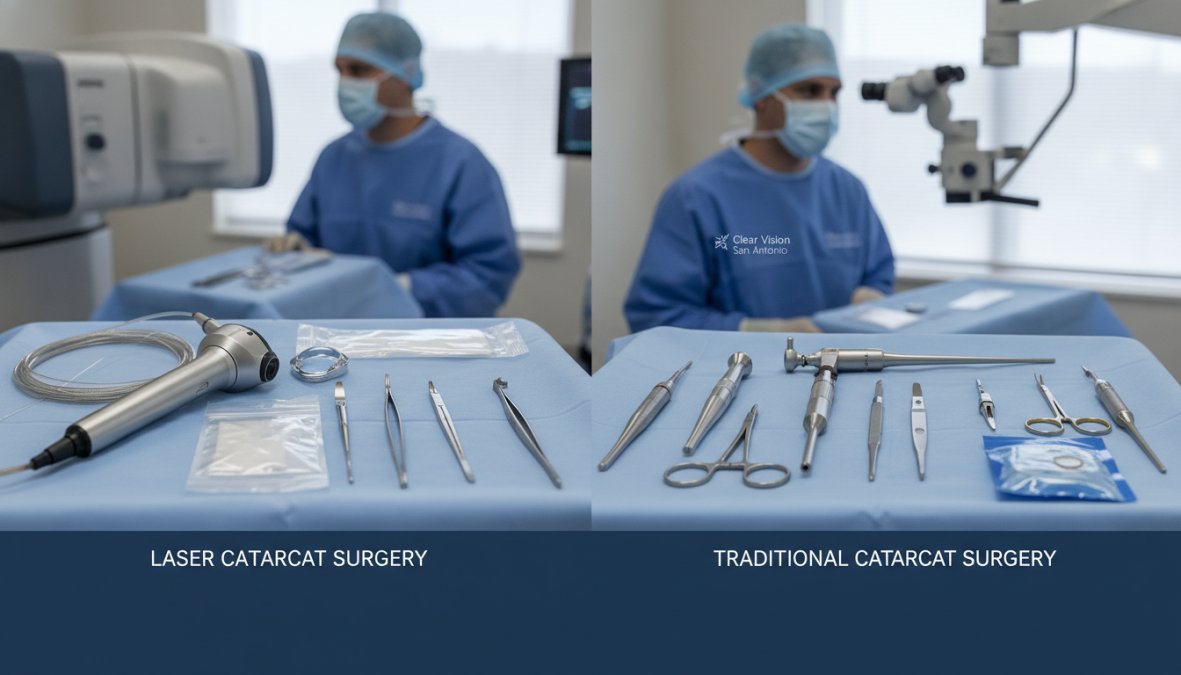
Laser Cataract Surgery vs Traditional Cataract Surgery Cost Comparison
Understanding the full financial picture requires comparing surgery type, IOL selection, facility charges, and insurance coverage.
| Factor | Traditional Cataract Surgery | Laser-Assisted Cataract Surgery |
|---|---|---|
| Surgeon’s technique | Manual incisions, phacoemulsification | Laser incisions, automated fragmentation |
| Typical out-of-pocket (basic IOL) | $500-$1,500 | $2,000-$3,500 |
| Typical out-of-pocket (premium IOL) | $2,000-$4,000 | $3,500-$6,000 |
| Insurance coverage | Covers IOL and facility | Covers IOL and facility only |
| Precision advantage | Good for most patients | Superior for complex cases |
| Recovery timeline | 4-6 weeks to stable vision | 2-4 weeks typical |
Surgical Technique and Precision Differences
Traditional cataract surgery relies on the surgeon’s hand to create corneal incisions and perform the capsulotomy. Laser-assisted cataract surgery uses femtosecond laser technology to program incisions based on real-time 3D imaging. The laser creates corneal incisions at predetermined depth and angle, performs the capsulotomy with superior edge quality, and fragments the cataract into smaller pieces before phacoemulsification begins.
The precision difference matters most for patients with dense cataracts, very short or very long eyes, or those requiring astigmatism correction. For straightforward cataracts in average-sized eyes, the precision advantage becomes less clinically meaningful.
Out-of-Pocket Expenses and Insurance Coverage
Medicare covers cataract surgery as medically necessary when vision impairment affects daily function. Coverage includes the surgeon’s fee, facility charges, and a standard monofocal IOL, but not the femtosecond laser component or premium lenses.
Private insurance typically follows Medicare’s lead, covering the surgical procedure and basic IOL while classifying laser assistance and premium lenses as elective upgrades. Your out-of-pocket responsibility for laser cataract surgery remains 100% of the laser fee.
Some facilities bundle laser fees into “premium packages” that include both the laser and premium IOL. Request an itemized breakdown before committing.
Benefits of Laser Cataract Surgery: What You Actually Get for the Premium
The clinical benefits of laser-assisted cataract surgery are real but not universal.
Femtosecond Laser Precision and Surgical Accuracy
The femtosecond laser creates incisions with micrometer precision while minimizing thermal damage. Its 3D imaging system maps your eye’s anatomy and programs incisions accordingly. For corneal incisions, it creates precisely angled, self-sealing wounds. For the capsulotomy, it performs a complete circular opening with consistent edge quality. For lens fragmentation, it creates patterns that break the cataract into smaller pieces before ultrasound begins.
This precision translates to three practical benefits: reduced phacoemulsification energy, improved wound integrity, and more predictable refractive outcomes. However, precision doesn’t guarantee better final vision for all patients. Research shows laser-assisted cataract surgery improves surgical reproducibility and reduces complications in complex cases, but many patients achieve equally good outcomes with traditional surgery.
Astigmatism Correction and Vision Outcomes
If you have corneal astigmatism, laser-assisted cataract surgery offers meaningful advantage. The laser can create limbal relaxing incisions with precision that manual techniques struggle to match. For patients with 1.5 diopters or more of astigmatism, this combination significantly improves the chance of achieving good uncorrected vision without glasses.
Reduced Phacoemulsification Energy
Laser fragmentation reduces the cataract into smaller pieces before phacoemulsification begins. Studies show this reduces total ultrasound energy by 30-50% depending on cataract density. For dense cataracts, this energy reduction matters substantially. For mild to moderate cataracts, the difference becomes minimal.
Reduced energy particularly benefits patients with compromised corneas or previous eye surgery. For healthy eyes with straightforward cataracts, the energy reduction provides benefit but doesn’t dramatically change outcomes.
Laser Cataract Surgery Recovery Time: Does Speed Matter?
Post-Operative Timeline and Activity Restrictions
Both laser-assisted and traditional cataract surgery involve similar post-operative restrictions: antibiotic and anti-inflammatory eye drops for 4-6 weeks, avoiding heavy lifting and water exposure for the first week, and attending follow-up visits at 1 day, 1 week, 1 month, and 3 months.
Laser-assisted surgery typically produces less corneal inflammation, meaning less redness and irritation in the first 48 hours. Some patients notice clearer vision sooner. However, both approaches require the same activity restrictions and follow-up schedule.
Return to Normal Vision and Functional Recovery
Functional vision typically stabilizes within 2-4 weeks for laser-assisted surgery and 4-6 weeks for traditional surgery. Best-corrected visual acuity stabilizes within 6-8 weeks for both approaches, with the difference rarely exceeding 2 weeks.
Laser assistance shows advantage for patients with premium IOLs, who achieve better visual quality sooner because the laser’s precision optimizes the IOL’s optical performance.
Laser Cataract Surgery Success Rate: Clinical Evidence and Long-Term Outcomes
Visual Acuity and Patient Satisfaction Data
Cataract surgery achieves 20/25 vision or better in approximately 90% of patients without significant corneal disease or retinal problems. Laser-assisted surgery achieves similar rates, with advantage appearing in specific subgroups: patients with astigmatism, dense cataracts, or premium IOL choices.
Research demonstrates that laser-assisted cataract surgery improves refractive predictability, particularly for astigmatism correction, translating to fewer patients needing glasses after surgery.
Patient satisfaction depends heavily on realistic expectations. Patients who understand that cataract surgery removes the cloudy lens but doesn’t eliminate presbyopia report higher satisfaction regardless of surgical technique.
Complication Rates and Safety Profile
Both laser-assisted and traditional cataract surgery carry low complication rates in experienced hands. Serious complications occur in fewer than 2% of cases overall.
Laser-assisted surgery may reduce certain complications: corneal edema occurs less frequently due to reduced ultrasound energy, and the laser’s precision improves capsulotomy quality. However, laser-assisted surgery introduces rare complications related to the docking mechanism or laser system malfunction.
The safety profile of both approaches is excellent. The choice should rest on clinical benefit for your specific situation, not safety concerns.
Who Should Choose Laser-Assisted Cataract Surgery?
Ideal Candidates and Patient Factors
You’re an ideal candidate for laser-assisted cataract surgery if you have:
- Moderate to dense cataracts
- Significant corneal astigmatism (1.5 diopters or more)
- Premium IOL selection
- High visual demands
- Compromised corneas or previous eye surgery
- Strong motivation for spectacle independence
You may not need laser-assisted surgery if you have:
- Mild to moderate cataracts in an average-sized eye
- No significant astigmatism
- Realistic expectations for standard monofocal IOL outcomes
- Budget constraints
- Good vision in the other eye
Age alone doesn’t determine candidacy. A 75-year-old with dense cataracts and astigmatism benefits more from laser assistance than a 55-year-old with mild cataracts and no astigmatism.
Premium IOL Compatibility and Refractive Outcomes
Premium IOLs cost $1,500-$3,500 per lens and promise vision at multiple distances without glasses. Laser-assisted surgery optimizes premium IOL performance by ensuring precise lens positioning, ideal capsulotomy size, and accurate astigmatism correction.
For standard monofocal IOLs, the laser premium becomes a larger percentage of total cost and delivers smaller absolute visual benefit, shifting the cost-benefit analysis unfavorably.
Insurance, Billing, and Hidden Costs: What You Need to Know
Medicare and Insurance Coverage Reality
Medicare covers cataract surgery as a covered benefit when cataracts impair vision enough to affect daily function. Coverage includes the surgeon’s fee, facility charges, and a basic monofocal IOL, but not the femtosecond laser component.
The laser fee is classified as an elective upgrade. You pay 100% of laser costs out-of-pocket. Private insurance follows similar patterns.
Some Medicare Advantage plans offer supplemental benefits that may cover portions of premium services. Check your specific plan documentation before surgery.
The laser fee is your responsibility regardless of insurance. Budget the full amount as out-of-pocket expense.
Consumable Costs and Facility Fees
Facility fees vary widely based on whether surgery occurs in an ambulatory surgery center versus a hospital outpatient department. Hospital facilities typically charge 30-50% more.
Premium toric IOLs cost $1,500-$2,500 per lens. Post-operative medications cost $100-$200 for the full course. Some surgeons’ offices charge additional fees for advanced imaging, ranging from $100-$300.
Request an itemized quote breaking down surgeon’s fee, facility fee, laser fee, IOL cost, imaging fees, and post-operative medication costs to prevent surprise charges.
The Psychological and Experience Factor: Beyond Clinical Metrics
The femtosecond laser creates a distinctive clicking sound and sensation of pressure during the laser phase. Some patients find this reassuring; others find it anxiety-inducing. Traditional surgery involves phacoemulsification vibration, which some patients find more disturbing.
Laser-assisted patients often see clearer vision sooner, which reinforces confidence in the procedure choice. Traditional surgery patients experience slightly slower visual recovery, which sometimes creates anxiety even though outcomes ultimately match.
Patient satisfaction research shows that expectations significantly influence satisfaction more than actual outcomes. The premium cost itself creates psychological investment; some patients report increased satisfaction because they feel they received "the best technology available," while others experience buyer’s remorse if results don’t dramatically exceed traditional surgery outcomes.
Deciding whether laser cataract surgery is worth the extra cost requires honest assessment of your visual needs, astigmatism correction goals, and financial comfort with out-of-pocket spending. For patients with significant astigmatism, dense cataracts, or premium IOL selection, the laser premium delivers genuine clinical value. For others, traditional cataract surgery achieves equally good outcomes at substantially lower cost. Clear Vision San Antonio’s experienced ophthalmologists can review your specific situation and recommend the approach most likely to achieve your visual goals.
Frequently Asked Questions
Does insurance cover laser cataract surgery?
Most insurance plans, including Medicare, cover the cost of standard cataract surgery but typically classify laser-assisted cataract surgery as an elective upgrade. The femtosecond laser component is usually considered an out-of-pocket expense. Medicare covers the intraocular lens (IOL) implant and basic surgical procedure, but premium features like astigmatism correction with the laser often require patient payment. Contact your specific insurance provider for exact coverage details.
What is the success rate of laser cataract surgery?
Laser-assisted cataract surgery achieves high visual acuity outcomes, with studies showing successful vision correction in the majority of patients. However, clinical efficacy data shows that improvements over traditional phacoemulsification may vary depending on individual eye conditions. Success rates are influenced by factors like corneal health, IOL selection, and patient candidacy. Long-term visual outcome data indicates that both laser and traditional approaches produce comparable final vision results for most patients, though laser precision may offer advantages in complex cases.
How long is the recovery time after laser cataract surgery?
Most patients experience improved vision within days to a week after laser-assisted cataract surgery. Full post-operative recovery typically takes 4-6 weeks, though this timeline is similar to traditional surgery. The reduced phacoemulsification energy used with femtosecond laser assistance may potentially minimize inflammation and accelerate healing in some cases. Patients should follow their ophthalmologist's restrictions on physical activity and eye protection during the recovery period to ensure optimal surgical outcomes.
Is laser cataract surgery worth the extra cost if my cataracts aren't severe?
The value depends on your visual goals and lifestyle. If you have mild cataracts and standard vision needs, traditional cataract surgery may be sufficient and more cost-effective. However, if you have astigmatism, desire premium vision correction, or want the benefits of enhanced surgical precision, laser-assisted cataract surgery may justify the additional expense. Discuss your specific eye health, refractive errors, and long-term vision expectations with your ophthalmologist to determine if the premium investment aligns with your needs.
What makes laser cataract surgery different from traditional cataract surgery?
Laser-assisted cataract surgery uses a femtosecond laser to perform precise corneal incisions, create a perfect capsulotomy, and fragment the lens before phacoemulsification. Traditional cataract surgery relies on the surgeon's manual technique for these steps. The femtosecond laser offers computer-controlled accuracy, customized incision placement, and the ability to correct astigmatism with limbal relaxing incisions. This precision may reduce surgical time, minimize ultrasound energy exposure, and potentially improve outcomes in complex cases, though both approaches achieve excellent results for most patients.
This article was written using GrandRanker