

Table of Contents
- What Causes Eyes to Feel Tired at the End of the Day
- Digital Eye Strain and Screen Time
- Dry Eyes Symptoms and End-of-Day Discomfort
- Environmental and Ergonomic Factors
- How to Relieve Eye Strain During and After Work
- Eye Exercises for Tired Eyes and Prevention
- When to See an Eye Doctor About Tired Eyes
- Conclusion
Last Updated: August 2, 2026
What Causes Eyes to Feel Tired at the End of the Day
Eye fatigue affects approximately 59% of the population, especially those who spend significant time on screens or detailed work. The muscles controlling your eyes fatigue under sustained tension without adequate breaks. By the end of the day, these muscles have been working continuously, leading to the sensation that your eyes feel tired and heavy.
Asthenopia and Visual Exhaustion
Asthenopia, the clinical term for eye strain, describes the discomfort that results from prolonged visual effort. The ciliary muscles, small muscles inside your eye responsible for changing focus, accumulate metabolic waste and deplete their energy reserves when working continuously. You might have perfect 20/20 vision yet experience significant eye fatigue, since the issue is muscular fatigue rather than a refractive error or disease.
The ciliary muscles fatigue fastest when you maintain a single focal length for hours, like staring at a computer screen. Varying your focal distance throughout the day significantly reduces end-of-day fatigue.
Ciliary Muscle Fatigue from Focusing Effort
Your eyes’ focusing system requires constant, active effort whenever you concentrate on something. The ciliary muscles contract to change the shape of your lens, a process called accommodation, which allows you to see clearly at different distances. The closer an object is to your eyes, the more forcefully your ciliary muscles must contract.
Throughout the day, your focusing effort compounds. If you spend the morning reading emails, the afternoon in meetings, and the evening on your phone, your ciliary muscles never get a genuine break. If you have an uncorrected refractive error, even a mild one, your ciliary muscles must work harder to compensate and maintain clear vision.
Digital Eye Strain and Screen Time
Digital eye strain, also called computer vision syndrome, has become one of the most common reasons people report that their eyes feel tired at the end of the day. The condition develops from reduced blinking, sustained near focus, glare, and blue light emitted by digital displays. Adults spend an average of 7-10 hours daily on digital devices, creating unprecedented demands on the visual system.
How Computer Vision Syndrome Develops
Computer vision syndrome emerges from a perfect storm of visual demands that screens create. When you focus on a screen, your eyes blink less frequently, blinking decreases by approximately 66% during screen use compared to normal reading. This reduced blinking means your tear film, the protective layer of moisture covering your eye, breaks down more quickly and doesn’t get replenished as often.
Screens also demand sustained accommodation at a fixed focal length. Unlike reading a physical book, screens lock your focusing system into a single distance, exhausting your ciliary muscles far more efficiently. Screen brightness and contrast create additional visual processing demands.
If you experience computer vision syndrome symptoms by midday and they worsen through the evening, you likely have an uncorrected refractive error that screens are exacerbating. Schedule an eye exam, even a small correction can reduce end-of-day fatigue by 40-60%.
Blinking Rate and Tear Film Disruption
The tear film covering your ocular surface provides lubrication, delivers oxygen and nutrients to your cornea, and washes away debris. When you blink normally, you spread a fresh layer of tears across your eye. However, screen use disrupts this protective mechanism dramatically.
During focused screen work, your blinking rate drops from the normal 15-20 blinks per minute to approximately 5-8 blinks per minute. This 60-70% reduction means your tear film isn’t being refreshed regularly, and the existing tear layer begins to break down. By evening, after hours of reduced blinking, your tear film is severely compromised, and your eyes feel tired, scratchy, and irritated.
Dry Eyes Symptoms and End-of-Day Discomfort
Dry eye syndrome represents one of the most common causes of end-of-day eye fatigue. When your ocular surface lacks adequate tear film, your eyes must work harder to maintain clear vision and comfort.
Ocular Surface Changes Throughout the Day
Your ocular surface undergoes significant changes from morning to evening. When you wake up, your tear film is fresh and your ocular surface is well-hydrated. Throughout the day, several factors deplete your tear film: reduced blinking during focused work, environmental factors like heating or air conditioning that increase tear evaporation, and the natural decrease in tear production that occurs as the day progresses.
The lipid layer of your tear film, the outermost layer that prevents tear evaporation, becomes depleted throughout the day. Environmental factors accelerate these changes, air-conditioned offices with low humidity or heated environments during winter increase tear evaporation dramatically.
Dry eye symptoms and end-of-day eye fatigue are often inseparable. If your eyes feel tired specifically at the end of the day, dryness is likely a significant contributing factor, even if you don’t consciously notice dryness as a symptom.
Environmental and Ergonomic Factors
The environment where you work and how your workspace is arranged dramatically influence whether your eyes feel tired at the end of the day. Environmental factors, lighting, glare, humidity, and workspace setup, often play an equally important role as screen time.
Lighting, Glare, and Contrast Sensitivity
Improper lighting creates a cascade of visual demands that exhaust your eyes throughout the day. If your workspace is too dim, your pupils dilate and your visual system works harder to process images. If your workspace is too bright, your pupils constrict and your eyes work harder to manage excess light.
Glare, reflected light that reduces contrast and creates visual discomfort, is one of the most common environmental causes of end-of-day eye fatigue. When glare is present, your visual system must work harder to extract useful information from your screen. By evening, this sustained extra effort manifests as significant eye fatigue. Optimal lighting typically ranges from 300-500 lux for office work, with light sources positioned to minimize glare on your screen.
Workspace Ergonomics and Eye Muscle Imbalance
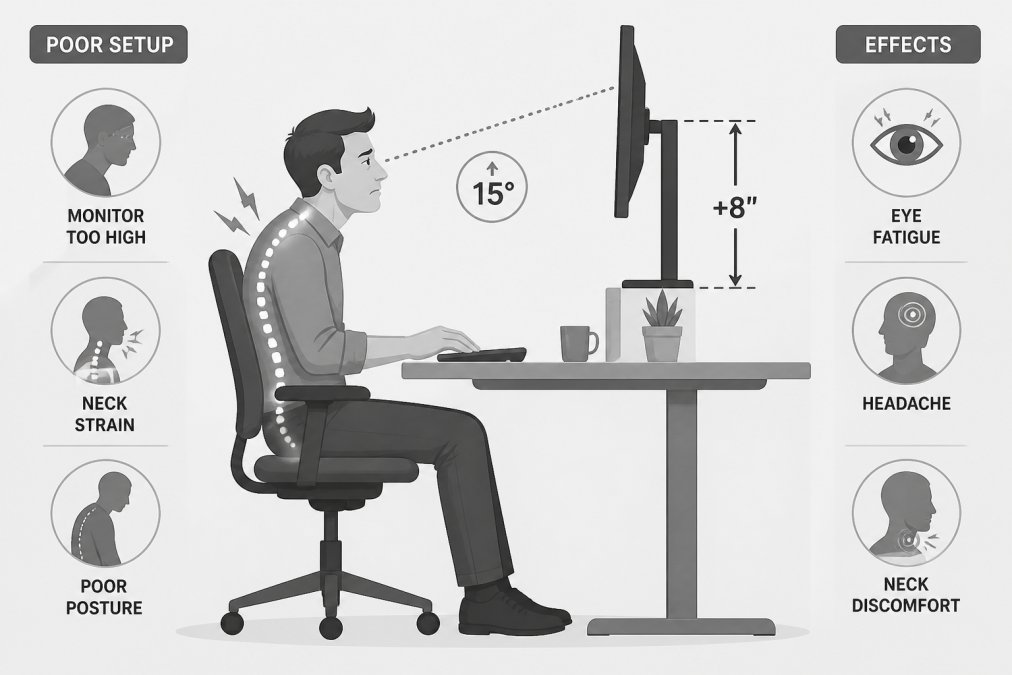
How your workspace is physically arranged directly affects whether your eyes feel tired at the end of the day. Monitor position, viewing distance, and head posture all influence the focusing effort your eyes must expend. When your monitor is positioned too high, you look upward, which causes your eyelids to open wider and increases tear evaporation. When your monitor is too low, you look downward, which can create neck strain that radiates to your eyes.
The viewing distance between your eyes and your screen is critical. The standard recommendation is 20-26 inches, approximately an arm’s length, because this distance represents the optimal balance between screen visibility and focusing effort. Neck and shoulder tension directly influences eye fatigue, muscle tension in your neck radiates to the muscles controlling your eyes, increasing overall muscular fatigue.
How to Relieve Eye Strain During and After Work
Understanding why your eyes feel tired at the end of the day is valuable, but knowing how to prevent and relieve that fatigue is essential. Most end-of-day eye fatigue is preventable through practical strategies you can implement immediately.
The 20-20-20 Rule and Immediate Relief Methods
The 20-20-20 rule is one of the most effective and evidence-based strategies for preventing eye fatigue during screen work. Every 20 minutes, look at something 20 feet away for at least 20 seconds. This practice gives your ciliary muscles a break from accommodation, encourages a more normal blinking rate, and allows your tear film to stabilize.
Beyond the 20-20-20 rule, several immediate relief methods work well. Palming, covering your eyes with your palms without applying pressure and creating total darkness, allows your eyes to relax completely for 2-3 minutes. Warm compresses applied to your eyelids for 5 minutes help relieve fatigue by improving tear film quality and reducing muscle tension. Artificial tears provide temporary relief and are particularly helpful if your fatigue is driven by dryness.
Blue Light Filters and Screen Adjustments
Screen adjustments that reduce fatigue include lowering your screen brightness to match your ambient lighting, increasing text size so you don’t need to lean forward, and adjusting contrast to create clarity without excessive harshness. The color temperature of your screen also matters. Warmer color temperatures (more red, less blue) in the evening reduce the stimulating effect of blue light and support better sleep. Position your screen so the top is at or slightly below eye level, which encourages a natural downward gaze angle and reduces tear evaporation.
Eye Exercises for Tired Eyes and Prevention
Specific eye exercises can strengthen your ciliary muscles and improve your eye’s ability to handle sustained visual demands. Unlike general rest, targeted exercises build resilience and reduce the fatigue you experience.
Practical Exercises to Strengthen Ciliary Muscles
The focusing exercise, also called accommodation training, directly strengthens your ciliary muscles. Hold your finger approximately 4 inches from your face and focus on it clearly. Then shift your focus to an object 20 feet away. Alternate between near and far focus every few seconds for 2-3 minutes.
The eye tracking exercise improves the coordination of your eye muscles. Hold your finger at arm’s length and move it slowly in a large circle while keeping your eyes focused on your finger. Complete 10 circles in each direction. The convergence exercise strengthens the muscles that coordinate your two eyes. Hold your finger at arm’s length and slowly bring it toward your nose while maintaining focus. Stop when you feel strain, then relax. Repeat 10-15 times.
Performing these exercises daily, particularly in the morning before your eyes become fatigued, builds muscular endurance. Many people find that 5-10 minutes of daily eye exercises reduces their end-of-day fatigue by 30-50% within 2-3 weeks.
| Exercise | Duration | Frequency | Best Timing |
|---|---|---|---|
| Focusing (near-far) | 2-3 minutes | Daily | Morning or midday |
| Eye tracking | 2 minutes | Daily | Midday break |
| Convergence | 2 minutes | Daily | Morning |
| Palming | 2-3 minutes | 2-3x daily | When fatigue develops |
Daily Habits That Reduce End-of-Day Fatigue
Take regular visual breaks, beyond the 20-20-20 rule, aim for a 5-10 minute break every hour where you step away from your desk entirely and look at distant objects. Natural light exposure throughout the day supports eye health and reduces fatigue. Sunlight triggers dopamine production in your retina, which strengthens your eyes’ ability to focus.
Adequate hydration supports tear production and overall eye health. Dehydration reduces tear volume, making your eyes more susceptible to dryness and fatigue. Nutrition also plays a role, antioxidants like lutein, zeaxanthin, and anthocyanins support ocular health. Foods rich in these compounds, such as leafy greens, berries, and colorful vegetables, should be part of your regular diet. Omega-3 fatty acids support tear film quality.
Sleep quality directly affects your eyes’ ability to handle visual demands the following day. During sleep, your eyes repair damage from the day’s visual stress and restore tear film reserves. Prioritizing 7-9 hours of quality sleep is one of the most effective fatigue prevention strategies.
When to See an Eye Doctor About Tired Eyes
While most end-of-day eye fatigue is manageable through environmental adjustments and self-care strategies, certain symptoms warrant professional evaluation.
Red Flags and Symptoms Requiring Professional Evaluation
Contact an eye care professional if your eye fatigue is accompanied by vision changes, persistent eye pain, or symptoms that don’t improve with preventive strategies. Sudden onset of severe fatigue that differs from your normal pattern could indicate an underlying condition. If your fatigue is accompanied by headaches that extend beyond your eyes, particularly if they’re one-sided or associated with other neurological symptoms, professional evaluation is warranted.
Persistent redness, discharge, or swelling around your eyes suggests inflammation or infection rather than simple fatigue. If your eyes feel gritty despite using artificial tears, or if you have visible crusting at your eyelash line, these are signs of dry eye disease requiring professional management. Double vision accompanying eye fatigue is a red flag that could indicate eye muscle coordination problems. If one eye feels significantly more tired than the other consistently, this asymmetry warrants professional evaluation.
Refractive Errors and Presbyopia as Hidden Causes
Many cases of end-of-day eye fatigue result from uncorrected or undercorrected refractive errors that people don’t realize they have. A small amount of hyperopia, myopia, or astigmatism might not cause noticeable blurred vision during brief viewing but creates significant ciliary muscle strain during sustained focus.
Presbyopia, the age-related loss of focusing ability that typically begins around age 40, is a common hidden cause of end-of-day eye fatigue in middle-aged and older adults. As your lens loses flexibility with age, your ciliary muscles must work harder to maintain focus at near distances. Astigmatism is particularly prone to causing end-of-day fatigue because it affects focus at all distances. An eye examination that includes refraction testing can identify these hidden refractive errors. If your current glasses or contacts prescription is more than 1-2 years old, a new examination might reveal changes in your refraction that explain your increasing fatigue.
If your eyes feel tired at the end of the day and the strategies above haven’t provided adequate relief, a comprehensive eye examination is your next step. At Clear Vision San Antonio, our eye doctors perform detailed refraction testing and ocular surface evaluation to identify the specific causes of your fatigue. Whether your fatigue results from an uncorrected refractive error, dry eye disease, or environmental factors, we develop personalized treatment plans that address your specific situation. Request an appointment with Clear Vision San Antonio today and discover how specialized eye care can eliminate your end-of-day eye fatigue and help you maintain clear, comfortable vision throughout your day.
Frequently Asked Questions
Is it normal for eyes to feel tired at the end of the day?
Yes, end-of-day eye fatigue is extremely common, especially for people who spend hours on screens or doing focused work. Your ciliary muscles, which control focusing, work continuously throughout the day without rest. This sustained focusing effort, combined with reduced blinking and environmental factors like glare, naturally leads to visual exhaustion. However, if the fatigue is severe, persistent, or accompanied by vision changes, blurred vision, or significant discomfort, consult an eye care professional to rule out underlying conditions like refractive errors or dry eye syndrome.
What are the main symptoms of digital eye strain?
Digital eye strain, also called computer vision syndrome, typically causes blurred vision, dry or irritated eyes, headaches, neck strain, and heavy eyelids by day's end. You may notice difficulty focusing on distant objects after screen time, or experience photophobia (light sensitivity). Symptoms often worsen the longer you work without breaks. The condition develops because screen work reduces your blinking rate by up to 66 percent, disrupting your tear film and leaving the ocular surface exposed. Taking regular screen breaks and practicing the 20-20-20 rule (every 20 minutes, look at something 20 feet away for 20 seconds) helps prevent these symptoms.
Can eye exercises really help with tired eyes?
Yes, targeted eye exercises can reduce end-of-day fatigue by strengthening your ciliary muscles and improving focusing flexibility. Simple exercises like focusing on near and distant objects alternately, gentle eye rotations, and palming (covering eyes with palms to relax them) promote blood circulation and reduce strain. Regular practice improves your eyes' ability to sustain focus without fatigue. However, exercises work best as part of a broader approach that includes proper lighting, ergonomic workspace setup, adequate blinking, and regular breaks. If exercises alone don't resolve persistent tiredness, have an eye care professional evaluate you for refractive errors or dry eye syndrome.
How does dry eye syndrome contribute to tired eyes at the end of the day?
Dry eye syndrome directly causes end-of-day eye fatigue because your tear film becomes progressively thinner and less stable throughout the day. When tear production decreases or tear quality deteriorates, your ocular surface becomes irritated, forcing your eye muscles to work harder to maintain visual acuity. This additional focusing effort leads to asthenopia (eye strain) and the sensation of heavy, tired eyelids. Screen time worsens dry eye by reducing blinking, which normally distributes tears across your eyes. If you experience persistent dry eye symptoms like grittiness, burning, or paradoxical tearing, ask your eye doctor about clinical management options such as artificial tears, punctal plugs, or other specialized treatments.
This article was written using GrandRanker