
Table of Contents
- What Is Dry Eye After Cataract Surgery?
- Why Does Dry Eye Occur After Cataract Surgery?
- Recognizing Dry Eye Symptoms After Cataract Surgery
- 7 Ways to Manage Dry Eyes After Cataract Surgery
- 1. Use Preservative-Free Artificial Tears Regularly
- 2. Apply Warm Compresses to Stimulate Oil Glands
- 3. Practice Eyelid Massage and Blink Exercises
- 4. Take Omega-3 Supplements to Reduce Inflammation
- 5. Use a Humidifier in Your Environment
- 6. Consider Prescription Medicated Eye Drops
- 7. Modify Your Daily Habits and Environment
- Best Eye Drops for Dry Eyes After Cataract Surgery
- How Long Do Dry Eyes Last After Cataract Surgery?
- When to Seek Medical Attention
- Recovery Timeline and What to Expect
Last Updated: July 27, 2026
Dry eyes after cataract surgery are one of the most common complaints patients experience during recovery. Understanding the 7 ways to manage dry eyes after cataract surgery can make a significant difference in comfort and healing. At Clear Vision San Antonio, we’ve seen firsthand how the right management strategies dramatically improve quality of life during the post-operative period.
What Is Dry Eye After Cataract Surgery?
Dry eye after cataract surgery occurs when the eye fails to produce adequate tears or tears evaporate too quickly. The surgical procedure disrupts corneal nerves responsible for stimulating tear production. During surgery, the surgeon creates an incision to access and remove the clouded lens, then implants an intraocular lens (IOL). This manipulation temporarily suppresses the lacrimal gland’s ability to produce tears. The tear film, which consists of three layers, lipid (oil), aqueous (water), and mucin (mucus), becomes destabilized, leaving the cornea vulnerable to dryness.
Most patients experience some degree of dry eye in the weeks and months following surgery. The condition typically improves as corneal nerves regenerate, but without proper management, symptoms can persist and interfere with vision quality and daily activities.
Why Does Dry Eye Occur After Cataract Surgery?
Post-operative dry eye involves multiple factors. The surgical incision damages corneal nerves that normally trigger tear production; these nerves need months to regenerate. Surgery-triggered inflammation temporarily suppresses lacrimal gland function. Additionally, blinking patterns often change after surgery due to discomfort, reducing natural tear spread across the ocular surface.
Certain risk factors increase dry eye likelihood: pre-existing dry eye disease, advanced age, hormonal changes in women, autoimmune conditions like Sjögren’s syndrome, and environmental factors such as low humidity and air conditioning. The surgical technique also matters, phacoemulsification may cause more corneal nerve disruption than small incision cataract surgery (SICS), though both can result in temporary dry eye.
Recognizing Dry Eye Symptoms After Cataract Surgery
Early symptom identification allows prompt intervention. Common symptoms include a gritty, sandy sensation, burning or stinging that worsens throughout the day, and excessive tearing (which paradoxically indicates dry eye as the eye reflexively overproduces tears in response to irritation). Blurry vision frequently accompanies dry eye because an unstable tear film distorts light. Light sensitivity, conjunctival redness, and foreign body sensation are also hallmark symptoms.
Symptoms typically peak within the first two weeks, then gradually improve over subsequent weeks and months.
7 Ways to Manage Dry Eyes After Cataract Surgery
(/how-to-prepare-for-cataract-surgery-consultation/)]
1. Use Preservative-Free Artificial Tears Regularly
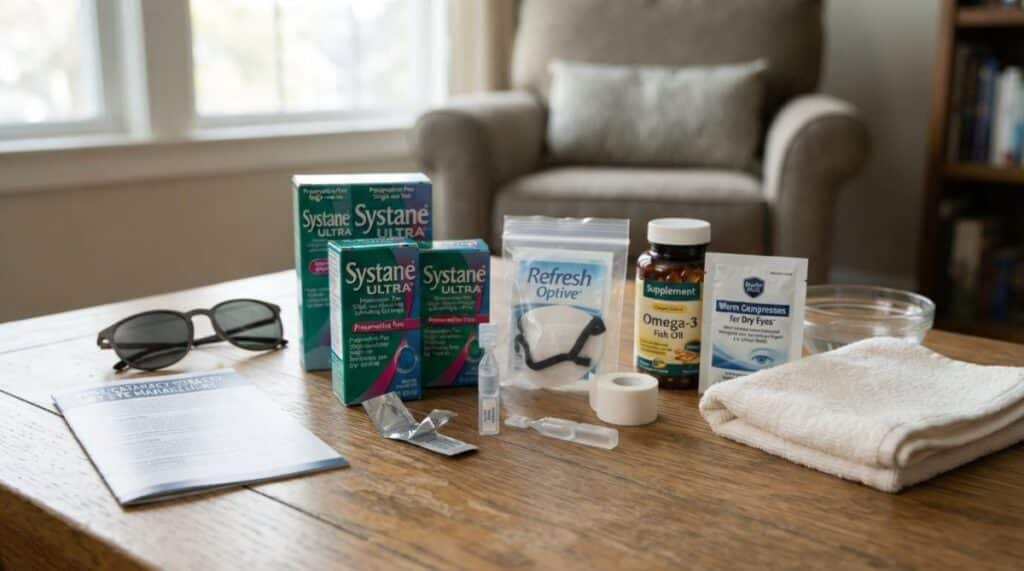
Preservative-free artificial tears are the foundation of dry eye management after cataract surgery. Unlike preserved drops containing antimicrobial agents, preservative-free formulations minimize irritation and allow frequent application without causing additional ocular surface damage.

Apply preservative-free artificial tears every two to three hours during waking hours, or more frequently if symptoms warrant. Single-use vials are preferable to multi-dose bottles because they eliminate contamination risk.
Refresh Optive Mega-3 Lubricant Eye Drops contain flaxseed oil to support the lipid layer of the tear film, addressing all three tear layers for comprehensive relief. Pricing ranges from $17.97 to $23.99 per package.
Apply artificial tears before they’re needed rather than waiting until symptoms become severe. Preventive use maintains tear film stability and prevents the inflammatory cycle from escalating.
2. Apply Warm Compresses to Stimulate Oil Glands
Warm compresses soften lipids produced by meibomian glands in the eyelids. These glands produce the oil layer of the tear film, critical for tear stability and preventing evaporation. When these glands become sluggish after surgery, warm therapy reactivates them and improves oil secretion quality.
Apply a warm compress to closed eyes for eight to ten minutes, one to two times daily at approximately 40°C (104°F). The Bruder Moist Heat Eye Compress features patented MediBeads Technology that absorbs moisture and releases natural, constant moist heat. It heats in 20-30 seconds and costs $15.95 to $28.00.
Never apply heat that’s too intense; excessive temperature can damage delicate eyelid skin and worsen inflammation. The compress should feel warm and soothing, not hot.
3. Practice Eyelid Massage and Blink Exercises
Eyelid massage manually expresses oils from meibomian glands, improving tear film quality and stability. Combined with deliberate blinking exercises, this technique retrains eye muscles and increases tear distribution across the ocular surface.
Perform eyelid massage by gently closing your eyes and using your index finger to massage the upper eyelid in small circular motions along the lid margin, moving from inner to outer corner. Repeat on the lower eyelid for one to two minutes, applying gentle pressure without causing discomfort.
Follow massage with conscious blinking exercises. Blink slowly and deliberately ten times, ensuring your eyelids completely close with each blink. Many post-operative patients unconsciously blink less frequently or incompletely, reducing tear spread. Perform these exercises three to four times daily for best results.
4. Take Omega-3 Supplements to Reduce Inflammation
Omega-3 fatty acids reduce ocular surface inflammation and support healthy tear gland function. These nutrients improve meibomian gland secretion composition, making tears more stable and less prone to evaporation. Research shows patients taking omega-3 supplements experience faster resolution of post-operative dry eye symptoms.
Nordic Naturals Ultimate Omega provides 1280 mg of omega-3s (EPA and DHA) per serving from fresh, wild-caught fish. Pricing ranges from $25.49 to $64.56 depending on package size.
Begin supplementation immediately after surgery and maintain consistent daily intake. Results typically emerge after four to six weeks. Discuss omega-3 supplementation with your eye care provider, particularly if you take blood-thinning medications.
5. Use a Humidifier in Your Environment
Environmental humidity directly impacts tear evaporation rates. Air conditioning, heating systems, and low ambient humidity accelerate tear film breakdown. Adding moisture to your environment reduces evaporative loss and creates conditions favorable for tear stability.
Use a humidifier in spaces where you spend extended time: bedroom during sleep, office during work, and living room during evening hours. Maintain indoor humidity levels between 40-60%, which research suggests is optimal for ocular surface health. Cool mist humidifiers are preferable to warm mist models.
6. Consider Prescription Medicated Eye Drops
When over-the-counter measures prove insufficient, prescription medicated eye drops address the underlying inflammation driving dry eye symptoms.
Xiidra (lifitegrast ophthalmic solution) 5% blocks the LFA-1 protein to prevent T-cell activation and migration, interrupting the inflammatory cycle at its source. Typical dosing is one drop twice daily in each affected eye. Results often emerge within two to four weeks.
Restasis (cyclosporine ophthalmic emulsion) 0.05% reduces inflammation that interferes with natural tear production. This immunomodulator helps the eye’s own lacrimal glands function more effectively. Restasis comes in single-use vials and is typically administered twice daily.
Prescription drops are most effective when combined with artificial tears and environmental modifications. They’re not a standalone solution but rather a crucial addition to a comprehensive management strategy.
7. Modify Your Daily Habits and Environment
Behavioral changes during the post-operative period significantly impact dry eye recovery. Screen time, air exposure, and environmental irritants all accelerate tear evaporation and worsen symptoms.
Reduce screen time during the first few weeks after surgery. When screen work is unavoidable, follow the 20-20-20 rule: every 20 minutes, look at something 20 feet away for 20 seconds. Avoid dusty, smoky, and heavily air-conditioned environments. Wear wraparound sunglasses outdoors to shield eyes from wind and UV exposure. Stay well-hydrated by drinking adequate water throughout the day. Position computer screens slightly below eye level to reduce eyelid opening and tear evaporation.
Best Eye Drops for Dry Eyes After Cataract Surgery
| Product | Type | Key Ingredient | Price Range | Best For |
|---|---|---|---|---|
| Refresh Optive Mega-3 | OTC Artificial Tears | Flaxseed oil, HydroCell Technology | $17.97-$23.99 | Comprehensive tear film support |
| TheraTears Preservative-Free | OTC Artificial Tears | 5 electrolytes (natural tear mimicry) | $11.78-$16.26 | Budget-conscious patients, frequent use |
| Xiidra | Prescription | Lifitegrast (LFA-1 inhibitor) | Varies with insurance | Moderate to severe inflammation |
| Restasis | Prescription | Cyclosporine (immunomodulator) | Varies with insurance | Chronic dry eye, tear production deficit |
Over-the-Counter Options
Over-the-counter artificial tears form the first line of defense against post-operative dry eye. Refresh Optive Mega-3 stands out for its comprehensive approach to tear film restoration. The flaxseed oil addresses the lipid layer deficiency common after cataract surgery, while the aqueous base hydrates the surface. The preservative-free formulation makes it safe for frequent use.
TheraTears offers exceptional value without compromising efficacy. The electrolyte composition more closely mimics natural tears than standard saline-based drops, promoting faster symptom relief.
Prescription Medicated Drops for Persistent Symptoms
Xiidra is typically the first prescription choice for post-operative dry eye because it works relatively quickly and has a well-established safety profile. The LFA-1 inhibition mechanism directly targets the inflammatory cascade.
Restasis is preferred for patients with dry eye driven primarily by tear production insufficiency. While Restasis requires a longer commitment, the long-term benefit for chronic dry eye is well-documented.
How Long Do Dry Eyes Last After Cataract Surgery?
Most patients experience significant improvement in dry eye symptoms within two to four weeks after cataract surgery. By six weeks, many patients report substantial symptom resolution, with blurry vision clearing and discomfort diminishing noticeably.
Complete resolution often takes longer. Corneal nerve regeneration continues for three to six months after surgery. Some patients experience residual dry eye symptoms for up to one year post-operatively, though this is less common in patients without pre-existing dry eye disease.
Patients with pre-operative dry eye disease should expect a longer recovery timeline. Most dry eye symptoms eventually resolve as the ocular surface fully heals and corneal nerve function normalizes.
If dry eye symptoms worsen rather than improve after the first two weeks, contact your eye care provider immediately. Worsening symptoms may indicate complications like corneal abrasion or infection that require prompt medical attention.
When to Seek Medical Attention
Contact your eye care provider immediately if you experience severe pain, sudden vision loss, or signs of infection such as purulent discharge or fever. Seek prompt attention if you develop symptoms of corneal abrasion: severe pain, light sensitivity, and the sensation of something embedded in the eye.
Schedule a follow-up appointment if dry eye symptoms persist beyond six weeks despite consistent use of artificial tears and warm compresses. Your eye care provider can assess tear production using objective tests like the Schirmer test or tear break-up time (TBUT) measurement.
Contact your provider if you develop redness that doesn’t improve with artificial tears, or if you notice changes in vision quality that seem unrelated to normal post-operative healing. Regular follow-up appointments, typically scheduled at one week, one month, three months, and six months post-operatively, allow your eye care provider to monitor healing and adjust management strategies as needed.
Recovery Timeline and What to Expect
The post-operative recovery timeline for dry eye follows a fairly predictable pattern. During the first week after surgery, expect maximum discomfort. The ocular surface is most inflamed, tear production is most suppressed, and the eye is most sensitive to environmental irritants. Artificial tears, warm compresses, and protective measures are essential during this phase.
By the end of week two, most patients notice improvement. Inflammation begins subsiding, tear production starts recovering, and discomfort gradually decreases.
Weeks three through six represent the transition phase. Significant improvement is evident, though complete resolution hasn’t yet occurred. Most patients can resume normal activities.
By six months, most patients have achieved substantial or complete resolution of dry eye symptoms. Those with pre-operative dry eye disease may still require occasional artificial tear use, but acute post-operative symptoms have typically resolved.
Dry eyes after cataract surgery are frustrating, but they’re highly manageable when you implement a comprehensive strategy early. The seven management approaches outlined above address different aspects of the problem and work synergistically to restore ocular surface health. Clear Vision San Antonio specializes in post-operative eye care and provides personalized guidance to help patients navigate recovery with confidence. Our team uses advanced diagnostic testing to assess tear film quality and corneal nerve function, allowing us to tailor management strategies to each patient’s specific needs. If dry eye symptoms are affecting your post-operative recovery, request an appointment to discuss specialized treatment options and get back to clear, comfortable vision faster.
Frequently Asked Questions
Is dry eye normal after cataract surgery?
Yes, dry eye is a common post-operative symptom after cataract surgery. The procedure can temporarily disrupt the corneal nerves and tear film that protect your eye's ocular surface. Most patients experience some degree of dryness during the recovery period, though severity varies. This is a normal part of healing and typically improves over time with proper management and care.
What are the best eye drops for dry eyes after cataract surgery?
Preservative-free artificial tears are ideal for post-surgical dry eyes because preservatives can irritate the sensitive ocular surface. Popular options include Refresh Optive Mega-3 (which addresses all three layers of the tear film) and TheraTears (formulated with electrolytes found in natural tears). For persistent symptoms unresponsive to over-the-counter drops, prescription options like Xiidra and Restasis target underlying inflammation to improve tear production and quality.
How long do dry eyes last after cataract surgery?
Most patients experience significant improvement within the first 3-6 months after cataract surgery. However, some residual dryness may persist for 6-12 months or longer, depending on individual healing rates and pre-existing dry eye conditions. Consistent use of artificial tears, warm compresses, and other management strategies can accelerate recovery. If symptoms persist beyond one year, discuss long-term treatment options with your eye doctor.
Can I use warm compresses for dry eyes after cataract surgery?
Yes, warm compresses are highly effective for post-surgical dry eye. They help loosen and mobilize oils produced by the meibomian glands, improving tear film stability. Devices like the Bruder Moist Heat Eye Compress or OPTASE Moist Heat Mask provide consistent moist heat therapy. Apply for 8-10 minutes daily, typically in the morning or evening, to help relieve burning sensation and gritty feeling associated with post-operative dryness.
What causes dry eyes to worsen after cataract surgery?
Dry eyes worsen after cataract surgery due to temporary disruption of corneal nerves and reduced tear production during the recovery period. Environmental irritants, reduced blink frequency during healing, inflammation of the ocular surface, and pre-existing dry eye conditions can all exacerbate symptoms. Additionally, the surgical incision and manipulation of the eye can affect the tear film's composition and stability. Most cases improve as the cornea heals and tear production normalizes.
This article was written using GrandRanker