
Table of Contents
- Understanding Astigmatism and Cataracts
- How Cataract Surgery for Patients with Astigmatism Works
- Toric IOL for Astigmatism: Your Primary Correction Option
- Limbal Relaxing Incisions for Cataract Surgery
- Cost of Astigmatism Correction During Cataract Surgery
- Recovery After Cataract Surgery with Astigmatism Correction
- Are You a Candidate for Astigmatism Correction?
- Conclusion: Clear Vision at Every Distance
Cataract Surgery for Astigmatism: Complete Guide
Last Updated: July 24, 2026
Astigmatism, a refractive error caused by an irregularly shaped cornea, affects roughly one in three Americans, and many develop cataracts with age. At Clear Vision San Antonio, we’ve helped hundreds of patients combine cataract removal with astigmatism correction in a single procedure. Below, we’ll explain how this works, what your options are, and what to expect before, during, and after surgery.
Understanding Astigmatism and Cataracts
Astigmatism is a refractive error where the cornea or lens has an irregular shape, causing blurred vision at all distances due to uneven light focus on the retina.
Cataracts develop when the eye’s natural lens becomes cloudy over time, typically due to aging, UV exposure, or medical conditions, progressively blocking light and causing blurred, dimmed, or yellowed vision.
The challenge arises when both conditions exist simultaneously. Traditional cataract surgery removes the cloudy lens but doesn’t address astigmatism. Modern techniques allow surgeons to correct astigmatism during cataract surgery itself, offering reduced dependence on glasses after healing.
Many patients assume their blurred vision is purely from cataracts. A comprehensive pre-operative eye exam reveals whether astigmatism is also present, which changes your surgical approach entirely.
How Cataract Surgery for Patients with Astigmatism Works
Modern cataract surgery for astigmatism removes the cloudy lens and replaces it with an intraocular lens (IOL) that corrects both conditions.
The phacoemulsification process
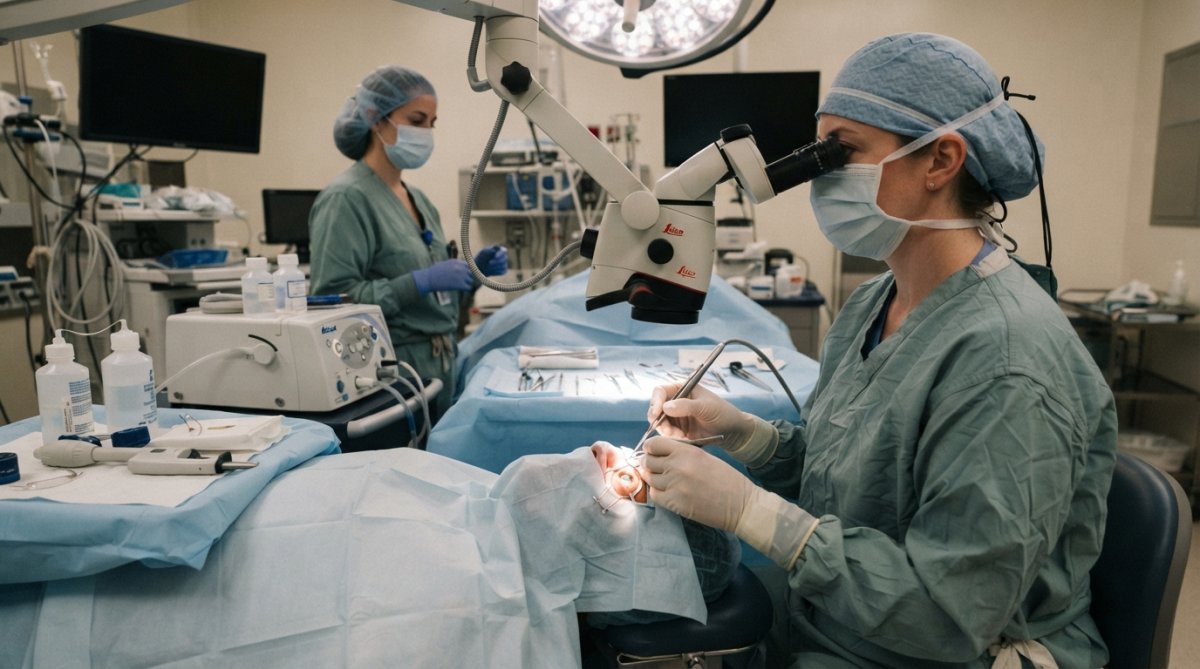
Phacoemulsification is the standard cataract removal technique. The surgeon makes a small incision (typically 2.2-2.8 millimeters) in the cornea and inserts a probe that emits ultrasonic waves to break the cloudy lens into tiny fragments, which are then suctioned out. The incision often requires no stitches and heals within weeks.
For astigmatism, the surgeon may make additional small incisions called limbal relaxing incisions (LRIs) to reshape the cornea, or select a toric IOL designed to correct astigmatism. After lens fragments are removed, the surgeon inserts the new IOL through the same small incision. If a toric IOL is used, precise alignment is critical, even a 10-degree misalignment can significantly reduce astigmatism correction.
Why astigmatism requires specialized correction
Standard (spherical) IOLs correct distance vision but don’t address astigmatism because they have uniform power across all meridians. Astigmatism requires different optical power in different directions, this is where toric IOLs and limbal relaxing incisions come in. Without addressing astigmatism during cataract surgery, patients typically need glasses afterward.
Pre-operative corneal topography maps the cornea’s curvature and reveals the axis and magnitude of astigmatism, guiding the surgeon’s IOL power and implantation axis selection.
The key difference between standard cataract surgery and cataract surgery for astigmatism is the lens choice and surgical technique. Both aim to restore clear vision, but astigmatism correction requires specialized planning and execution.
(/can-i-get-lasik-with-astigmatism/) Works]
Toric IOL for Astigmatism: Your Primary Correction Option
A toric intraocular lens (IOL) is an artificial lens implant designed with different optical powers in different meridians, allowing it to correct both the cataract and astigmatism in a single lens. Toric IOLs have become the gold standard for astigmatism correction during cataract surgery.
How toric intraocular lenses work
Toric IOLs have two different powers: one that corrects distance vision (sphere) and another that corrects astigmatism (cylinder). The lens must be implanted at a specific axis to align with the patient’s corneal astigmatism. The surgeon uses alignment markers visible through the surgical microscope to position the lens correctly.
Modern toric IOLs come in various designs and power combinations. Some are single-focus lenses that optimize distance vision; others are multifocal or extended-range lenses that attempt to provide clear vision at multiple distances. Lens selection involves calculating the IOL power needed using sophisticated formulas that account for corneal curvature, axial length, anterior chamber depth, and other biometric measurements.
Expected visual outcomes with toric IOLs
Approximately 80-90% of patients achieve 20/40 vision or better without glasses after healing, and many achieve 20/20 vision or better. Surgical precision in lens alignment is paramount; even a 5-degree rotation from the intended axis can reduce astigmatism correction by about 10%. Patients with very high astigmatism (greater than 3 diopters) may benefit from combining a toric IOL with limbal relaxing incisions.
If you experience blurred or distorted vision weeks after surgery, don’t assume the procedure failed. Corneal swelling can persist for several weeks, and vision may continue to improve even after the first month. However, if vision doesn’t improve by the 3-month mark, contact your surgeon, as lens rotation or other complications may require evaluation.
Limbal Relaxing Incisions for Cataract Surgery
Limbal relaxing incisions (LRIs) are small surgical incisions made at the limbus (the junction between the cornea and sclera) to reshape the cornea and reduce astigmatism. Unlike toric IOLs, which correct astigmatism optically, LRIs work mechanically by altering corneal shape.
How LRI compares to toric IOL correction
LRIs have been used for decades and remain valid, particularly for mild to moderate astigmatism. The incisions are typically 4-6 millimeters long and placed on the steep axis of the cornea. As they heal, they cause the cornea to flatten slightly along that axis, reducing astigmatism.
The advantage of LRIs is that they’re independent of lens alignment, once healed, their effect is permanent. However, LRIs have limitations. The effect is less predictable than toric IOLs, and the magnitude of correction varies between patients based on healing response. Most surgeons today prefer toric IOLs for mild to moderate astigmatism because they offer more predictable outcomes. For severe astigmatism (greater than 3-4 diopters), some surgeons combine a toric IOL with LRIs to maximize correction.
Cost of Astigmatism Correction During Cataract Surgery
The financial aspect of cataract surgery with astigmatism correction is a legitimate concern for many patients.
Insurance coverage and out-of-pocket considerations
Medicare covers standard cataract surgery and a basic monofocal IOL. If you choose a toric IOL or premium lens designed to reduce dependence on glasses, the additional cost is typically your responsibility. Many insurance plans follow Medicare’s lead, covering basic cataract surgery but not premium lens upgrades.
The out-of-pocket cost depends on several factors: the type of IOL selected, whether LRIs are needed, your insurance plan’s specific coverage policies, and your surgeon’s fees. Some practices offer financing options or payment plans. Discuss pricing transparently with your surgeon’s office before surgery and ask for a detailed breakdown of what’s covered by insurance and what you’ll pay out of pocket.
Request a detailed cost estimate from your surgeon’s office at least two weeks before your scheduled surgery. This gives you time to contact your insurance company, verify coverage, and make an informed decision about lens options.
Recovery After Cataract Surgery with Astigmatism Correction
Recovery from cataract surgery for patients with astigmatism follows a predictable timeline, though individual healing rates vary.
Timeline and visual milestones
Days 1-3: Vision is typically blurry immediately after surgery due to corneal swelling and inflammation. You’ll wear an eye shield to prevent accidental rubbing. Your surgeon will prescribe antibiotic and anti-inflammatory eye drops to prevent infection and reduce swelling.
Week 1: Vision begins to improve as corneal swelling decreases. Many patients notice clearer vision by day 3 or 4, though fluctuations are normal. You can resume light activities like reading and watching television, but avoid strenuous activity, swimming, and dusty environments. Follow-up appointments are typically scheduled for 1 day, 1 week, and 1 month after surgery.
Weeks 2-4: Vision continues to improve, though some haziness may persist. Most patients can return to normal activities, including work and exercise. Avoid heavy lifting or contact sports for at least 4 weeks. Eye drops continue to be essential for managing inflammation and dryness.
Months 1-3: Vision stabilizes during this period. Corneal swelling fully resolves, and the final refractive outcome becomes apparent. Most patients achieve their final visual outcome by the 3-month mark, though subtle improvements can continue for up to 6 months.
Post-operative visual quality expectations
The quality of vision after cataract surgery for patients with astigmatism depends on several factors: the accuracy of pre-operative measurements, surgical precision, the type of IOL used, and individual healing factors. Most patients report that colors appear brighter and more vivid after surgery.
Some patients experience side effects in the immediate post-operative period. Glare or halos around lights, particularly at night, are common and usually diminish over weeks as the cornea fully heals. Dry eye is another common post-operative symptom, particularly in the first few weeks, and typically resolves within 3-6 months with artificial tears or prescription eye drops.
Residual refractive error, meaning you still need glasses for certain tasks after surgery, is possible even with careful planning. If your vision doesn’t meet your expectations by the 3-month mark, your surgeon may discuss options like glasses, contact lenses, or, in some cases, a secondary procedure like LASIK or PRK to fine-tune the result.
Are You a Candidate for Astigmatism Correction?
Not every patient is a candidate for astigmatism correction during cataract surgery, and not every patient wants it.
Candidacy criteria and pre-operative consultation
You’re likely a good candidate for astigmatism correction if you have:
- Clinically significant cataracts affecting your vision and daily function
- Documented astigmatism (typically 0.75 diopters or greater)
- Realistic expectations about post-operative vision
- Healthy eyes otherwise (no advanced macular degeneration, severe glaucoma, or other retinal disease)
- The financial ability or insurance coverage for premium lens options
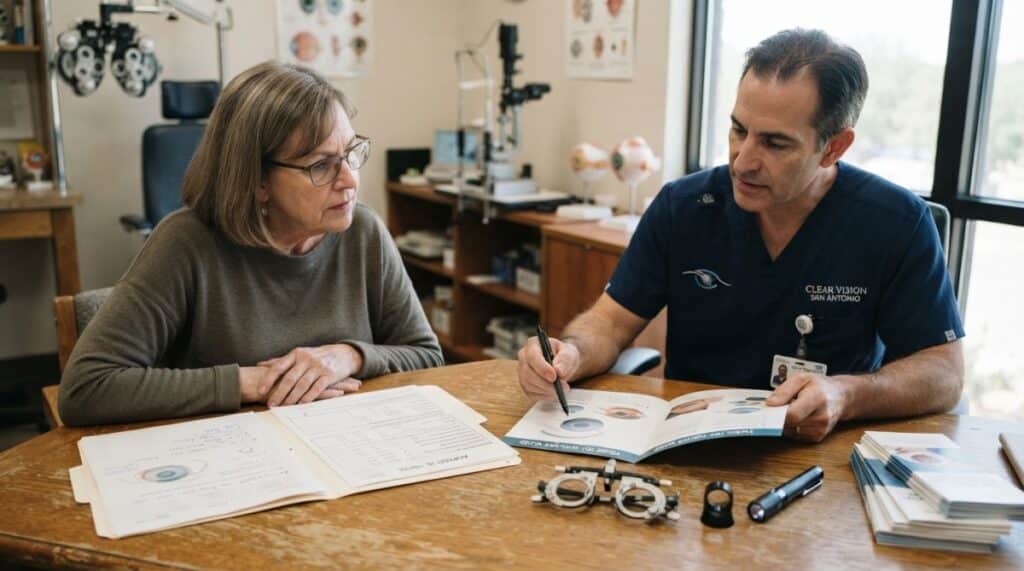
During your pre-operative consultation, your surgeon will perform several tests: visual acuity measurement, slit-lamp examination, dilated retinal examination, corneal topography, optical biometry, and sometimes anterior segment OCT imaging. These tests provide the data needed to calculate IOL power accurately and determine whether astigmatism correction is appropriate for you.
Certain conditions may make you a less-than-ideal candidate. If you have advanced age-related macular degeneration, your potential for visual improvement is limited. If you have severe dry eye disease, your surgeon may recommend treating that first. If you have irregular astigmatism caused by corneal scarring or keratoconus, standard toric IOLs may not be suitable.
Expectations matter significantly. If you hope for perfect vision without any glasses, you may be disappointed. However, if you’re willing to accept some minor visual trade-offs in exchange for reduced dependence on glasses, astigmatism correction during cataract surgery is likely worth pursuing.
Cataract surgery combined with astigmatism correction represents a significant opportunity to improve your vision and quality of life. Clear Vision San Antonio provides comprehensive pre-operative evaluation, advanced surgical techniques including toric IOL implantation, and personalized post-operative care to help you achieve the clearest vision possible. Our experienced ophthalmologists use state-of-the-art diagnostic equipment and surgical technology to ensure precise outcomes tailored to your unique visual needs. Request an appointment with Clear Vision San Antonio today to discuss your options and take the first step toward clear vision at every distance.
Frequently Asked Questions
Can cataract surgery correct astigmatism?
Yes. Cataract surgery can address both the clouded lens and corneal astigmatism simultaneously through specialized techniques. Toric IOLs are specifically designed to correct astigmatism during cataract extraction, while limbal relaxing incisions offer an alternative approach. Your ophthalmologist will determine which method best suits your corneal curvature and refractive error during your pre-operative consultation.
What is a toric IOL and how does it work for astigmatism?
A toric intraocular lens is an implant with different power meridians that corrects corneal astigmatism while replacing your clouded natural lens. Unlike standard IOLs, toric IOLs have an axis orientation that must be precisely aligned during surgery. This specialized lens design allows patients to achieve improved distance vision and reduced dependence on glasses after cataract surgery, addressing the refractive error that standard lenses cannot correct.
What is the recovery time after cataract surgery with astigmatism correction?
Most patients experience improved vision within days, though full visual clarity typically develops over 4-6 weeks as the eye heals. During recovery, avoid strenuous activities, protect your eye from water and dust, and follow your surgeon's post-operative instructions carefully. Your ophthalmologist will schedule follow-up appointments to monitor healing and assess post-operative outcomes, ensuring your toric IOL or limbal relaxing incisions are performing as intended.
How much does astigmatism correction add to cataract surgery costs?
Pricing for astigmatism correction varies based on the technique used, your insurance coverage, and facility fees. Toric IOLs and limbal relaxing incisions are premium options that typically involve additional costs beyond standard cataract surgery. Contact Clear Vision San Antonio for a personalized quote, as insurance may cover portions of the procedure while other aspects remain out-of-pocket. Your ophthalmologist can discuss all financial options during your consultation.
EXTERNAL CITATIONS:
[EXTERNAL_LINK: American Academy of Ophthalmology clinical guidelines on cataract surgery | aao.org]
[EXTERNAL_LINK: Journal of Cataract & Refractive Surgery peer-reviewed research on toric IOL outcomes | jcrsjournal.com]
[EXTERNAL_LINK: FDA guidance on intraocular lens devices and astigmatism correction | fda.gov]
This article was written using GrandRanker