
Table of Contents
- Is Laser Eye Surgery Worth It for Over 50? The Verdict
- Understanding Age-Related Vision Changes and Candidacy
- LASIK Over 50 Risks: What You Need to Know
- Refractive Lens Exchange (RLE) vs LASIK Over 50
- Monovision LASIK Over 50: Solving the Reading Problem
- Cost of Laser Eye Surgery Over 50: Financial ROI Analysis
- Lifestyle-Specific Outcomes: Will It Improve Your Daily Life?
- Making the Right Decision: Is It Worth It for You?
Is Laser Eye Surgery Worth It for Over 50? A Complete Guide
Last Updated: July 16, 2026
When considering whether is laser eye surgery worth it for over 50, the answer depends on your eye health, vision goals, and lifestyle priorities. At Clear Vision San Antonio, we help patients navigate this decision by examining the full picture: not just surgical eligibility, but realistic outcomes, alternatives, and long-term value. This guide breaks down the key factors that determine whether LASIK or other refractive surgery makes sense for you in your 50s and beyond.
Your eyes have changed significantly since your 20s. Presbyopia, the age-related loss of focusing ability, affects nearly everyone over 45, creating complexity that younger patients never face. Add in considerations around dry eye, corneal health, and premium lens-based alternatives, and the "right" choice becomes genuinely personal.
Is Laser Eye Surgery Worth It for Over 50? The Verdict
The honest answer depends on three factors: your eye health must be stable and strong enough to tolerate the procedure; your expectations about reading vision and presbyopia must align with realistic outcomes; and the financial and lifestyle benefits must outweigh ongoing commitments to eye drops and potential enhancements.
For many patients in their 50s, LASIK delivers genuine value. If you’ve spent decades in glasses or contacts, the freedom from corrective lenses often justifies the investment. Active professionals, outdoor enthusiasts, and people tired of contact lens maintenance frequently report high satisfaction.
However, LASIK isn’t universally "worth it" at this age. If you have moderate to advanced dry eye, thin corneas, or early cataracts, lens-based alternatives like Refractive Lens Exchange (RLE) may deliver better outcomes. If your primary vision complaint is presbyopia, monovision LASIK or multifocal IOLs solve the problem more elegantly than standard LASIK alone.
The real question isn’t “Should I have LASIK?” but rather “Which vision correction procedure best solves my specific problem?” Age 50+ opens options that younger patients don’t have, particularly lens-based solutions.
Key Factors That Determine Value
Three concrete factors separate patients who find laser eye surgery genuinely valuable from those who regret it: corneal health stability, realistic expectations about presbyopia, and alignment between your lifestyle and surgical outcomes.
Corneal thickness and stability form the foundation. LASIK requires removing corneal tissue to reshape your eye. If your corneas are thin (below 480 microns), you may not have enough tissue to safely reshape. Your corneal shape must be stable; if you had significant refractive changes in your 40s, wait until those changes plateau.
Presbyopia expectations matter enormously. Standard LASIK corrects distance vision but doesn’t restore the lens flexibility you lost. You’ll still need reading glasses for small print, unless you choose monovision (accepting slightly compromised distance vision in one eye to gain reading ability) or pursue lens-based alternatives. Many patients discover this reality post-operatively and feel disappointed.
Lifestyle-procedure alignment determines daily satisfaction. If you spend most time on screens, monovision might frustrate you more than it helps. If you’re an avid golfer or pilot, perfect distance vision in both eyes becomes critical.
Understanding Age-Related Vision Changes and Candidacy
Your eyes at 50 are fundamentally different from your eyes at 30. Understanding these changes clarifies why candidacy criteria shift with age and why some procedures become options only later in life.
The primary age-related change is presbyopia, the hardening of your eye’s lens that makes focusing on close objects progressively harder. By age 50, nearly 100% of people experience presbyopia. Your lens loses flexibility gradually, starting around age 40, until by 50 you can no longer accommodate at reading distance without optical help.
Candidacy requirements for patients over 50 include:
- Stable refractive error (no significant changes in the past 12 months)
- Healthy corneas with adequate thickness (typically 480+ microns after surgery)
- No advanced cataracts
- Well-controlled dry eye, or willingness to manage it post-operatively
- Realistic expectations about presbyopia and reading vision
- No uncontrolled diabetes or autoimmune conditions affecting healing
Age itself is not a barrier. The American Academy of Ophthalmology does not set an upper age limit for LASIK. What matters is eye health, not the number of years you’ve lived.
The most common reason patients over 50 regret [LASIK is](/is-lasik-surgery-safe-for-me/) unmet expectations about reading vision. If your ophthalmologist hasn’t explicitly discussed how you’ll handle presbyopia, ask directly.
Presbyopia and the Reading Glasses Question
After LASIK, you will likely still need reading glasses for small print, unless you choose monovision or pursue a lens-based alternative.
Standard LASIK corrects your refractive error but cannot restore the lens flexibility that presbyopia steals. Monovision LASIK offers one solution: correct one eye for distance and the other for near vision. Your brain learns to use each eye for its optimized distance. Many patients adapt beautifully; others find it creates subtle visual confusion, particularly for intermediate tasks like computer work.
Bifocals or progressive glasses remain necessary for many patients post-LASIK, even with monovision.
Eye Health Stability as the Primary Factor
Before any laser eye surgery, your eye health must be stable and strong. Stability means your refractive error hasn’t changed significantly in the past year, and your ocular surface can tolerate the procedure and heal properly.
Refractive stability is non-negotiable. If your prescription is still shifting, wait. Your eyes are still changing. At 50+, most patients achieve stability.
Ocular surface health determines healing and long-term comfort. Your tear film becomes thinner and less stable as you age. LASIK temporarily disrupts this layer, creating post-operative dry eye in nearly all patients for the first few months. If you already have moderate to severe dry eye, LASIK can worsen it substantially, sometimes permanently.
Corneal health encompasses thickness, topography, and absence of disease. Keratoconus, corneal scarring, or corneal dystrophies may disqualify you from LASIK.
LASIK Over 50 Risks: What You Need to Know
LASIK is safe and effective, with satisfaction rates above 95% in most studies. But specific risks become more relevant at age 50+.
The most significant risk is dry eye syndrome. LASIK disrupts corneal nerves during flap creation, temporarily reducing tear production and sensation. In younger patients, this usually resolves within 3-6 months. In patients over 50, recovery takes longer, sometimes 6-12 months, and some experience persistent dry eye.
Regression, gradual return of your original refractive error over months or years, occurs in some patients, more commonly in those over 50. Some regression is normal; significant regression requires an enhancement procedure.
Overcorrection or undercorrection happens when the laser reshapes your cornea more or less than intended. If undercorrected, you may still need glasses. If overcorrected, you may become hyperopic and struggle with near vision even more.
Halos and glare, particularly around lights at night, occur in 20-40% of patients in the first few months and usually resolve.
Dry Eye Syndrome and Corneal Considerations
Dry eye becomes increasingly prevalent with age. By 50, many people experience occasional dryness. LASIK exacerbates this by disrupting corneal nerves and temporarily reducing tear production.
Pre-operative dry eye assessment includes tear break-up time, Schirmer test, and corneal staining. If you score in the moderate-to-severe range, your ophthalmologist discusses whether LASIK is appropriate or whether alternatives like RLE might suit you better.
Post-operative dry eye management is essential. Nearly all LASIK patients use artificial tears frequently for the first few months. Many use them long-term. Prescription eye drops reduce inflammation and boost tear production. Most patients adapt and find the dry eye manageable.
Visual Recovery Timeline
LASIK recovery happens in phases.
Immediate recovery (first 24 hours): Your vision is blurry. Most patients achieve 20/40 vision (legally drivable) within 24 hours.
Early recovery (week 1-2): Vision improves rapidly. Most patients reach 20/20 or better by the end of week 1.
Stabilization (month 1-3): Vision continues to stabilize. Dry eye peaks around week 1-2, then gradually improves. Halos and glare, if present, diminish. By month 3, most patients achieve their final refractive outcome.
Plan your LASIK surgery for a time when you can take 3-5 days off work. Vision is blurry for the first 24 hours, and you cannot drive. By day 3-5, most patients return to work.
Refractive Lens Exchange (RLE) vs LASIK Over 50
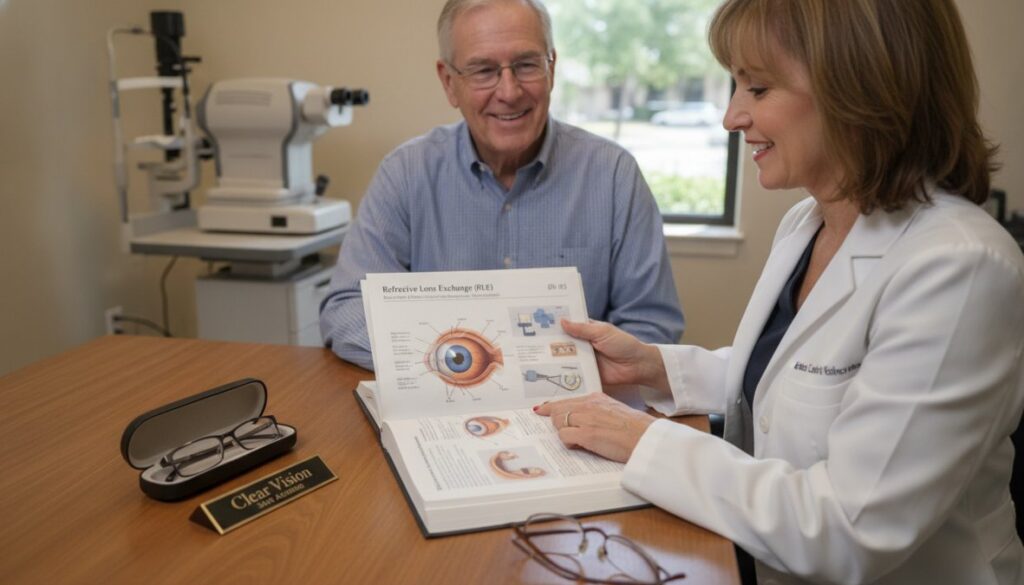
For patients over 50, Refractive Lens Exchange offers a compelling alternative to LASIK, particularly if presbyopia is your primary concern or if you have early cataracts.
RLE replaces your natural lens with a synthetic intraocular lens (IOL). Your surgeon removes your eye’s lens and implants a premium IOL. This single procedure corrects distance vision, astigmatism, and presbyopia simultaneously. It’s the same surgical approach used for cataract surgery.
Why RLE appeals to patients over 50:
- Solves presbyopia directly (unlike LASIK, which cannot restore lens flexibility)
- Corrects distance vision and astigmatism in one procedure
- Premium IOLs provide functional vision at multiple distances
- If you develop cataracts later, you’ve already had lens replacement
- Generally lower dry eye risk than LASIK
- Excellent long-term stability
Why some patients prefer LASIK:
- Preserves your natural lens
- Shorter recovery time (1-2 weeks vs. 4-6 weeks for RLE)
- Lower cost
The financial comparison: Standard LASIK typically costs $2,000-$3,000 per eye. RLE with a standard IOL costs similar amounts. RLE with a premium multifocal IOL costs $3,500-$5,000 per eye, but it solves presbyopia, which standard LASIK does not. If you factor in the cost of reading glasses post-LASIK, the premium IOL option becomes more financially competitive.
When Lens-Based Alternatives Make More Sense
RLE becomes the better choice in specific scenarios: early cataracts, severe presbyopia with minimal distance refractive error, moderate-to-severe dry eye, thin corneas, or high myopia.
SMILE and ICL Options for Older Patients
Two additional procedures deserve mention: SMILE (Small Incision Lenticule Extraction) and ICL (Implantable Collamer Lens).
SMILE corrects myopia and astigmatism without creating a corneal flap. A femtosecond laser creates a thin lens-shaped piece of tissue within your cornea, which your surgeon extracts through a tiny 3-4mm incision. SMILE carries lower dry eye risk than LASIK because it preserves more corneal nerves. However, SMILE does not correct hyperopia or presbyopia.
ICL is a permanent contact lens surgically placed inside your eye, in front of your natural lens. It corrects myopia, hyperopia, and astigmatism without removing or reshaping corneal tissue. ICL is reversible. For patients with thin corneas, high refractive error, or dry eye, ICL is an option. However, ICL does not address presbyopia.
| Procedure | Best For | Presbyopia Solution | Dry Eye Risk | Reversibility |
|---|---|---|---|---|
| LASIK | Distance-dominant patients, healthy corneas | Monovision or reading glasses | Moderate | Not reversible |
| RLE with multifocal IOL | Presbyopia + distance correction, early cataracts | Directly solved | Low | Not reversible |
| SMILE | Myopic patients, dry eye concerns | Monovision or reading glasses | Low | Not reversible |
| ICL | High myopia, thin corneas, dry eye | Reading glasses needed | Very low | Reversible |
Monovision LASIK Over 50: Solving the Reading Problem
If you choose LASIK and want to minimize dependence on reading glasses, monovision is the primary option.
Monovision means correcting one eye for distance and the other for near vision. Your dominant eye is typically corrected for distance (20/20 at far), and your non-dominant eye is corrected for near (20/20 at reading distance, usually around 16 inches). Your brain learns to use each eye for its optimized distance. This process, called neuroadaptation, takes 1-2 weeks for some patients and several months for others.
Who succeeds with monovision: Patients with good neuroplasticity, outdoor-focused lifestyles, and minimal computer work often adapt beautifully. Retired professionals, golfers, hikers, and travelers frequently report high satisfaction.
Who struggles with monovision: Patients who work on screens 8+ hours daily often find monovision frustrating. The intermediate distance (computer screen) falls between your two corrected distances, creating slight blur or eye strain.
Monovision vs. Multifocal IOLs: Which Approach Fits Your Lifestyle
Monovision LASIK and multifocal IOLs both attempt to solve presbyopia, but they work differently.
Monovision LASIK sacrifices some distance acuity in your near eye to gain reading ability. Most people don’t notice this because your dominant eye maintains 20/20 distance vision.
Multifocal IOLs (used in RLE) use optical zones to provide clear vision at multiple distances simultaneously. Advanced multifocal IOLs provide a continuous range of clear vision rather than discrete zones.
The lifestyle question: If you spend most time outdoors or on distance-focused activities, monovision LASIK works well and costs less. If you spend significant time on screens or reading, multifocal IOLs provide better intermediate and near vision.
Multifocal IOLs solve the presbyopia problem more completely than monovision, but they cost more and require lens replacement. Monovision LASIK is a budget-friendly compromise that works well for distance-dominant patients.
Cost of Laser Eye Surgery Over 50: Financial ROI Analysis
Understanding the financial picture helps you evaluate whether is laser eye surgery worth it for over 50 from an economic standpoint.
LASIK costs typically range from $2,000 to $3,000 per eye. Most practices offer financing options (12-24 month payment plans with 0% interest).
RLE costs are similar for standard monofocal IOLs but significantly higher for premium multifocal IOLs ($3,500-$5,000 per eye). Insurance typically does not cover elective RLE for refractive correction alone.
Long-Term Savings vs. Ongoing Glasses and Contacts
Over a 20-year period, LASIK often pays for itself through savings on glasses, contacts, and eye exams.
A typical patient spending $150-$200 annually on glasses spends roughly $3,000-$4,000 over 20 years. Add contact lens costs ($200-$400 annually) and you’re at $4,000-$8,000 over 20 years. Add eye exams and the total reaches $6,000-$12,000 over 20 years.
Against this, LASIK at $4,000-$6,000 for both eyes (including potential enhancement) looks financially attractive. You break even in 10-15 years and enjoy 5-10 years of savings at the end.
Insurance Coverage and Payment Options
Insurance typically does not cover elective refractive surgery because these procedures correct refractive error, not disease. However, there are exceptions.
RLE with cataracts: If you have cataracts, insurance may cover part of the cataract surgery. If you choose a premium IOL, insurance covers the standard monofocal IOL, and you pay the difference.
Workplace vision plans: Some employers offer vision benefits that include discounts on refractive surgery.
Financing options: Most practices offer 0% interest financing for 12-24 months.
Health Savings Accounts (HSAs): If you have an HSA, you can use pre-tax dollars to pay for refractive surgery, effectively reducing your cost by your tax bracket.
Lifestyle-Specific Outcomes: Will It Improve Your Daily Life?
The ultimate "worth it" question is whether LASIK or another procedure genuinely improves your daily quality of life.
Active Professionals and Outdoor Enthusiasts
For active patients, golfers, runners, hikers, travelers, outdoor photographers, LASIK delivers substantial quality-of-life improvement. Imagine playing 18 holes without worrying about glasses slipping. Imagine hiking in rain without water-spotted lenses. Imagine traveling internationally without packing backup glasses and contacts.
Specific scenarios where LASIK excels:
- Golfers: Clear distance vision improves performance and enjoyment.
- Runners/athletes: No glasses slipping, no contact lens drying during exercise.
- Travelers: One less thing to worry about; backup glasses unnecessary.
- Water sports enthusiasts: No concerns about losing glasses in water.
For these patients, LASIK is often worth it, even if you still need reading glasses for fine print.
Psychological Benefits of Vision Independence
Beyond practical benefits, many patients report significant psychological benefits from vision independence. The daily ritual of putting on glasses or inserting contacts suddenly disappears. You wake up and see clearly. Some patients describe it as liberation or reclaiming their face, no longer defined by glasses. These psychological benefits are real and contribute to high satisfaction rates.
Making the Right Decision: Is It Worth It for You?
Determining whether is laser eye surgery worth it for over 50 requires honest self-assessment across multiple dimensions.
Start with eye health. Schedule a comprehensive eye exam with an ophthalmologist experienced in refractive surgery. Ask specifically about your candidacy for LASIK, RLE, SMILE, and ICL. Discuss your corneal thickness, tear production, and any dry eye or early cataracts.
Clarify your vision priorities. What bothers you most about your current vision? Distance blur? Reading difficulty? Dependence on glasses or contacts? Your answer determines which procedure best fits your needs.
Assess your lifestyle realistically. How much time do you spend on screens? How much time outdoors? How much do you read? Your lifestyle determines whether monovision works for you and whether the freedom from glasses is genuinely valuable.
Evaluate your financial situation. Can you afford the upfront cost? Will the long-term savings matter to you? Does your employer offer vision benefits or HSA options that reduce your cost?
Discuss expectations with your surgeon. Your ophthalmologist should explicitly discuss what you’ll see post-operatively, both benefits and limitations. A surgeon who spends time managing expectations is worth the investment.
Consider a trial. Some surgeons offer monovision trials using contact lenses before committing to surgery. This lets you experience monovision for a few weeks and determine whether you adapt well.
Decision Framework and Next Steps
| Factor | LASIK Best | RLE Best | SMILE Best | ICL Best |
|---|---|---|---|---|
| Primary concern | Distance vision | Presbyopia + distance | Dry eye + myopia | Thin corneas + high myopia |
| Corneal thickness | Adequate (480+) | Not relevant | Adequate (470+) | Not relevant |
| Dry eye status | Mild/none | Moderate | Moderate/severe | Moderate/severe |
| Presbyopia solution | Monovision or glasses | Multifocal IOL | Monovision or glasses | Reading glasses needed |
| Cost | Low-moderate | Moderate-high | Moderate | Moderate-high |
| Recovery time | 1-2 weeks | 4-6 weeks | 1-2 weeks | 1-2 weeks |
| Reversibility | No | No | No | Yes |
Next steps:
- Schedule a comprehensive refractive surgery evaluation with an experienced ophthalmologist
- Discuss your lifestyle, vision priorities, and expectations
- Ask about your candidacy for each procedure
- Review financial options
- If considering monovision, request a trial with contact lenses
- Take time to think through the decision
- If you decide to proceed, choose a surgeon with extensive experience in your chosen procedure
At Clear Vision San Antonio, our team specializes in helping patients over 50 navigate this decision. We perform comprehensive evaluations, discuss realistic outcomes, and offer advanced procedures including LASIK, RLE with premium lens implants, and SMILE. We understand that vision correction at 50+ involves unique considerations: presbyopia, dry eye, and early cataracts. If you’re considering laser eye surgery, request an appointment to discuss your options with our experienced team.
The decision about whether is laser eye surgery worth it for over 50 ultimately rests on your individual circumstances: your eye health, vision priorities, lifestyle, and financial situation. For many patients, refractive surgery at 50+ delivers genuine value, freedom from glasses, improved quality of life, and long-term financial savings. For others, alternatives like RLE with multifocal IOLs solve the presbyopia problem more completely. The "worth it" question isn’t about age; it’s about fit. By understanding your options, managing expectations about presbyopia and dry eye, and choosing the right procedure for your specific needs, you can make a decision you won’t regret.
Frequently Asked Questions
Can someone over 50 get laser eye surgery?
Yes, age alone is not a barrier to laser eye surgery over 50. Candidacy depends on eye health stability, corneal thickness, and absence of conditions like cataracts or advanced dry eye. Many patients in their 50s, 60s, and beyond are excellent candidates. An ophthalmologist will evaluate your specific eye health to determine eligibility for LASIK, SMILE, RLE, or other refractive surgery options.
What are the main disadvantages of LASIK over 50?
Key drawbacks include increased dry eye risk, presbyopia (requiring reading glasses despite surgery), longer visual recovery, and potential complications if corneal nerves are affected. Additionally, patients may still need bifocals for near vision unless monovision is selected. Pre-existing conditions like cataracts or thin corneas may disqualify candidates. Discuss these risks with your ophthalmologist to determine if alternatives like RLE are better suited.
Is Refractive Lens Exchange (RLE) better than LASIK for over 50?
RLE may be preferable if you have presbyopia, early cataracts, or thin corneas. It corrects distance and near vision simultaneously using multifocal intraocular lenses and addresses age-related changes comprehensively. LASIK is less invasive with faster recovery but doesn't solve presbyopia without monovision trade-offs. The best choice depends on your corneal health, visual needs, and lifestyle. Your ophthalmologist can recommend the optimal refractive surgery for your situation.
Will I need reading glasses after laser eye surgery over 50?
Most patients over 50 will need reading glasses after LASIK unless monovision is chosen, which corrects one eye for distance and one for near vision. This creates a compromise in intermediate vision. Alternatively, Refractive Lens Exchange with multifocal IOLs can reduce or eliminate reading glasses dependency. Discuss your visual priorities with your eye doctor to select the approach that best matches your lifestyle and professional demands.
How much does laser eye surgery cost for someone over 50?
Pricing varies based on the procedure type, your eye health, and the technology used. For current pricing and personalized quotes, contact Clear Vision San Antonio directly. Costs typically depend on whether you choose LASIK, SMILE, RLE, or ICL, as well as any additional diagnostics or enhancements needed. Many practices offer financing options. Insurance rarely covers elective refractive surgery, but some employers offer vision benefits that may help offset costs.
This article was written using GrandRanker