

Table of Contents
- Is LASIK Worth the Cost? Breaking Down the Real Numbers
- LASIK vs Contacts Cost Comparison: Which Costs More Over Time?
- Age-Specific ROI: Is LASIK Worth the Cost at Every Stage of Life?
- Pros and Cons of LASIK Surgery: An Honest Assessment
- Risks, Complications, and the Hidden Costs They Can Create
- Is LASIK Covered by Insurance or Other Benefit Plans?
- LASIK Financing Options: Making the Procedure Accessible
- LASIK Recovery Time, Post-Op Care, and What to Expect
Last Updated: June 16, 2026
Deciding whether is lasik worth the cost is one of the most financially significant healthcare questions you can ask yourself. At Clear Vision San Antonio, we’ve guided thousands of patients through this exact calculation, and the answer is almost never simple. Laser-assisted in situ keratomileusis (LASIK) reshapes the cornea to correct nearsightedness, farsightedness, and astigmatism, reducing or eliminating dependence on corrective lenses. Below, we’ll break down the real numbers, the age-specific math, the risks most people underestimate, and the financing tools that make the decision more accessible than most people expect.
Here’s what most guides get wrong: they frame this as a pure cost comparison. The real question is whether the procedure matches your lifestyle, your prescription stability, and your long-term vision goals.
Is LASIK Worth the Cost? Breaking Down the Real Numbers
LASIK is an elective procedure, which means the full out-of-pocket expense lands on you. Understanding what drives that number is the first step toward an honest cost-benefit analysis.
Average Cost of LASIK Per Eye in 2026
The average cost of LASIK surgery ranges from around $2,000 to $3,000 per eye, depending on technology, surgeon experience, and location. Custom wavefront-guided and bladeless procedures sit at the higher end. Budget-advertised prices below $500 per eye almost always exclude pre-operative evaluation, post-operative care, and enhancements, so the sticker price rarely reflects the true out-of-pocket expense.
Beware of “discount LASIK” advertising. Prices significantly below the market average often exclude follow-up visits and enhancement procedures, which can add hundreds of dollars to the total cost if your vision regresses.
What Drives the Price: Technology, Surgeon Experience, and Location
Three variables move the price most dramatically. Technology: bladeless LASIK using a femtosecond laser costs more than microkeratome-based procedures but is widely considered the safer standard. Surgeon experience: a board-certified ophthalmologist with a high-volume practice typically charges more, with the premium usually justified by lower complication rates. Location: urban markets like San Antonio tend to have competitive pricing, though facility overhead can also push prices up. Alternatives like SMILE, PRK, and ICL carry different price points and candidacy requirements, which matters if LASIK isn’t the right fit for your corneal thickness or prescription range.
LASIK vs Contacts Cost Comparison: Which Costs More Over Time?
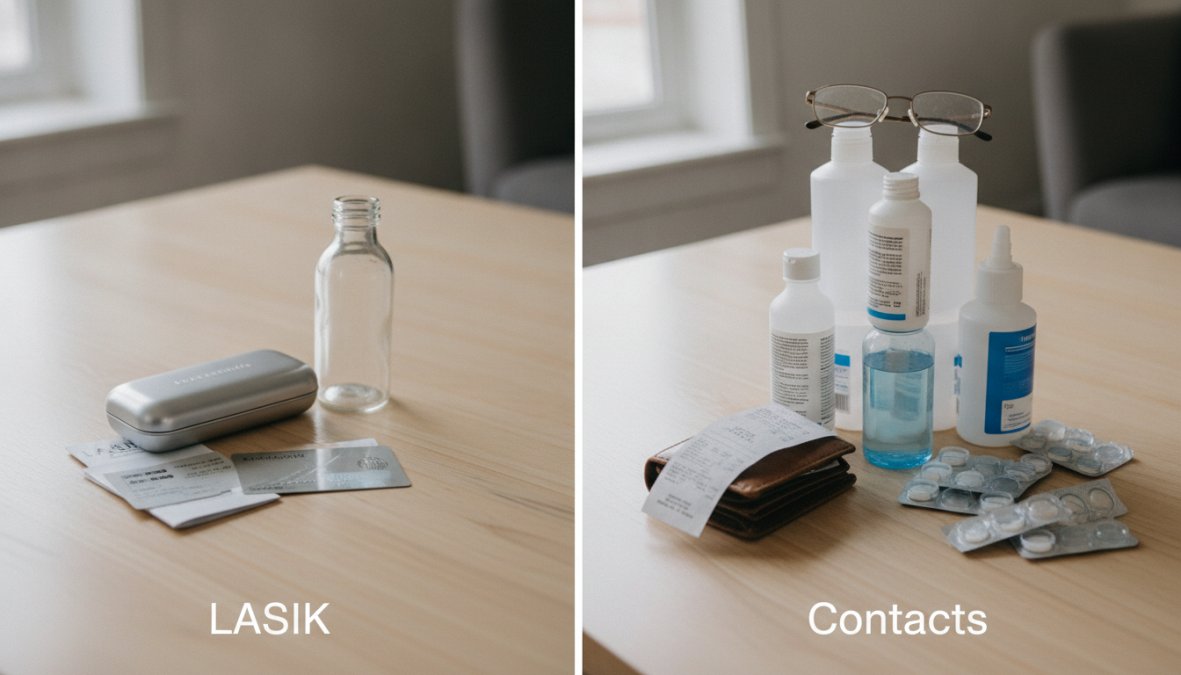
The long-term cost comparison consistently favors LASIK for daily contact lens wearers. A typical contact lens wearer spends on lenses, solution, cases, and annual exams; glasses wearers add frame replacements and prescription updates. Cumulative corrective lens costs over a decade often exceed the one-time cost of LASIK. According to the American Academy of Ophthalmology’s patient education resources, many patients recoup the cost of LASIK within five to seven years compared to ongoing contact lens expenses.
The Hidden Costs of Corrective Lenses Most People Overlook
The obvious costs are lenses and solution. The hidden costs tip the calculation:
- Replacement glasses after breakage or loss (often not fully covered by vision insurance)
- Daily disposable lenses for travel or sports, purchased on top of a regular supply
- Prescription sunglasses, which can cost as much as standard frames
- Dry eye treatments triggered by extended contact lens wear
- Lost productivity from lens-related eye infections or irritation
A patient who has worn contacts since age 18 and reaches age 35 without LASIK has likely spent a meaningful sum on vision correction, and the spending continues indefinitely.
Age-Specific ROI: Is LASIK Worth the Cost at Every Stage of Life?
The return on investment from LASIK is not uniform across a lifetime. Age at surgery dramatically affects how much value you extract from the procedure.
Your 20s and 30s: Maximum Long-Term Savings Window
Patients who undergo LASIK in their 20s or early 30s see the strongest financial return, more years of lens-free vision means more years of avoided corrective lens costs. A 25-year-old with a stable prescription has potentially 40 or more years of improved visual acuity before presbyopia requires additional correction. The key requirement is prescription stability: most ophthalmologists want no meaningful change for at least one to two years before performing refractive surgery.
Is LASIK Worth It After 40? What Changes and What Doesn’t
The calculus shifts after 40 for one specific reason: presbyopia. This age-related near-vision change is not corrected by standard LASIK, so patients over 40 who have LASIK for distance will likely still need reading glasses. LASIK remains highly effective for distance correction in this age group, and many patients find the trade-off worthwhile. For patients over 50, refractive lens exchange or advanced lens implants may offer a more comprehensive solution addressing both distance and near vision simultaneously.
If you’re over 40 and considering LASIK, ask your ophthalmologist specifically about monovision LASIK, which corrects one eye for distance and one for near. Many patients adapt well to this approach and reduce their dependence on reading glasses significantly.
Pros and Cons of LASIK Surgery: An Honest Assessment
LASIK has a strong safety profile and high patient satisfaction rates, but it is not without real trade-offs.
Pros:
- Rapid visual improvement: most patients notice significantly better vision within 24 hours
- Long-term freedom from corrective lenses for the majority of candidates
- High success rate for achieving 20/40 vision or better, with many patients reaching 20/20
- Eliminates ongoing contact lens expenses and associated dry eye risk from lens wear
- Short recovery timeline compared to other surgical procedures
Cons:
- Not every patient is a candidate; thin corneas, severe astigmatism, or unstable prescriptions may disqualify you
- Dry eyes are a common post-operative side effect, sometimes lasting months
- Night vision disturbances, including halo effect and glare, affect a subset of patients
- The corneal flap is a permanent structural change
- Presbyopia will still develop with age, requiring reading glasses even after successful LASIK
For well-selected candidates, LASIK delivers on its promise. For borderline candidates, alternatives like PRK or ICL deserve serious consideration.
Risks, Complications, and the Hidden Costs They Can Create
Surgical risks are real, and so are their financial consequences. The most commonly reported complications include persistent dry eyes, undercorrection or overcorrection requiring an enhancement, regression over time, and in rare cases, corneal flap issues or ectasia. Enhancement procedures are not always included in the original surgical fee. Treating chronic dry eyes with prescription drops or punctal plugs adds ongoing expense. Patients who develop significant night vision issues may find the quality-of-life impact outweighs the financial savings from eliminating corrective lenses.
According to the U.S. Food and Drug Administration’s LASIK patient information, patients should have a thorough pre-operative evaluation to identify risk factors before proceeding. Corneal thickness, pupil size in low light, and pre-existing dry eyes all influence both candidacy and complication risk.
Are You a Good Candidate for LASIK? Key Factors to Evaluate
A good candidate typically meets these criteria:
- Stable prescription for at least one to two years
- Adequate corneal thickness for safe flap creation and tissue removal
- No significant dry eye condition prior to surgery
- Pupil size within normal parameters for low-light environments
- No autoimmune conditions or other health factors that impair healing
- Realistic expectations, including the possibility of needing reading glasses after 40
Patients outside these parameters are not out of options. PRK avoids the corneal flap entirely, making it suitable for thinner corneas. ICL is an additive procedure that doesn’t remove corneal tissue, making it viable for high prescriptions or thin corneas that disqualify patients from LASIK.
Is LASIK Covered by Insurance or Other Benefit Plans?
LASIK is classified as elective by most health insurers, so standard health insurance does not cover it. Vision insurance plans occasionally offer a network discount, but the out-of-pocket expense remains substantial. The more useful question is how to use tax-advantaged accounts to reduce the effective cost.
Using an FSA or HSA to Offset Out-of-Pocket Expenses
Both flexible spending accounts (FSA) and health savings accounts (HSA) can pay for LASIK with pre-tax dollars. In a 25% effective tax bracket, this reduces the real cost by 25%, a meaningful advantage. HSA funds roll over year to year, while FSA funds typically have a use-it-or-lose-it deadline, so planning your procedure around your FSA contribution cycle maximizes the benefit. Some employers also offer negotiated LASIK discounts through specific providers, making it worth checking your benefits package before scheduling a consultation.
Paying for LASIK through an HSA or FSA is one of the most straightforward ways to reduce the real cost of the procedure. For many patients, this alone reduces the effective price by hundreds of dollars.
LASIK Financing Options: Making the Procedure Accessible
Most LASIK providers offer financing plans spread over 12 to 24 months, often with promotional interest-free periods. CareCredit and Alphaeon Credit are two commonly used healthcare financing platforms that many ophthalmology practices accept. A few practical notes:
- Deferred-interest promotions are not the same as zero-interest, carrying a balance past the promotional period triggers retroactive interest charges.
- Monthly payments on a 24-month plan for a $4,000 procedure typically fall in a manageable range for most working adults.
- Some practices offer in-house payment plans with more flexible terms than third-party financing.
The financing decision should be made alongside, not instead of, the candidacy evaluation. According to the Consumer Financial Protection Bureau’s guidance on medical financing, patients should read the full terms of any deferred-interest medical financing agreement carefully before signing.
LASIK Recovery Time, Post-Op Care, and What to Expect
LASIK recovery is faster than most patients expect. The majority notice dramatically improved vision within 24 hours and return to desk work within one to two days, though strenuous activity, swimming, and eye rubbing are restricted for several weeks.

Post-operative care typically includes:
- Prescription antibiotic and anti-inflammatory eye drops for the first week
- Lubricating eye drops to manage dry eyes, often continued for several months
- Protective eye shields worn during sleep for the first few nights to prevent accidental rubbing
- Follow-up appointments at 24-48 hours, one week, one month, and three months post-surgery
- Avoiding makeup, dusty environments, and contact sports during the initial healing phase
The recovery timeline for PRK is notably longer, initial vision may be blurry for several days to a week, with full stabilization taking several weeks, a legitimate factor when comparing the two procedures for patients who cannot afford extended downtime.
The Psychological Impact of Vision Freedom After LASIK
This is the angle most cost-benefit analyses miss. The financial ROI of LASIK is calculable; the psychological ROI is harder to quantify but consistently reported as transformative. Many patients describe waking up and seeing clearly without reaching for glasses, swimming or traveling without the logistical burden of corrective lenses, and reduced anxiety about losing or damaging glasses in critical moments. For patients who have worn corrective lenses since childhood, unaided vision often carries genuine emotional weight.
This matters in the cost analysis because it reframes the question. Is LASIK worth the cost is not purely financial, it is a quality-of-life question. The financial math may break even at year five or six. The daily experience of vision freedom starts on day two.
| Factor | LASIK | Contacts (Annual) | Glasses (Annual) |
|---|---|---|---|
| Upfront Cost | One-time fee | Low | Low-Medium |
| 10-Year Total | One-time fee | Substantial ongoing | Moderate ongoing |
| Dry Eye Risk | Post-op period | Ongoing with wear | Minimal |
| Night Vision | Possible halo/glare | Normal | Normal |
| Lifestyle Freedom | High | Moderate | Moderate |
| Candidacy Required | Yes | No | No |
Choosing to undergo LASIK combines financial planning, medical candidacy, and personal lifestyle priorities. Clear Vision San Antonio offers comprehensive pre-operative evaluations using advanced diagnostic technology to determine whether LASIK, ICL, or another vision correction approach is the right fit for your specific needs. Our team of expert ophthalmologists provides personalized attention at every stage, from initial consultation through post-operative care. Request an appointment with Clear Vision San Antonio and take the first step toward clear vision for life.
Frequently Asked Questions
How much does LASIK cost on average per eye?
LASIK costs typically range from around $1,500 to $3,000 per eye, depending on the technology used, the surgeon's experience, and your geographic location. Advanced procedures like custom wavefront or bladeless LASIK generally sit at the higher end of that range. While the upfront out-of-pocket expense feels significant, comparing it against years of spending on corrective lenses often reveals that LASIK can pay for itself within a few years for many patients.
Does insurance cover LASIK eye surgery?
Most standard vision insurance plans classify LASIK as an elective procedure and do not cover it. However, some employer-sponsored plans offer partial discounts through vision benefit networks. The most practical ways to reduce your out-of-pocket expense are a flexible spending account (FSA) or health savings account (HSA), both of which allow you to use pre-tax dollars toward refractive surgery costs. Always verify your specific plan details with your provider before scheduling.
Are there hidden costs associated with LASIK surgery?
Yes. Beyond the quoted procedure price, potential hidden costs include pre-operative exams, post-operative care visits, prescription eye drops, and, in rare cases, enhancement procedures if your vision correction needs a touch-up. If complications like persistent dry eyes or night vision disturbances occur, additional treatment costs can add up. Choosing a provider that bundles post-op care into the original fee and offers a lifetime enhancement guarantee can help protect you from unexpected expenses down the line.
Is LASIK worth it after age 40?
LASIK can still deliver excellent visual acuity results for patients over 40, but the age-specific ROI calculation changes. Presbyopia, the natural loss of near-focus ability, typically begins around this age, meaning LASIK corrects distance vision but may not eliminate the need for reading glasses. Alternatives like monovision LASIK, ICL, or advanced lens implants may offer a more complete solution. A thorough candidacy evaluation with an ophthalmologist, including corneal thickness and prescription stability checks, is essential before deciding.
What is the typical LASIK recovery time?
Most patients notice significantly improved vision within 24 to 48 hours after the procedure. Full stabilization of visual acuity generally takes one to three months. During the recovery timeline, you'll use prescribed eye drops to prevent infection and manage dry eyes, avoid rubbing your eyes, and attend follow-up visits. Strenuous activity and swimming are usually restricted for a few weeks. Most people return to work within one to two days, making the recovery timeline far less disruptive than many expect.
What LASIK financing options are available if I can't pay upfront?
Many LASIK providers, including specialized ophthalmology practices, offer in-house financing plans or partner with third-party medical lenders. Common options include zero-interest promotional periods ranging from 12 to 24 months, extended monthly payment plans, and FSA or HSA payment acceptance. Some practices also offer price-matching or package pricing that bundles both eyes with post-operative care. Comparing financing terms carefully, particularly the interest rate after any promotional period ends, helps you find the most cost-effective path to vision correction.
This article was written using GrandRanker