
Table of Contents
- Understanding the Causes of Night Driving Glare
- Oncoming Headlights and Light Intensity
- Astigmatism and Night Driving Symptoms
- Cataracts and Age-Related Vision Changes
- Environmental and Vehicle Factors
- How to Reduce Night Driving Glare
- When to See an Eye Doctor for Night Vision Problems
- Conclusion
Last Updated: June 19, 2026
Night driving is one of the most demanding visual tasks most people perform daily. The causes of night driving glare are more varied than most drivers realize, pointing to a mix of optical, physiological, and environmental factors working against you simultaneously. What most guides get wrong is treating night driving glare as a single problem with a single fix. It’s a cascade of compounding issues, and addressing only one while ignoring the others produces minimal improvement.
Understanding the Causes of Night Driving Glare
Night driving glare is the visual discomfort and reduced contrast sensitivity that occurs when bright light sources overwhelm the eye’s ability to adapt in low-light conditions. The causes fall into two broad categories: physiological factors (what’s happening inside your eyes) and environmental factors (what’s happening around your vehicle).
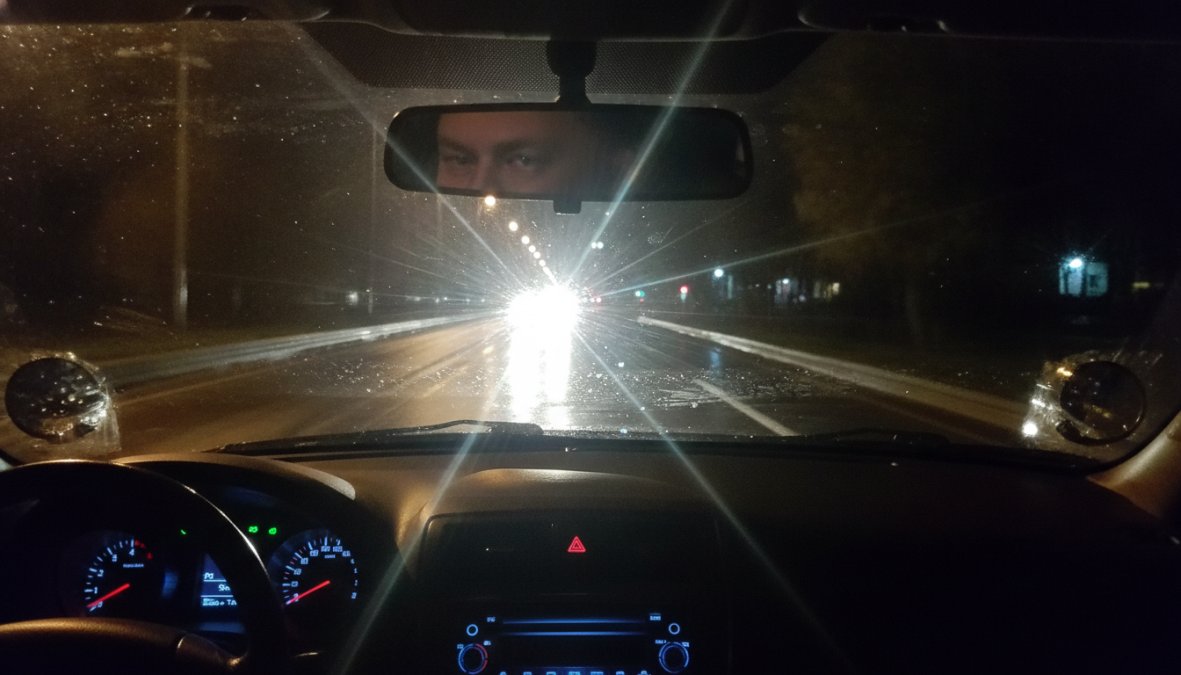
How light scattering affects your vision
Light scattering is the core mechanism behind most glare complaints. When light enters the eye, any irregularity in the cornea, lens, or vitreous fluid causes light rays to scatter across a wider area of the retina instead of converging at a single point. The result is a washed-out, hazy image with reduced contrast. The retina’s rod cells, responsible for low-light vision, are easily overwhelmed by scattered light and take time to recover, which is why a brief flash from oncoming traffic can leave you temporarily blinded for several seconds.
The role of pupil dilation at night
At night, the pupil expands significantly to allow more light into the eye. This helps with seeing in dim conditions but comes with a trade-off: a larger pupil exposes more of the peripheral cornea and lens to incoming light. The peripheral areas of these structures are optically less precise than the central zones, meaning more opportunity for aberrations and scattered light hitting the retina. Drivers with even minor refractive errors notice this effect dramatically at night.
If your night vision seems [dramatically worse than your daytime vision](/best-vision-correction-for-over-50/), even with corrective lenses, ask your optometrist to measure your higher-order aberrations. Standard prescriptions address sphere and cylinder, but not the subtler distortions that pupil dilation exposes.
Oncoming Headlights and Light Intensity
The most immediate trigger for night driving discomfort is oncoming headlights, and the problem has grown considerably worse as vehicle lighting technology has changed.
Why modern LED and HID headlights create more glare
Traditional halogen headlights emit warm, yellowish light at relatively low intensity. LED and HID headlights, now standard on most new vehicles, emit much cooler, blue-shifted light at significantly higher luminous intensity. The human eye is more sensitive to blue light under low-light conditions, making these lights feel disproportionately bright. According to the Insurance Institute for Highway Safety’s headlight research, headlight quality varies enormously across vehicle models, and many factory-installed systems produce excessive glare for oncoming drivers even when aimed correctly. The blue light component also scatters more readily within the eye than longer-wavelength light.
Halos and starbursts from oncoming traffic
Halos are rings of light surrounding bright sources, while starbursts are radial spikes extending outward from a light point. Both are caused by light scattering within the eye’s optical system. Drivers with astigmatism typically report starbursts; those with early cataracts or significant higher-order aberrations tend to report halos. These visual artifacts reduce contrast between a light source and the surrounding scene, making it harder to judge distance and position of oncoming vehicles.
Astigmatism and Night Driving Symptoms
Astigmatism is one of the most common and most underdiagnosed causes of night driving glare. Many drivers live with mild astigmatism for years without knowing it because their daytime vision remains acceptable.
How corneal irregularities scatter light
Astigmatism is a refractive error caused by irregular curvature of the cornea or lens, resulting in light focusing at multiple points rather than a single point on the retina. A normal cornea is spherical; an astigmatic cornea is shaped more like a football, with different curvatures along different axes. At night, when the pupil dilates, a larger portion of the cornea’s irregular surface is exposed to incoming light, resulting in pronounced light scattering that manifests as starbursts around headlights. According to the American Academy of Ophthalmology’s patient education resources, astigmatism affects a significant portion of the adult population, and many cases are mild enough to go uncorrected while still causing meaningful night vision impairment.
Refractive error and reduced contrast sensitivity
Contrast sensitivity is the ability to distinguish between an object and its background when the difference in brightness is subtle. It’s a different measurement from visual acuity and matters most for safe night driving. Uncorrected or undercorrected refractive errors, including myopia, hyperopia, and astigmatism, all reduce contrast sensitivity. A driver who reads the 20/20 line on an eye chart in daylight may struggle to detect a pedestrian in dark clothing at the edge of their headlight beam. Night myopia, a shift in the eye’s focal point in low light, means a daytime prescription may be slightly underpowered for night driving.
Do not assume your current prescription is adequate for night driving just because your daytime vision feels sharp. Night myopia and pupil-dependent aberrations require specific testing. An outdated or marginally underpowered prescription is one of the most common correctable causes of night driving glare.
Cataracts and Age-Related Vision Changes
Cataracts are the leading age-related cause of severe night vision impairment and develop gradually enough that many drivers don’t notice the progression until it’s significant.
Light scattering through clouded lenses
Cataracts are a clouding of the eye’s natural crystalline lens caused by the gradual denaturation of lens proteins over time. As the lens loses clarity, it becomes an increasingly effective scatterer of light. When light passes through a clouded lens, it diffracts in multiple directions before reaching the retina, producing halos around lights, washed-out contrast, and a general sense that everything looks dimmer. Cataracts affect the eye’s ability to manage glare from high-intensity sources like headlights far more severely than they affect daytime vision. A driver with moderate cataracts may feel comfortable driving in daylight but become unsafe at night. Cataract surgery, which replaces the clouded lens with a clear artificial intraocular lens, typically produces dramatic improvements in night vision and glare tolerance.
Environmental and Vehicle Factors
Environmental and vehicle factors contribute meaningfully to night driving glare and are often the easiest to fix.
Dirty windshields and worn wiper blades
A dirty windshield is a glare amplifier. Every smear, film, and streak acts as a scattering medium for oncoming headlights, turning a single bright source into a diffuse wash of light across your visual field. The most problematic films are thin, oily residues left by exhaust and interior off-gassing, nearly invisible in daylight but highly apparent at night. Worn wiper blades smear rather than clear these films. Replacing wiper blades every six to twelve months and cleaning the inside of the windshield with a microfiber cloth and glass cleaner is one of the highest-return-on-investment improvements a driver can make for night vision.
Dashboard reflections and interior lighting
Interior light sources reflect off the windshield and create visual noise. A brightly lit dashboard, phone screen at eye level, or dome lights create reflections that overlap with the external scene. Reducing dashboard brightness to the minimum comfortable level at night meaningfully reduces visual clutter competing with the road ahead.
How to Reduce Night Driving Glare
Many causes of night driving glare respond well to targeted interventions. Addressing them systematically produces the best results.
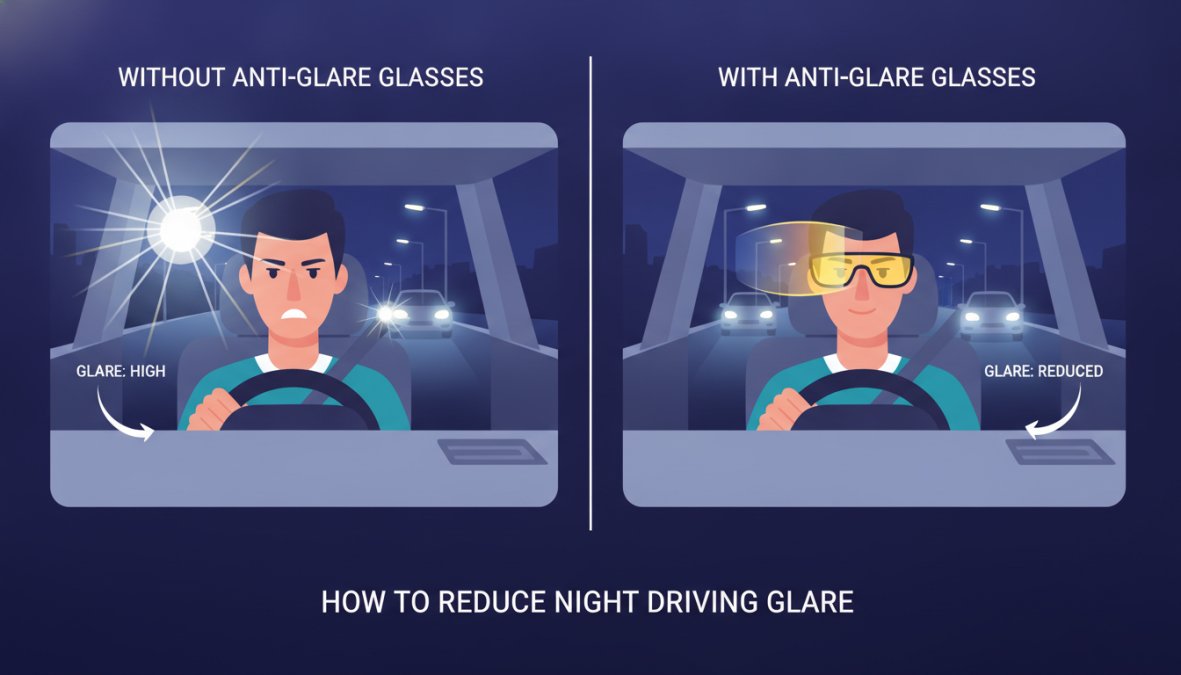
Best glasses for night driving with anti-reflective coatings
Anti-reflective (AR) coating is the single most impactful optical intervention for night driving glare. Standard uncoated lenses reflect a portion of incoming light back toward the driver’s eyes, adding to the total glare load. An AR-coated lens eliminates most of this internal reflection, allowing more light to pass through cleanly. For drivers with astigmatism or other refractive errors, ensuring the prescription is current and optimized for night conditions is equally important. A common mistake is purchasing over-the-counter yellow-tinted "night driving glasses." These lenses reduce total light transmission, which is counterproductive in already-dark conditions, and do not address underlying scattering mechanisms.
| Lens Option | Glare Reduction | Light Transmission | Best For |
|---|---|---|---|
| AR-coated prescription lenses | High | Maximized | Most drivers |
| Yellow-tinted OTC lenses | Low | Reduced | Not recommended |
| Polarized lenses | Moderate | Reduced | Daytime/water glare |
| Standard uncoated lenses | None | Standard | Baseline reference |
Vehicle-specific technology and headlight adjustment
Modern vehicles offer several technology-based tools for managing glare. Auto-dimming rearview mirrors use electrochromic technology to automatically reduce the intensity of headlights from vehicles behind you. Misaligned headlights on your own vehicle are another overlooked factor. Headlights aimed too high direct light into the eyes of oncoming drivers and reflect back into your field of view from road signs and overhead surfaces. Most vehicle manufacturers recommend checking headlight alignment annually, particularly after any front-end impact or suspension work.
Practical driving techniques to minimize glare exposure
Several driving habits directly reduce glare exposure: avoid looking directly at oncoming headlights and shift your gaze to the right edge of your lane; increase following distance at night since reduced contrast sensitivity effectively lengthens reaction time; allow your eyes to adapt before driving by spending two minutes in a dimly lit environment; and keep all interior light sources minimized, including phone screens set to night mode.
The most effective approach combines an up-to-date prescription with AR-coated lenses, a clean windshield, reduced interior lighting, and the habit of looking away from direct light sources. No single fix addresses all contributing factors.
When to See an Eye Doctor for Night Vision Problems
Night vision difficulty is not simply an inconvenience. It’s a signal worth taking seriously, as it can indicate a treatable condition that will worsen without intervention.
Red flags that warrant an eye exam
Certain symptoms indicate that night driving glare goes beyond environmental factors and requires professional evaluation: halos or starbursts that have appeared or worsened over the past six to twelve months; difficulty seeing pedestrians or road markings that were previously easy to detect; glare that persists even after cleaning the windshield and updating your prescription; a noticeable difference in night vision quality between your two eyes; or any sudden change in night vision. Any driver over 40 who has not had a comprehensive eye exam in the past year should schedule one, regardless of specific complaints.
What an ophthalmologist will test
A comprehensive eye exam for night vision concerns goes well beyond the standard visual acuity chart. An ophthalmologist will assess contrast sensitivity, measure higher-order aberrations using wavefront analysis, evaluate the clarity of the crystalline lens for early cataract formation, and examine the corneal surface for irregularities. For patients whose night vision problems stem from cataracts, cataract surgery with advanced intraocular lens implants can restore clarity that no amount of prescription adjustment can achieve. For those with significant corneal irregularities, procedures like LASIK or ICL implantation may address the underlying refractive error responsible for glare and halos.
Night driving discomfort is a solvable problem for most drivers, but solving it requires identifying the specific causes rather than applying generic remedies. Clear Vision San Antonio offers comprehensive eye exams that include contrast sensitivity testing, wavefront analysis, and cataract screening, giving patients a precise picture of what’s driving their night vision difficulties. With advanced lens implant options and LASIK and ICL procedures available, the team provides tailored solutions for patients whose night vision problems go beyond what a new prescription can address. Request an appointment with Clear Vision San Antonio and get a clear answer about what’s affecting your vision after dark.
Frequently Asked Questions
What causes night driving glare and halos around headlights?
Night driving glare occurs when light from oncoming headlights scatters across your retina, especially when your pupils dilate in darkness. Halos and starbursts form when light bends through irregularities in your cornea or lens, conditions like astigmatism intensify this effect. Cataracts, dirty windshields, and refractive errors all contribute to increased light scattering, reducing your visual acuity and contrast sensitivity at night.
Does astigmatism cause night driving glare symptoms?
Yes. Astigmatism causes the cornea to have an irregular shape, which scatters incoming light unevenly across the retina. This refractive error is particularly noticeable at night when pupils dilate, making halos and starbursts around headlights much more pronounced. If you experience significant glare during night driving, an eye exam can determine whether astigmatism is the cause and whether prescription glasses or contact lenses could help.
What are the best glasses for night driving?
The best glasses for night driving feature anti-reflective (AR) coatings that reduce light reflection on the lens surface, improving light transmission to your eye. Some drivers benefit from polarized lenses, though these can sometimes reduce visibility of digital dashboards. Look for lenses with blue light filtering if you're sensitive to LED headlights. If you have astigmatism or other refractive errors, ensure your prescription is current, an outdated prescription worsens glare perception.
When should I see an eye doctor about night driving problems?
Schedule an eye exam if you experience persistent halos, starbursts, or difficulty seeing clearly at night despite good road lighting. These symptoms may indicate astigmatism, cataracts, or night myopia. An ophthalmologist can perform visual acuity tests, assess your cornea and retina health, and check for early cataracts. If night driving glare is affecting your road safety or confidence, don't delay, timely diagnosis can prevent accidents and guide you toward effective solutions.
This article was written using GrandRanker