
Table of Contents
- What Premium Lens Implants Are and How They Differ from Standard Options
- Premium IOL vs Standard IOL: Key Differences in Vision Outcomes
- Multifocal IOL Pros and Cons: Understanding Trade-Offs
- Cataract Surgery Lens Implant Cost: What You’ll Actually Pay
- Does Insurance Cover Premium IOL? Coverage and Out-of-Pocket Expenses
- Who Should Choose Premium Lens Implants: Candidacy and Lifestyle Factors
- The Real Value: Long-Term Outcomes and When the Premium Upgrade Pays Off
- Frequently Asked Questions
Last Updated: October 20, 2026
What Premium Lens Implants Are and How They Differ from Standard Options
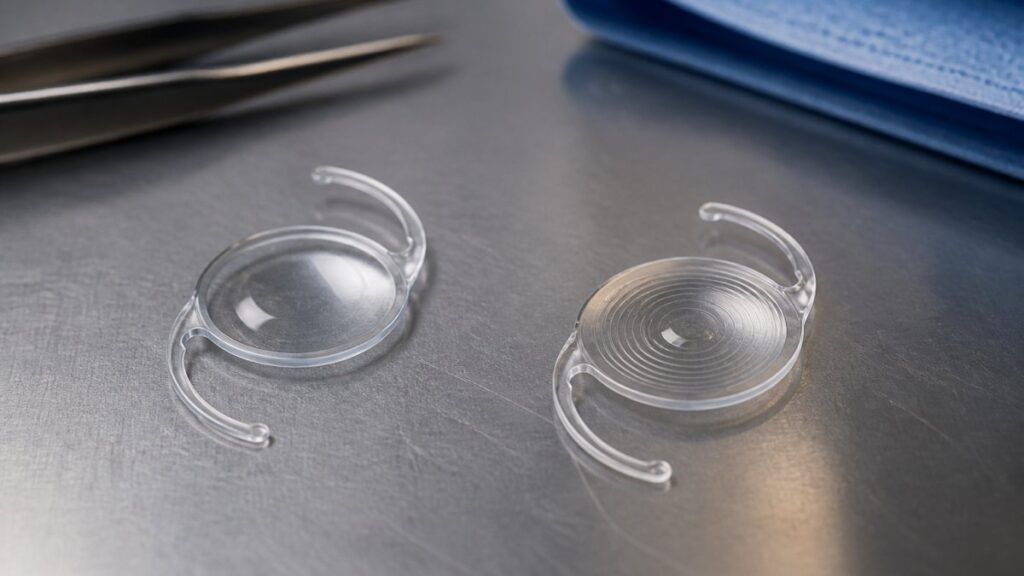
A premium intraocular lens (IOL) is an advanced implant used during premium lens implant surgery to replace your eye’s clouded natural lens. Unlike standard monofocal lenses that correct one distance, premium IOLs address near, intermediate, and far vision, reducing glasses dependence after surgery.
The procedure takes 10-15 minutes per eye, and the lens you choose determines your visual outcomes and lifestyle flexibility.
Standard monofocal lenses versus premium IOL options
Standard monofocal lenses focus light at one distance, usually distance vision. You’ll see clearly at that distance but will likely need reading glasses for near tasks.
Premium IOLs take a different approach. Multifocal lenses split incoming light to create two or three focal points, allowing you to see clearly at multiple distances. Extended-depth-of-focus lenses create a continuous range of clear vision.
The choice depends on your lifestyle, visual priorities, and budget.
Premium IOL vs Standard IOL: Key Differences in Vision Outcomes
The core difference is visual range and glasses dependence. A standard monofocal IOL corrects one distance well, usually far vision, achieving 20/20 distance vision but requiring reading glasses for near work (Factors to Consider in Choosing an IOL for Cataract Surgery).
Premium IOLs expand your range of clear vision. Multifocal designs let you see at distance, intermediate, and near without glasses, while extended-depth-of-focus lenses create a continuous band of focus.
Clear Vision San Antonio helps patients evaluate these differences through detailed consultations, weighing eye anatomy, daily activities, and visual demands against the premium upgrade.
Standard IOLs remain right for many patients, especially those who don’t mind reading glasses, have limited budgets, or lack premium coverage.
Multifocal IOL Pros and Cons: Understanding Trade-Offs
Multifocal IOLs divide incoming light between two or three focal points, allowing clear distance, intermediate, and near vision without glasses, dramatically reducing glasses dependence (When to Use Multifocal Intraocular Lenses).
Pros of multifocal IOLs:
- See clearly at multiple distances without glasses
- Reduced dependence on reading glasses for most daily tasks
- Good for active lifestyles where glasses are inconvenient
- Effective for people who value convenience over visual perfection
Cons of multifocal IOLs:
- Halos and glare around lights, especially at night
- Reduced contrast sensitivity in dim lighting
- Some patients report difficulty with tasks requiring very sharp vision (like fine detail work)
- Adaptation period of 4-6 weeks as your brain adjusts
- Not ideal for night drivers or those in careers requiring perfect night vision
- Higher out-of-pocket cost
Extended-depth-of-focus lenses and toric options
Extended-depth-of-focus (EDOF) lenses create a continuous range of clear vision rather than distinct focal points.
Toric IOLs correct astigmatism, an irregular corneal shape that blurs vision at all distances. They come in standard and premium versions; premium toric lenses combine astigmatism correction with multifocal or EDOF technology.
Candidacy depends on your eye anatomy, degree of astigmatism, and lifestyle priorities, which an ophthalmologist evaluates during a comprehensive eye exam.
Cataract Surgery Lens Implant Cost: What You’ll Actually Pay
The cost of lens implant surgery varies by lens type, surgeon experience, facility, and insurance coverage.
Standard monofocal IOL surgery is typically covered by insurance, including Medicare. Your out-of-pocket cost depends on your deductible, copay, and coinsurance; many patients pay $500-$2,000 per eye after insurance.
Premium IOL surgery involves an upgrade fee because insurers classify premium lenses as elective enhancements. You pay for standard surgery through insurance, then cover the upgrade separately, typically several hundred to several thousand dollars per eye.
What the premium upgrade fee actually includes
Most practices bundle several items into the premium upgrade fee. A transparent quote usually breaks down into these components:
- The premium IOL itself, the difference between the standard monofocal lens cost and the premium lens cost. This is often the smallest line item.
- Pre-operative testing, corneal topography, biometry, and macular imaging used to confirm candidacy and calculate lens power. Some practices include this in the standard surgical fee; others charge separately for premium lens planning.
- Surgeon’s premium lens fee, a professional fee for the additional planning, counseling, and surgical technique required for premium lens implantation.
- Facility fee differential, some ambulatory surgery centers and hospital outpatient departments charge a higher facility fee for premium cases.
- Post-operative refractive visits, additional visits to fine-tune vision and manage adaptation, which may or may not be included.
- Enhancement or touch-up coverage, some practices include a limited window for laser enhancement or lens exchange if the outcome needs adjustment; others exclude it.
Ask whether the quoted upgrade fee is per eye or for both eyes, and whether it includes follow-up visits beyond the standard post-operative period. A quote that looks lower per eye can cost more overall if follow-up care is billed separately.
How costs vary by lens type and by eye
Premium lens pricing isn’t uniform. Multifocal lenses generally carry a higher upgrade fee than EDOF lenses, and toric lenses used only for astigmatism often cost less than toric lenses combining multifocal or EDOF vision.
Costs also vary by setting: hospital outpatient departments generally charge higher facility fees than ambulatory surgery centers. The lens itself is rarely the largest driver, professional and facility fees usually are.
Questions to ask before you commit
Ask your surgeon’s office for an itemized cost breakdown before surgery. This should include:
- Surgeon’s fee
- Facility fee
- Anesthesia
- Pre-operative testing
- Post-operative care visits
- The IOL itself (premium upgrade amount if applicable)
Many practices offer financing and bilateral surgery discounts. Clarify whether your quote includes all follow-up visits, as some practices bill post-operative care separately.
Does Insurance Cover Premium IOL? Coverage and Out-of-Pocket Expenses
Coverage depends on your plan and lens type. Medicare and most private insurers cover cataract surgery and standard monofocal IOLs as medically necessary but typically don’t cover upgrading to a premium lens.
Here’s how it usually works:
Insurance covers the standard surgery and monofocal lens. If you choose a premium lens instead, you pay the difference out of pocket as an elective upgrade.
Vision insurance typically doesn’t cover cataract surgery or IOL costs at all, as this is a medical procedure, not a vision benefit.
Medicare covers standard monofocal IOL surgery but not premium upgrades. Some Medicare Advantage plans offer supplemental coverage, so review your plan details.
Before committing, verify coverage with your insurer and surgeon’s office, and ask for a written out-of-pocket estimate for each lens option you’re considering.
Who Should Choose Premium Lens Implants: Candidacy and Lifestyle Factors
Not every patient is a good candidate for premium IOLs. Eye health, visual demands, and lifestyle determine the best choice.

Good candidates for premium IOLs:
- People who are highly motivated to reduce glasses dependence
- Active individuals who find glasses inconvenient (athletes, outdoor enthusiasts)
- Patients with healthy retinas and no significant eye disease beyond cataracts
- Those whose work involves multiple visual distances (teachers, healthcare workers, engineers)
- People comfortable with potential trade-offs like halos or glare
- Patients with realistic expectations about visual outcomes
Better candidates for standard monofocal lenses:
- Night drivers who are sensitive to halos and glare
- Patients with limited budgets or no insurance coverage for premium upgrades
- Those with pre-existing eye conditions like macular degeneration or advanced glaucoma
- People who don’t mind wearing glasses for reading
- Patients with very high astigmatism (some premium options aren’t available)
- Those with dry eye disease, as premium lenses can make this more noticeable
Your ophthalmologist evaluates eye health, visual needs, and lifestyle during a comprehensive exam, discussing which options are medically appropriate.
At Clear Vision San Antonio, our team takes time to understand your daily activities and visual priorities so your lens choice aligns with how you actually live.
The Real Value: Long-Term Outcomes and When the Premium Upgrade Pays Off
Whether premium lens implant surgery is worth it comes down to value over time. A premium IOL costs more upfront, but reduced glasses dependence lasts the rest of your life, most IOLs never need replacement.
A lens-by-lens value framework
Value differs by lens type. Weigh each design’s upfront fee against its specific benefit and trade-off.
Multifocal lenses. The value case rests on the widest range of clear vision without glasses, from near reading to distance.
Extended-depth-of-focus lenses. The value case rests on a continuous range of clear vision with a lower reported rate of halos than multifocal designs.
Toric lenses. The value case rests on correcting astigmatism at the time of cataract surgery, which improves clarity at all distances.
The break-even math, with honest limits
Consider the cumulative cost of glasses: many people spend $100-$300 per year on eyeglasses and frames, or $2,000-$6,000 over two decades. A premium lens upgrade of a few thousand dollars can break even when you factor in glasses you won’t need to buy.
That math has limits. It assumes you would otherwise buy new glasses every year or two, which not everyone does.
Matching the decision to your daily visual demands
A practical way to decide is to list the visual tasks that matter most to you and see how each lens design performs against them.
- If you drive at night regularly, prioritize contrast sensitivity and low halo risk. Extended-depth-of-focus or standard monofocal lenses may serve you better than a multifocal.
- If you read or use a phone frequently, prioritize near vision. Multifocal lenses offer the widest near range, though extended-depth-of-focus lenses are a reasonable compromise.
- If you work at a computer most of the day, prioritize intermediate vision. Extended-depth-of-focus lenses are designed around this distance.
- If you have astigmatism, a toric lens corrects it regardless of the other design you choose.
- If you are highly sensitive to visual side effects, a standard monofocal lens remains the most predictable option, with excellent distance vision and no halo trade-off.
The premium upgrade is most likely to pay off when your daily life regularly demands clear vision at more than one distance and you are comfortable with the trade-offs of the lens design that fits those demands. It is least likely to pay off when you drive at night often, are highly sensitive to halos, or are content wearing glasses for reading.
Beyond the math, there’s the lifestyle factor: people who choose premium lenses often report improved quality of life, convenience seeing clearly at multiple distances without glasses, freedom during travel or outdoor activities, and reduced dependence on corrective devices.
However, the premium upgrade isn’t worth it for everyone.
The key is honest self-assessment: How much does glasses dependence bother you? How much are you willing to pay to reduce it? Are you comfortable with potential halos or glare?
Frequently Asked Questions
What is the biggest complaint after cataract surgery with premium IOLs?
Patients sometimes report halos or glare around lights, especially at night, particularly with multifocal intraocular lenses. This occurs because the lens splits incoming light to create multiple focal points. Most people adapt within weeks to months, and the effect typically lessens over time. Contrast sensitivity may also be slightly reduced compared to standard monofocal lenses. Your eye doctor can discuss which premium IOL type minimizes these effects based on your lifestyle and visual priorities.
Can premium cataract lenses reduce the need for glasses after surgery?
Yes. Premium intraocular lenses are designed to provide clear vision at multiple distances, near, intermediate, and far, reducing spectacle dependence significantly. Multifocal and extended-depth-of-focus lenses offer the greatest reduction in glasses reliance. However, most patients still need reading glasses occasionally for very small print or in dim lighting. Standard monofocal lenses typically require glasses for either near or distance vision. The degree of glasses independence depends on the specific premium IOL type and your individual visual needs.
Who is a good candidate for a premium lens implant?
Good candidates are generally those undergoing cataract surgery who have realistic expectations and want to reduce glasses dependence. You should have relatively healthy eyes aside from the cataract, stable vision prescription, and no significant retinal disease. Patients with astigmatism may benefit from toric premium lenses. Those with certain eye conditions, severe dry eye, glaucoma, or macular degeneration, may not be ideal candidates. Your ophthalmologist will evaluate your individual eye health, lifestyle demands, and visual goals to determine if a premium IOL is right for you.
Is it cheaper to replace lenses with premium implants or get new glasses?
Premium lens implant surgery costs more upfront than new glasses, but the long-term value differs. New glasses may require replacements every few years and multiple pairs for different activities. A premium intraocular lens is a one-time surgical expense with a lifetime implant, reducing ongoing glasses purchases. Over time, the cumulative cost of multiple pairs of glasses may approach or exceed the initial premium IOL upgrade cost. Additionally, premium IOLs provide vision quality that new glasses alone cannot match at all distances simultaneously.