
Last Updated: October 28, 2026
Quick Summary
Femtosecond laser eye surgery safety comes down to the fact that the femtosecond laser is a precision cutting instrument, not a treatment that removes your cataract by itself. It creates incisions, opens the lens capsule and softens the lens, so it carries its own laser-specific risks on top of the risks shared with any cataract operation.
- The femtosecond laser performs the corneal incision, the capsulorhexis and lens fragmentation during FLACS.
- The surgeon completes lens removal and implantation by hand after the laser step.
- The laser cuts tissue through photodisruption, creating tiny gas bubbles along a programmed plane.
- Ask your surgeon for absolute numbers on capsule tears and conversions, not adjectives.
- Laser assistance typically adds a patient-paid fee on top of standard cataract surgery.
Table of Contents
- What Femtosecond Laser Safety for Eye Surgery Really Means
- Benefits of Femtosecond Laser vs Manual Phacoemulsification
- Femtosecond Laser Cataract Surgery Complications: What the Evidence Shows
- Laser Cataract Surgery Recovery Time and What to Expect
- Who Is a Good Candidate and Who Should Avoid Laser Assistance
- What Happens If the Laser Step Is Incomplete or Cannot Proceed
- Questions to Ask at Your Consultation
- Frequently Asked Questions
What Femtosecond Laser Safety for Eye Surgery Really Means
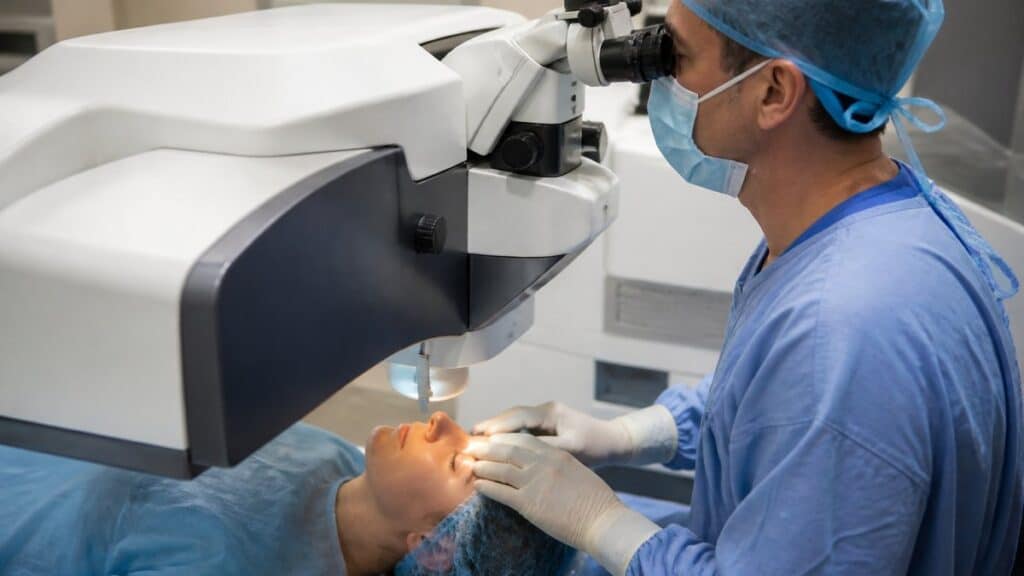
Femtosecond laser safety for eye surgery explained comes down to one idea: the laser replaces the surgeon’s blade for specific steps, and every safety question follows from that substitution. The femtosecond laser is a precision cutting instrument, not a treatment that removes your cataract by itself. It creates incisions, opens the lens capsule, and softens the lens before the surgeon removes it.
That matters for how you read safety claims. A laser-assisted procedure has its own risk list, separate from the risks of cataract surgery itself. The U.S. Food and Drug Administration guidance on laser devices treats ophthalmic lasers as regulated medical devices, which is why manufacturers must document performance and adverse events.
Femtosecond laser-assisted cataract surgery (FLACS) is a cataract operation in which a femtosecond laser performs the corneal incision, the capsulorhexis, and lens fragmentation, after which the surgeon completes removal and lens implantation by hand.
How the Laser Works and Why Precision Matters
The femtosecond laser emits pulses measured in quadrillionths of a second (New technology update: femtosecond laser in cataract surgery). Each pulse cuts tissue through a process called photodisruption, creating tiny gas bubbles that separate tissue along a programmed plane.
That is where the precision argument comes from.
Precision is not the same as safety, though. A perfectly executed cut still carries the risks any cut carries.
Here is what the femtosecond laser actually does during a laser-assisted cataract operation.
| Step | What the laser does |
|---|---|
| Corneal incision | Creates the incision |
| Capsulorhexis | Opens the lens capsule |
| Lens fragmentation | Softens the lens before removal |
| Removal and implantation | Completed by the surgeon by hand |
Benefits of Femtosecond Laser vs Manual Phacoemulsification
If you are weighing whether the added cost is justified for your situation, our breakdown of whether laser cataract surgery is worth the extra cost covers the trade-offs in detail.
Femtosecond Laser Cataract Surgery Complications: What the Evidence Shows
Femtosecond laser cataract surgery complications fall into two buckets: the risks shared with any cataract operation, and a smaller set unique to the laser step. The shared list is familiar, infection, inflammation, swelling of the retina, and posterior capsule opacification, which can develop months later and is usually treatable with an in-office laser procedure. What most guides skip is the harder question: how often do these events actually happen, and how good is the evidence behind the numbers?
Laser-Specific Risks and Potential Harms
A common mistake is assuming “laser” means “no cutting.” The laser cuts. It simply cuts differently. If you want to understand what happens when an operation does not go as planned, our guide to what happens if cataract surgery fails walks through the possibilities honestly.
Ask your surgeon for absolute numbers, not adjectives. “What is your personal rate of capsule tears and conversions?” and “How many of these cases have you done?” tell you more than any brochure claim about laser precision.
::: (Source: photodisruption)
Laser Cataract Surgery Recovery Time and What to Expect

Our cataract surgery recovery timeline lays out what each week typically looks like.
Who Is a Good Candidate and Who Should Avoid Laser Assistance
Tier one, straightforward candidates.
Tier two, proceed with caution.
Tier three, manual surgery is usually the better default.
The right question is not “is the laser better?” It is “does the laser help in my eye, and what is the plan if it does not?” That answer comes from a consultation with imaging, not an article. Bring your questions in writing and expect specific answers, our guide to preparing for a cataract surgery consultation includes a printable list you can use to compare surgeons.
Ask every surgeon you consult two screening questions: “What in my imaging or history would make you choose manual surgery instead?” and “How often do you convert, and why?” The specificity of the answers tells you how carefully the practice screens.
What Happens If the Laser Step Is Incomplete or Cannot Proceed
Ask any surgeon you consult how often they convert and why. The answer tells you more about their practice than any brochure.
Questions to Ask at Your Consultation
Bring specific questions, and expect specific answers. Preparing them in advance helps you compare what you hear. Our guide to preparing for a cataract surgery consultation includes a fuller question list you can print and bring.
- How many laser-assisted cases have you performed, and how often do you convert to manual?
- What does the laser add for my specific eye, based on my imaging?
- What are my personal risk factors given my other health conditions?
- What will I feel during docking, and what happens if I move?
- What is the total cost, including the laser fee, and what does insurance cover?
Cost deserves its own conversation. Laser assistance typically adds a patient-paid fee on top of standard cataract surgery, and coverage varies by plan. For local pricing context, see our cataract surgery cost guide for San Antonio.
At Clear Vision San Antonio, we use advanced technology lens implants. Request an appointment to review your options.
Frequently Asked Questions
What are the risks associated with femtosecond laser eye surgery?
Ask a qualified ophthalmologist about the risks of femtosecond laser-assisted cataract surgery and whether it is appropriate for your situation.
Is femtosecond laser-assisted cataract surgery FDA-approved?
Ask a qualified ophthalmologist about the regulatory status and intended use of any femtosecond laser system being considered for your procedure.
Who is a candidate for femtosecond laser eye procedures?
Whether femtosecond laser eye surgery is appropriate depends on individual circumstances. Discuss your situation with a qualified ophthalmologist.
What should I expect during recovery from laser-assisted eye surgery?
Ask your ophthalmologist what to expect during recovery and which post-operative instructions apply to your situation.
Femtosecond laser safety is a question of matching technology to your eye, not chasing the newest option. Clear Vision San Antonio offers personalized attention, advanced technology lens implants, and a team that explains the risks as clearly as the benefits. Get started with Clear Vision San Antonio and make your decision with a full picture of what surgery involves.
