

Table of Contents
- Laser Eye Surgery Price Comparison: What You’ll Actually Pay in 2026
- Types of Laser Eye Surgery and Their Costs: Standard vs. Custom vs. All-Laser
- LASIK vs PRK Cost: Which Procedure Fits Your Budget and Eyes?
- What Is Included in Laser Eye Surgery Cost, and What Isn’t
- Is Laser Eye Surgery Covered by Insurance or Vision Plans?
- Laser Eye Surgery Financing Options: Payment Plans, HSA, and FSA
- Laser Eye Surgery Price Comparison: Red Flags and How to Evaluate Providers
- Conclusion
Last Updated: June 15, 2026
Laser Eye Surgery Price Comparison: What You’ll Actually Pay in 2026
Doing a proper laser eye surgery price comparison before committing is one of the smartest financial moves a prospective patient can make. At Clear Vision San Antonio, we regularly see patients quoted wildly different prices with no framework for understanding why. The gap between the lowest and highest quotes for the same procedure can be substantial, and is rarely explained upfront. Below, we break down exactly what drives those differences and how to avoid overpaying.

National Average Cost Per Eye
Laser eye surgery is priced per eye. Nationally, patients can expect to pay from a few hundred to several thousand dollars per eye depending on procedure type, technology, and surgeon experience. Traditional LASIK sits at the lower end; custom wavefront-guided or all-laser procedures command a premium.
Here is what most guides get wrong: they quote a single "average" without specifying which procedure it covers. A standard LASIK price and an all-laser custom LASIK price are no more comparable than economy and business class airfare. Always ask which specific procedure the quoted price covers.
Why Prices Vary So Widely Between Providers
Several factors drive price variation, and understanding them is the difference between a smart decision and being misled by a low advertised number.
- Technology: Clinics using newer femtosecond laser platforms or advanced corneal mapping carry higher overhead, reflected in pricing.
- Surgeon experience: An ophthalmologist with decades of refractive surgery experience commands higher fees than a newer practitioner.
- Geographic market: Urban and high-cost-of-living areas generally see higher procedure prices.
- What is included: Some quotes bundle post-operative care and enhancements; others do not.
- Procedure complexity: Higher prescriptions, thin corneas, or significant astigmatism require more complex planning and add cost.
Be cautious of providers advertising unusually low per-eye prices. These offers frequently apply only to patients with very mild prescriptions and exclude post-op care. Read the fine print before scheduling a consultation.
Types of Laser Eye Surgery and Their Costs: Standard vs. Custom vs. All-Laser
The type of procedure you receive is the single biggest driver of total cost. Understanding the three main categories clarifies why two clinics can quote such different numbers for what a patient assumes is "the same thing."
| Procedure Type | Technology Used | Relative Cost | Best For |
|---|---|---|---|
| Traditional LASIK | Microkeratome blade | Lower | Mild to moderate prescriptions |
| All-Laser LASIK | Femtosecond laser | Mid-to-high | Patients wanting blade-free approach |
| Custom Wavefront-Guided LASIK | Femtosecond + wavefront mapping | Highest | Complex prescriptions, high visual demands |
| PRK | Surface ablation, no flap | Similar to Traditional LASIK | Thin corneas, contact sport patients |
Traditional LASIK (Microkeratome)
Traditional LASIK uses a precision mechanical blade to create the corneal flap before the excimer laser reshapes the underlying tissue. It has decades of clinical history and remains effective for straightforward cases of nearsightedness, farsightedness, and mild astigmatism. The lower price reflects older technology, not necessarily inferior outcomes for appropriate candidates. The real limitation is flap precision, which matters most for patients with irregular corneas or higher prescriptions.
All-Laser LASIK (Femtosecond Laser)
All-laser LASIK replaces the microkeratome with a femtosecond laser, producing a more precise, reproducible flap with consistent depth and edge profile. Patients with thinner corneas or those wanting to minimize mechanical risk often prefer this approach. The price premium over traditional LASIK is often modest at clinics that have fully amortized their laser platforms; the bigger cost driver is typically whether the reshaping step uses standard or wavefront-guided technology.
Custom Wavefront-Guided LASIK
Custom wavefront-guided LASIK is the most sophisticated procedure in the standard refractive surgery lineup. Detailed corneal mapping captures each eye’s unique optical imperfections, then guides the excimer laser with precision that generic ablation profiles cannot match. For patients with higher-order aberrations, previous corneal surgery, or demanding visual requirements, the investment is generally worth it. For a simple, low-degree prescription, the incremental benefit may be smaller, a conversation worth having with your surgeon before automatically upgrading.
LASIK vs PRK Cost: Which Procedure Fits Your Budget and Eyes?
PRK (photorefractive keratectomy) removes the epithelium rather than creating a flap, making it the preferred option for patients with thin corneas or higher risk of flap-related complications. Pricing is often comparable to traditional LASIK, sometimes slightly lower since no flap-creation step is required. However, recovery is significantly longer: several days of discomfort and blurry vision while the epithelium regenerates, versus the faster recovery most LASIK patients experience.
The hidden cost consideration with PRK is time off work. If your job requires sharp visual acuity immediately, the extended recovery has a real economic cost that never appears in the quoted price. Factor that into your total-cost calculation.
According to the American Academy of Ophthalmology’s patient education resources, both LASIK and PRK produce comparable long-term visual outcomes in appropriately selected candidates, making the choice primarily one of candidacy and recovery preference rather than outcome quality.
What Is Included in Laser Eye Surgery Cost, and What Isn’t
This is where most patients get surprised, and it is the most important section of any laser eye surgery price comparison exercise. A quoted price means very little without knowing what it covers.
Typically included in a bundled price:
- Pre-operative consultation and corneal mapping
- The surgical procedure itself (both eyes)
- Immediate post-operative medications
- Follow-up visits for a defined period (often 12 months)
- Enhancement or touch-up if needed within the guarantee window
Commonly excluded from advertised prices:
- Additional follow-up visits beyond the included period
- Enhancements outside the guarantee window
- Prescription eyeglasses or contacts during the healing phase
- Treatment of complications not covered by the enhancement policy
Always ask for a written breakdown before signing anything. A lower headline price that excludes post-operative care can easily exceed a higher all-inclusive quote once those costs accumulate.
Post-Op Complication and Enhancement Costs to Budget For
Enhancements are additional laser treatments performed when the initial procedure does not achieve target visual acuity or when regression occurs over time. Some clinics include lifetime enhancement guarantees; others charge per procedure. Budget accordingly if yours does not.
Dry eye is the most common post-operative complaint after refractive surgery. Prescription eye drops and ongoing management can add meaningful cost over the months following surgery. Patients with pre-existing dry eye should discuss this risk explicitly with their surgeon before proceeding.
Ask your surgeon specifically about their enhancement rate and what triggers eligibility. A clinic with a lifetime enhancement policy is offering real financial protection, not just a marketing promise. Get the terms in writing.
Is Laser Eye Surgery Covered by Insurance or Vision Plans?
Laser eye surgery is classified as elective by most vision insurance plans, so standard vision coverage typically does not apply. Some employer-sponsored plans offer a discount through contracted provider networks, real but modest, often a fixed dollar amount or percentage reduction. Check your specific plan documents rather than assuming either way.
FSA and HSA funds are a different story. The IRS explicitly allows LASIK and other vision correction surgeries as qualified medical expenses under IRS Publication 502 on medical and dental expenses. This is one of the most underused financial tools available to laser eye surgery candidates.
Laser Eye Surgery Financing Options: Payment Plans, HSA, and FSA
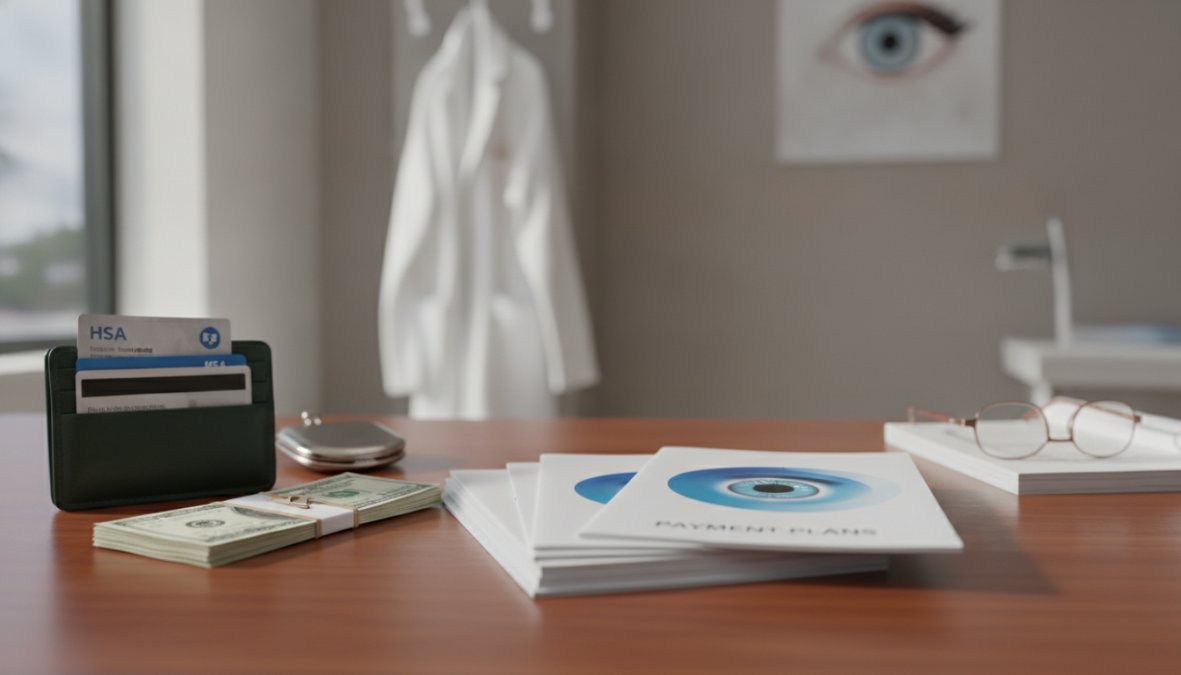
Most reputable clinics offer financing to spread costs across monthly payments. Standard financing through third-party medical credit companies often includes promotional 0% interest periods of 12 to 24 months. The critical detail: if the balance is not paid in full before the promotional period ends, deferred interest applies retroactively from the original purchase date, a significant and unexpected expense. A cleaner approach for many patients is combining a shorter financing term with pre-tax HSA or FSA dollars.
Maximizing HSA and FSA Tax Savings
HSA and FSA accounts let you pay for laser eye surgery with pre-tax dollars, effectively reducing out-of-pocket cost by your marginal tax rate, a meaningful reduction for a patient in the 22% federal bracket.
- FSA accounts operate on a use-it-or-lose-it basis within the plan year. If you have expiring FSA funds, scheduling your procedure before the deadline is a legitimate financial strategy.
- HSA accounts roll over indefinitely, can be invested, and are available only to patients enrolled in a high-deductible health plan (HDHP).
The smartest approach for many patients: max out HSA contributions before the procedure, pay with HSA funds, and invest what you would have spent on contacts and glasses going forward.
Long-Term ROI: LASIK vs. a Lifetime of Contacts and Glasses
The upfront cost looks different measured against a lifetime of vision correction spending. Contacts, lens solution, replacement pairs, and annual exams accumulate into a substantial figure over decades. According to Johnson & Johnson Vision’s iLASIK cost comparison tool, cumulative contact lens costs over many years can rival or exceed the cost of a single laser eye surgery procedure. For most daily contact lens wearers, the investment pays for itself within several years, after which the financial advantage compounds annually.
Laser eye surgery is not just a medical expense. For most daily contact lens wearers, it is a long-term financial investment with a calculable return. Run the numbers against your actual annual vision correction spending before dismissing the upfront cost as prohibitive.
Laser Eye Surgery Price Comparison: Red Flags and How to Evaluate Providers
Doing a thorough laser eye surgery price comparison means evaluating more than the number on the quote. Compare providers across four dimensions: technology (what laser platform?), transparency (is the quote all-inclusive?), experience (how many procedures has this surgeon performed?), and aftercare (what happens if you need an enhancement?).
According to the FDA’s guidance on LASIK patient selection and informed consent, patients should receive detailed information about risks, alternatives, and realistic outcomes before consenting to any refractive surgery procedure. A provider who rushes this process is a red flag regardless of price.
Price Transparency Red Flags to Watch For
- "Starting from" pricing: Almost always applies to a narrow patient range and is used to generate consultations, not represent typical costs.
- Pressure to decide same-day: Reputable providers understand patients need time to compare. High-pressure tactics are a warning sign.
- Vague enhancement policies: If a clinic cannot clearly explain enhancement terms in writing, assume the policy is unfavorable to patients.
- No itemized breakdown: You should be able to see exactly what your quote includes. Resistance to providing this is a transparency problem.
- Unusually low all-inclusive quotes: Pricing dramatically below market can indicate older technology, less experienced surgeons, or exclusions buried in fine print.
Questions to Ask Your Surgeon Before Committing
Before scheduling, these questions will give you a clear picture of what you are actually buying:
- What specific laser platform will be used for my procedure?
- Am I a candidate for wavefront-guided treatment, and is it included in my quote?
- What does your enhancement policy cover, and for how long?
- What is your personal complication rate for this procedure?
- Does this quote include all post-operative visits, or only a defined number?
- What is the process if I develop dry eye or other complications after surgery?
- Are there any reasons I might not be a good candidate that we should discuss?
A surgeon who answers these questions thoroughly and without defensiveness is demonstrating the transparency that correlates with good patient outcomes. Clear Vision San Antonio approaches every consultation with exactly this level of detail, covering candidacy, procedure options, and realistic outcome expectations before any financial commitment is made.
Sorting through conflicting price quotes and marketing claims is one of the most frustrating parts of pursuing laser eye surgery. Clear Vision San Antonio simplifies that process by combining advanced diagnostic technology with a commitment to transparent, personalized patient care. Whether you are exploring LASIK, PRK, or advanced lens implants, the team provides honest guidance on which procedure fits your eyes and your budget. Request an appointment with Clear Vision San Antonio and get the clear answers you need to make a confident decision.
Frequently Asked Questions
Why does laser eye surgery price vary so much between providers?
Laser eye surgery price comparison reveals wide variation because costs depend on several factors: the technology used (femtosecond laser vs. microkeratome), whether the procedure is standard or custom wavefront-guided, the surgeon's experience level, geographic location, and what post-operative care is bundled into the quoted price. Clinics advertising very low per-eye prices often exclude pre-op consultations, enhancement touch-ups, and follow-up visits, which can significantly increase your true out-of-pocket expenses.
What is the average cost of LASIK surgery per eye in the United States?
The national average cost of LASIK surgery typically ranges from roughly $2,000 to $3,000 per eye, depending on the procedure type and provider. Custom wavefront-guided or all-laser LASIK using a femtosecond laser tends to sit at the higher end of that range. Standard LASIK using a microkeratome may cost less but may not be suitable for all prescriptions, including complex cases of nearsightedness, farsightedness, or astigmatism.
Are there hidden costs in laser eye surgery quotes I should watch for?
Yes. A laser eye surgery price comparison should always account for costs beyond the headline figure. Common exclusions include the pre-operative corneal mapping consultation, post-operative medications, enhancement or touch-up procedures if visual acuity isn't fully corrected, and treatment for rare post-op complications. Ask every provider for an all-inclusive quote in writing and confirm whether lifetime enhancement coverage is included. This is one of the most important price transparency red flags to check before signing any agreement.
What laser eye surgery financing options are available, and can I use my HSA or FSA?
Most ophthalmology practices offer third-party financing plans, often at 0% interest for qualifying patients, allowing you to spread out-of-pocket expenses over 12 to 24 months. Importantly, LASIK and PRK are IRS-qualified medical expenses, meaning you can pay with pre-tax dollars from a Health Savings Account (HSA) or Flexible Spending Account (FSA). Using an FSA or HSA effectively reduces your real cost by your marginal tax rate, a meaningful saving on a $4,000-$6,000 bilateral procedure.
Is it worth paying more for premium laser eye surgery technology?
For most patients, upgrading to custom wavefront-guided or all-laser LASIK is worth the additional cost. These technologies use detailed corneal mapping to personalize the procedure, which can improve outcomes for patients with higher prescriptions or irregular corneas. The long-term ROI calculation also favors premium procedures: eliminating annual contact lens and glasses costs, which can exceed $500 per year, means most patients recoup the full investment within five to eight years of clear vision.
Does insurance cover laser eye surgery?
Standard vision insurance typically classifies LASIK, PRK, and similar refractive surgery procedures as elective, meaning they are not covered. However, some employer-sponsored vision plans offer negotiated discounts with participating ophthalmology networks. Military and certain federal employee benefits plans may include partial coverage. Always verify your specific plan's refractive surgery benefit before your consultation, and ask your provider whether they participate in any vision discount programs that could reduce your out-of-pocket expenses.
This article was written using GrandRanker