

Last Updated: November 1, 2026
Quick Summary
No single cataract lens gives clear vision at every distance, because an artificial lens cannot flex and refocus like your natural one. Each cataract lens is set for one zone or engineered to split light across several, so you trade sharpness at one distance for convenience at others.
- Monofocal lenses give the crispest distance vision but typically require reading glasses up close.
- Multifocal lenses reduce glasses dependence but can produce halos, glare, and reduced contrast sensitivity.
- Extended depth of focus lenses cover distance and intermediate vision with fewer halos than multifocal lenses.
- A toric lens corrects astigmatism, while standard IOLs correct only nearsightedness and farsightedness.
- Most people still need glasses for some tasks after cataract surgery, even with a premium lens.
Table of Contents
- Why One Cataract Lens Cannot Do Everything
- Monofocal vs Multifocal IOL: The Core Trade-Off
- Where an Extended Depth of Focus Lens Fits In
- Astigmatism Correction During Cataract Surgery
- Will You Still Need Glasses After Cataract Surgery?
- Matching a Cataract Lens to Your Daily Life
- What to Ask Before You Choose Your Lens
- Frequently Asked Questions
Why One Cataract Lens Cannot Do Everything
No single cataract lens restores clear vision at every distance without some compromise, because the eye’s natural lens flexes to change focus and an artificial lens cannot.
The eye works like a camera with an autofocus system. When you look from a road sign to a book, muscles in the eye reshape the natural lens to shift focus.
That single fact drives every decision that follows. According to the American Academy of Ophthalmology’s patient information on IOLs, the choice of lens implant shapes what you see clearly after surgery and how much you still rely on glasses.
How Your Eye Focuses at Near, Far, and Intermediate
Your eye focuses by bending light to a point on the retina. The cornea does most of the bending; the lens fine-tunes it. Three distance zones matter after surgery:
- Distance: driving, watching television, recognizing faces across a room
- Intermediate: a computer screen, a car dashboard, a stove dial
- Near: reading, phone screens, threading a needle
A natural, healthy lens shifts between all three in a fraction of a second. An artificial lens is set for one zone, or engineered to split light across several. That engineering is what separates lens categories.
Monofocal vs Multifocal IOL: The Core Trade-Off
The monofocal versus multifocal IOL decision comes down to sharpness at one distance versus convenience at several. A monofocal lens gives the crispest distance vision and typically requires reading glasses up close. A multifocal lens spreads focus across zones, reducing glasses dependence at the cost of some visual side effects.
Monofocal Lenses: Sharp Distance, Reading Glasses Up Close
Monofocal lenses are the most commonly implanted IOLs, and for good reason. They deliver clean, high-contrast distance vision with the fewest visual disturbances. Most people still need glasses for reading and often for intermediate tasks like computer work.
The upside is predictability. The drawback is obvious: you reach for glasses the moment you want to read a menu.
Multifocal Lenses: Multiple Distances, More Visual Side Effects
Multifocal lenses, also called presbyopia-correcting IOLs, use rings or zones to create several focal points at once. They reduce dependence on glasses for near and intermediate work.
The trade-off is real. Multifocal lenses can produce halos, glare, and reduced contrast sensitivity, especially in low light. Adaptation varies from person to person. If you have significant astigmatism or macular problems, a multifocal lens may not be the right fit.
Where an Extended Depth of Focus Lens Fits In
An extended depth of focus lens stretches one focal zone across distance and intermediate vision, landing between monofocal and multifocal (Factors to Consider in Choosing an IOL for Cataract Surgery).
Think of it as the middle path. If you spend your day at a computer and behind a windshield but read mostly in the evening, an extended depth of focus lens can reduce glasses use without the ring-shaped glare some multifocal wearers report.
Astigmatism Correction During Cataract Surgery
Astigmatism is corrected during cataract surgery by choosing a toric lens, which has built-in cylindrical power to neutralize the cornea’s irregular curve. Standard IOLs correct nearsightedness and farsightedness but not astigmatism.
If your cornea is shaped like a football rather than a basketball, light smears instead of focusing to a point. The National Eye Institute’s overview of astigmatism explains how the condition blurs vision at all distances.
Getting the axis right matters. A toric lens must be aligned precisely, and your surgeon measures your cornea beforehand to calculate the correction. For a deeper walkthrough, read our guide to cataract surgery for astigmatism.
Will You Still Need Glasses After Cataract Surgery?
Most people still need glasses for some tasks after cataract surgery, even with a premium lens. The useful question is not yes or no but which tasks, how often, and why. For a direct answer on whether a premium lens can reduce your need for reading glasses, see Can Premium Lens Implants Reduce Your Need for Reading Glasses?. The answer depends on three things: the lens you choose, how precisely your eye’s measurements match the implant’s power, and how demanding your visual tasks are.
What Each Lens Type Typically Leaves You Needing
- Monofocal set for distance: clear driving, television, and face recognition; reading glasses for books, phone screens, and menus; often a separate pair or progressive for computer work.
- Monofocal set for near (monovision or mini-monovision): reading without glasses in the treated eye, but reduced distance sharpness that may need a distance lens for driving, especially at night.
- Extended depth of focus: smooth distance and arm’s-length vision; reading glasses usually still needed for fine print and low light.
- Multifocal: the widest glasses-free range for many patients, but fine print in dim light and night driving may still call for a pair, and some wearers keep a low-power distance lens for nighttime.
- Toric: corrects astigmatism, but the residual prescription depends on how closely the implanted axis matches your corneal curve; a small residual is common and may need a thin prescription.
Why ‘Perfect at Every Distance’ Is Not a Realistic Promise
No implant replicates a young, flexible natural lens. Even a well-matched premium lens leaves small residual refractive error in many eyes, and the cornea’s healing and the lens’s position can shift the final prescription slightly. That is why surgeons typically wait several weeks after surgery before finalizing a glasses prescription. Setting realistic expectations before surgery helps you understand what to anticipate afterward.
Ask your surgeon before surgery: “For my daily tasks, which specific activities will likely still need glasses with each lens option?” A concrete task list is more useful than a general percentage.
Matching a Cataract Lens to Your Daily Life
The right cataract lens matches how you actually spend your hours, not how you imagine you might. A retired teacher who reads for hours has different needs than a contractor who drives and measures all day.
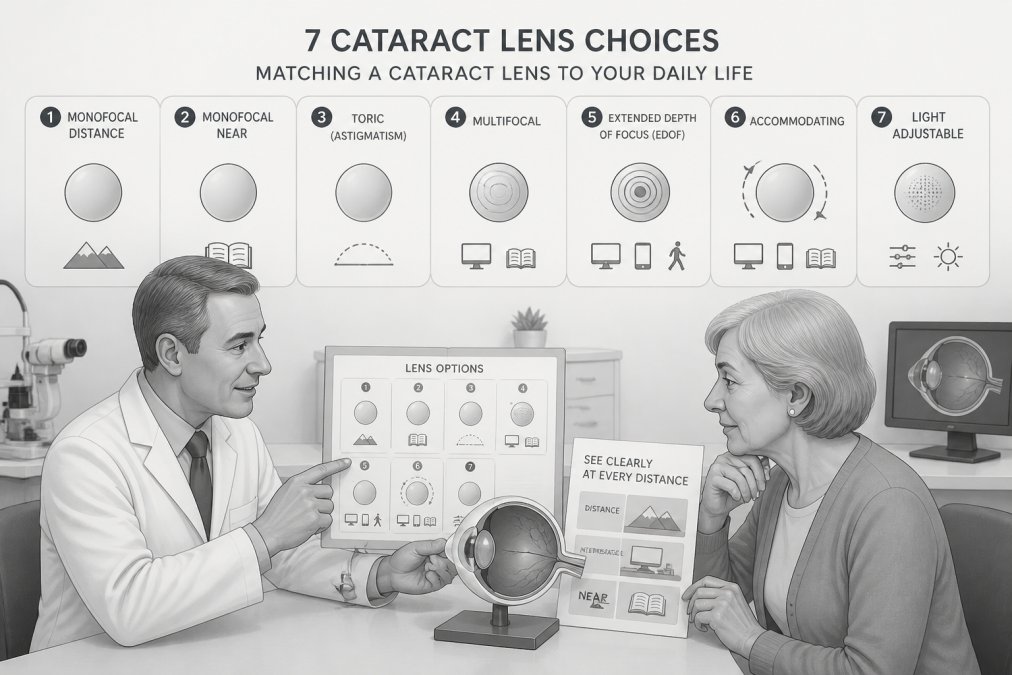
A Side-by-Side Way to Compare Your Options
Lens types can be compared by scoring each option against the situations you actually face. Consider this framework when discussing options with your eye doctor:
| Situation | Monofocal (distance) | Extended depth of focus | Multifocal | Toric (if astigmatism) |
|---|---|---|---|---|
| Night driving | Fewest halos and glare; may need a distance prescription | Fewer halos than multifocal; some glare possible | Most likely to amplify oncoming headlights | Corrects astigmatism; night glare depends on the base lens |
| All-day computer work | Usually needs intermediate glasses | Strong at arm’s length | Good, with some adaptation | Depends on the paired lens design |
| Reading fine print | Reading glasses | Reading glasses, especially in low light | Often glasses-free in good light | Depends on the paired lens design |
| Cooking, hobbies, yard work | Distance clear; near tasks need glasses | Balanced | Broadest range, with some visual noise | Improves clarity at all distances by reducing smear |
| Exercise and temperature swings | Stable, predictable | Stable | Some wearers notice rings in low light | Stable once aligned |
This is a starting point, not a prescription. Your eye health, astigmatism, and tolerance for visual side effects decide the final fit.
Night Driving, Screens, and Hobbies
Night driving is the sharpest dividing line. Multifocal lenses can amplify glare from oncoming headlights, which matters if you drive after dark regularly. Extended depth of focus lenses tend to produce fewer halos. Monofocal lenses produce the fewest disturbances of all.
Screen work pushes you toward intermediate clarity. If glare at night worries you, our guide to what causes night driving glare covers the underlying causes.
Environments Competitors Rarely Address
Fogging, glare, and contrast problems show up in specific settings, and the right lens depends on where you spend time:
- High humidity and temperature changes: moving between air conditioning and summer heat can fog any glasses you still wear; a lens that reduces glasses dependence reduces that problem.
- Workplace protective eyewear: if you wear safety glasses or goggles over prescription glasses, a wider glasses-free range can simplify compliance.
- Cooking and steam: near and intermediate clarity matter more than distance for stovetop work.
- Exercise and outdoor sport: wind, sweat, and glare reward stable distance vision and low visual noise.
Write down your three most common visual tasks and your three most frustrating ones. Bring that list to your consultation. The lens that solves your frustrating tasks is usually the right starting point.
A common mistake is choosing a lens based on a friend’s experience. Your eyes, your astigmatism, and your daily demands are yours alone. For a complete decision aid, see our patient guide to cataract lens options.
What to Ask Before You Choose Your Lens
Ask your surgeon to map your daily vision needs against each lens option, and ask what you should expect to still need glasses for. The right questions turn a confusing menu into a clear decision.
Use this checklist at your consultation:
- Which lens best fits my distance, intermediate, and near needs?
- How much glasses use should I expect with each option?
- Do I have astigmatism that needs a toric lens?
- What visual side effects are most likely for me, and how long do they last?
- How do my eye health and any other conditions affect my candidacy?
- What does recovery involve, and when can I drive and work?
A common mistake is choosing a lens based on a friend’s experience. Your eyes, your astigmatism, and your daily demands are yours alone.
Choosing a cataract lens is a genuine trade-off, not a search for a perfect option that does not exist.
Frequently Asked Questions
Which cataract lens can help me see near, intermediate, and far?
Multifocal and extended depth of focus lenses are designed to cover more than one distance. Multifocal lenses split light into several focal points, which can reduce dependence on glasses at near, intermediate, and far. Extended depth of focus lenses stretch the range of clear vision, usually favoring intermediate and distance while leaving some near tasks to reading glasses. Monofocal lenses give the sharpest single distance, typically far, with glasses for close work. Your eye health, astigmatism, and daily visual demands determine which option suits you.
What is the difference between monofocal and multifocal cataract lenses?
A monofocal IOL has one focal point, usually set for distance, so near and intermediate tasks need glasses. A multifocal IOL uses concentric zones to create several focal points at once, which can reduce glasses use but may produce halos, glare, or reduced contrast, especially at night. Monofocal lenses tend to deliver crisper single-distance vision with fewer visual disturbances. Neither is universally better; the choice depends on how much you value glasses-free reading versus the cleanest possible distance vision.
Will I still need glasses after cataract surgery?
Many people still use glasses for some tasks after cataract surgery, even with a premium lens. Monofocal patients usually need reading glasses and sometimes a distance prescription. Multifocal and extended depth of focus patients often read and drive without glasses but may keep a pair for fine print, low light, or night driving. Residual astigmatism also affects the outcome, which is why astigmatism correction during surgery matters. Your surgeon can outline a realistic glasses-free range before you decide.
Can astigmatism be corrected during cataract surgery?
Yes. Astigmatism is corrected with a toric intraocular lens or with limbal relaxing incisions made during surgery. A toric lens is implanted in place of a standard lens and is aligned to the curve of your cornea. Without correction, leftover astigmatism blurs vision at all distances and can make a premium lens feel disappointing. Your pre-surgical measurements map the amount and angle of astigmatism, and your surgeon decides whether a toric lens, incisions, or a standard lens is appropriate.
