Last Updated: October 22, 2026
Quick Summary
The main benefits of evo icl vs lasik come down to structure: LASIK permanently reshapes your cornea with a laser, while EVO ICL adds a removable lens inside the eye and leaves the cornea untouched. That difference drives candidacy, dry eye risk, recovery, and long-term flexibility, so the right choice depends on your corneal thickness, prescription, tear film, and eye health.
- EVO ICL suits thin corneas, high myopia, and some dry eye concerns better than LASIK.
- The EVO ICL lens can be removed or exchanged later if medically necessary.
- EVO ICL follow-up checks eye pressure, vault, cataract risk, and endothelial cell health.
- Published ranges list EVO Visian ICL at roughly $3,500 to $5,000 per eye versus LASIK at $1,500 to $3,000.
- Refractive surgery is generally elective and not covered by most health insurance plans.
Table of Contents
- EVO ICL vs LASIK at a Glance
- How LASIK and EVO ICL Work
- EVO ICL Candidacy: Who May Qualify
- EVO ICL Risks and Side Effects to Know
- LASIK vs ICL Recovery Time and the First Weeks
- EVO ICL vs LASIK Cost: What Drives the Price
- Long-Term Outcomes and Follow-Up Care
- Frequently Asked Questions
EVO ICL vs LASIK at a Glance
The benefits of EVO ICL vs LASIK come down to one structural difference: LASIK permanently reshapes your cornea with a laser, while EVO ICL adds a removable lens inside the eye and leaves the cornea untouched.
Here is the short version. LASIK is the more established laser treatment and typically produces rapid visual results.
At Clear Vision San Antonio, we evaluate both options during a single comprehensive eye examination, because the right answer depends on your corneal thickness, prescription, tear film, and eye health rather than on a general ranking.
| Factor | LASIK | EVO ICL |
|---|---|---|
| How it works | Laser reshapes corneal tissue | Implantable lens added inside the eye |
| Cornea | Permanently changed | Preserved, not reshaped |
| Reversible | No | Lens can be removed or exchanged |
| Best fit | Moderate prescriptions, adequate corneal thickness | Thin corneas, high myopia, some dry eye concerns |
| Recovery | Rapid results, often within days | Quick visual recovery with a structured follow-up schedule |
How LASIK and EVO ICL Work
LASIK and EVO ICL correct refractive error through opposite strategies. One alters the eye’s surface optics; the other adds an optical element without removing tissue. Understanding that split makes every later comparison easier to follow.
What LASIK Does to the Cornea
LASIK uses a laser to reshape the cornea so light focuses more precisely on the retina. The surgeon creates a thin flap in the outer corneal layer, then removes microscopic amounts of corneal tissue beneath it to change the eye’s curvature.
Because corneal tissue is removed, the change is permanent. That is why corneal thickness matters so much during candidacy screening: there must be enough tissue to remove safely while leaving a stable structural bed behind.
How the EVO ICL Lens Sits in the Eye
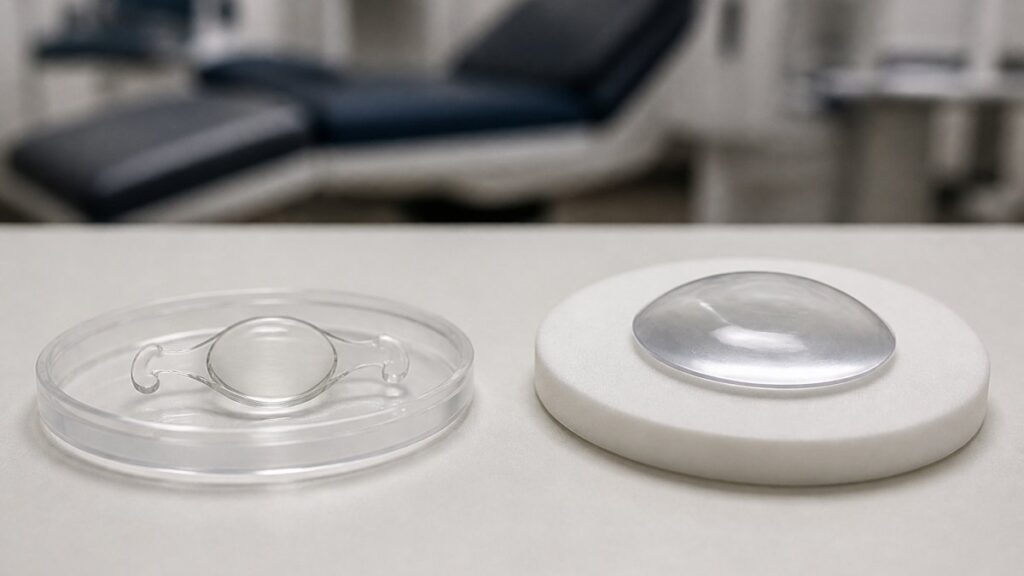
The EVO ICL is a phakic lens, meaning it is implanted while your natural lens stays in place. It sits behind the iris and in front of your crystalline lens, working alongside your eye’s own optics rather than replacing them.
Nothing is removed from the cornea. That reversibility is the feature patients ask about most, and it is the clearest structural contrast in the EVO ICL vs LASIK discussion.
EVO ICL Candidacy: Who May Qualify
EVO ICL candidacy usually comes down to corneal anatomy and prescription range.
A full eye examination drives the decision. We look at corneal thickness and shape, prescription stability, anterior chamber depth, endothelial cell health, tear film quality, and overall eye health.
The mistake we see most often is patients assuming they are disqualified from everything because one surgeon ruled out LASIK.
Bring your previous eye records, including corneal topography and refraction history, to your consultation. Prescription stability over time is one of the factors that shapes candidacy, and having that history shortens the evaluation process.
EVO ICL Risks and Side Effects to Know
EVO ICL risks are real and worth understanding before surgery. The procedure is generally regarded as safe in appropriately screened patients, but “safe” is not the same as “risk-free,” and the specific risks differ from those of LASIK because a manufactured lens is placed inside the eye rather than corneal tissue being removed.
Common Short-Term Effects
Most patients notice mild glare, halos around lights, and temporary visual fluctuation during the adjustment period. These typically settle as the eye adapts and the lens position stabilizes. Dryness can occur early on but is generally less pronounced than after laser surgery, because the corneal nerves are not cut.
Procedure-Specific Risks That Require Monitoring
This is where EVO ICL counseling separates good care from marketing. Because the lens sits in the anterior chamber near your natural lens, several things need to be tracked over time:
- Elevated eye pressure. The lens can affect the flow of fluid within the eye. Your surgeon checks pressure at every follow-up visit, and a rise is usually manageable when caught early.
- Cataract formation. The implant sits close to the natural lens, and over years this proximity can contribute to cataract development, particularly in older patients. This is one reason age and lens clarity are part of candidacy screening.
- Vault. “Vault” is the clearance between the implant and your natural lens. Too little clearance raises cataract risk; too much can affect the iris and pressure. Your surgeon measures vault at follow-up visits and can adjust or exchange the lens if needed.
What Follow-Up Actually Looks Like
A typical EVO ICL schedule includes visits on the day after surgery, within the first week, at one month, and then periodically thereafter.
This is where honest counseling matters. No surgeon can promise a risk-free outcome. What good care does is screen carefully, explain the specific risks your eye anatomy creates, and monitor you afterward so that manageable issues stay manageable.
Skipping follow-up visits after lens implantation removes your best chance of catching pressure changes, vault issues, or early cataract changes when they are easiest to manage. Schedule them before surgery, not after.
EVO ICL’s main long-term monitoring concerns, eye pressure, vault, cataract risk, and endothelial health, are exactly what the follow-up schedule is designed to track. Ask your surgeon how each one will be measured at your visits.
LASIK vs ICL Recovery Time and the First Weeks
LASIK vs ICL recovery time differs in rhythm more than in speed.

For both procedures, expect a short course of prescription eye drops, a restriction on rubbing your eyes, and guidance on swimming and contact sports for a period your surgeon sets.
The practical difference: LASIK recovery is largely about letting the corneal surface heal, while EVO ICL recovery includes confirming the implanted lens is sitting correctly.
EVO ICL vs LASIK Cost: What Drives the Price
EVO ICL vs LASIK cost differs because the procedures use different technology and materials. An implantable lens involves a manufactured lens, additional surgical steps, and often more extensive pre-operative measurements, which generally pushes the price above laser correction.
Published comparison resources list ranges rather than fixed prices. One EVO Visian ICL vs LASIK comparison from NVISION Eye Centers lists EVO Visian ICL at roughly $3,500 to $5,000 per eye and LASIK at roughly $1,500 to $3,000 per eye.
The Headline Price Is Not the Total Cost
Most cost comparisons stop at the per-eye number. That is the wrong comparison. What matters is total cost of ownership over the years you will actually live with the result. The components to compare side by side:
- Pre-operative evaluation. Both procedures require a comprehensive exam, but EVO ICL typically adds measurements such as anterior chamber depth, endothelial cell count, and lens vault planning. Ask whether these are bundled into the surgical fee or billed separately.
- The procedure and facility fee. This is the headline number most clinics advertise. Confirm whether it covers the surgeon, the facility, anesthesia, and the lens itself.
- Post-operative visits. LASIK often includes a set number of follow-up visits in the quoted price; EVO ICL usually involves a longer, more structured schedule. Ask how many visits are included and what each additional visit costs.
Insurance, Financing, and What Is Usually Not Covered
Refractive surgery is generally considered elective and is not covered by most health insurance plans, including Medicare and most Medicaid programs. Some vision plans offer discounts or financing arrangements rather than coverage.
Financing is widely available through third-party medical lenders and in-house payment plans. Compare the total financed amount, not the monthly payment, a longer term with a lower monthly payment can cost more overall.
Questions to Ask Before Comparing Two Quotes
- Is the lens, facility fee, and anesthesia included in this number?
- How many post-operative visits are included, and what does an extra visit cost?
- What is the policy and price for enhancement or lens exchange?
- Are pre-operative measurements and post-operative medications included?
- Is there a financing option, and what is the total cost after interest?
We do not publish fixed pricing because every treatment plan is built around one patient’s eye. Contact our team for current fees and a clear explanation of what is bundled into the quote.
The cheapest quoted price is rarely the cheapest total cost. Ask whether follow-up visits, enhancement procedures, and post-operative medications are included before comparing two quotes side by side.
Long-Term Outcomes and Follow-Up Care
Long-term stability favors careful patient selection more than procedure choice.
The difference shows up in flexibility. A LASIK outcome is fixed once the cornea heals, while an EVO ICL lens can be removed or exchanged if your prescription changes or a medical need arises.
Follow-up care is not optional for either. The American Academy of Ophthalmology emphasizes regular comprehensive eye exams, and the National Eye Institute notes that eye conditions such as cataracts and glaucoma can develop quietly with age.
Our approach at Clear Vision San Antonio is to plan the follow-up schedule before surgery and keep the same clinical team involved, so nothing about your eye health gets lost between visits.
Frequently Asked Questions
What are the main benefits of EVO ICL compared with LASIK?
EVO ICL adds an implantable collamer lens inside the eye instead of reshaping the cornea, so corneal tissue is preserved. The lens can be removed or exchanged if medically necessary, which LASIK cannot reverse. EVO ICL may also be an option for some people with thin corneas, high myopia, or dry eye who are not ideal LASIK candidates. LASIK, by contrast, is a permanent laser reshaping of the cornea with rapid visual results. A full eye examination is the only way to know which fits your eyes.
Who may be a better candidate for EVO ICL than LASIK?
EVO ICL candidacy often comes up for people with high prescriptions, thin corneas, or persistent dry eye, since the procedure does not remove corneal tissue. LASIK candidacy depends on adequate corneal thickness and a stable prescription. Neither option suits everyone: EVO ICL still requires a healthy eye and enough space inside the eye for the lens. An eye examination measuring corneal thickness, prescription, and overall eye health is what determines eligibility, so ask your eye doctor which path your measurements support.
How do EVO ICL and LASIK differ in recovery time?
LASIK recovery is typically described as rapid, with many people noticing clearer vision within a day or two and returning to normal activities quickly. EVO ICL recovery also tends to be short, but the eye is monitored for pressure and lens position in the following visits. Both procedures involve follow-up appointments and instructions on eye drops and avoiding rubbing the eyes. Your surgeon will give a specific timeline based on your procedure and healing, so treat any general recovery estimate as a guide, not a promise.
Does EVO ICL cost more than LASIK?
EVO ICL vs LASIK cost also depends on the lens, pre-op testing, and follow-up visits included. Ask for a written breakdown of what the fee covers and whether financing is available. Clear Vision San Antonio can provide current pricing at a consultation rather than an online estimate.
Can the EVO ICL lens be removed or replaced?
Yes. The EVO ICL is a phakic lens placed inside the eye without removing your natural lens, and it can be removed or exchanged if medically necessary. That reversibility is one of the clearest differences from LASIK, which permanently reshapes corneal tissue. Removal is still a surgical procedure with its own risks, so treat the option as a safety margin rather than a routine step. Your surgeon can explain when removal or exchange would be considered and what that involves.
Choosing between an implantable lens and laser corneal reshaping is a decision about your eye anatomy, not about which procedure sounds more advanced. Clear Vision San Antonio offers both LASIK and ICL evaluations, advanced technology lens implants, and a personalized consultation built around your corneal measurements, prescription, and eye health. Request an appointment and we will walk you through your candidacy, the risks that apply to your eyes, and what follow-up care looks like.