
Table of Contents
- How LASIK Reshapes the Cornea to Correct Refractive Error
- What LASIK Can and Cannot Fix: Nearsightedness, Farsightedness, and Astigmatism
- The LASIK Enhancement Rate: Why Some Patients Need a Second Procedure
- Presbyopia After LASIK: Why Reading Glasses May Still Be Needed
- The Cost for Laser Eye Surgery: What Factors Drive the Price
- Corneal Thickness and Other Factors That Affect Your Candidacy
- Long-Term Vision Stability and Post-LASIK Maintenance
- Frequently Asked Questions
Last Updated: September 25, 2026
How LASIK Reshapes the Cornea to Correct Refractive Error
Does LASIK completely correct vision? For many patients, it dramatically reduces dependence on glasses and contacts, but the honest answer to “Does LASIK completely correct vision?” is that “completely” is a word worth examining carefully. LASIK is a refractive surgery that reshapes the cornea, the clear front surface of the eye, so that light focuses more precisely on the retina. At Clear Vision San Antonio, we walk every patient through what the procedure can realistically achieve.
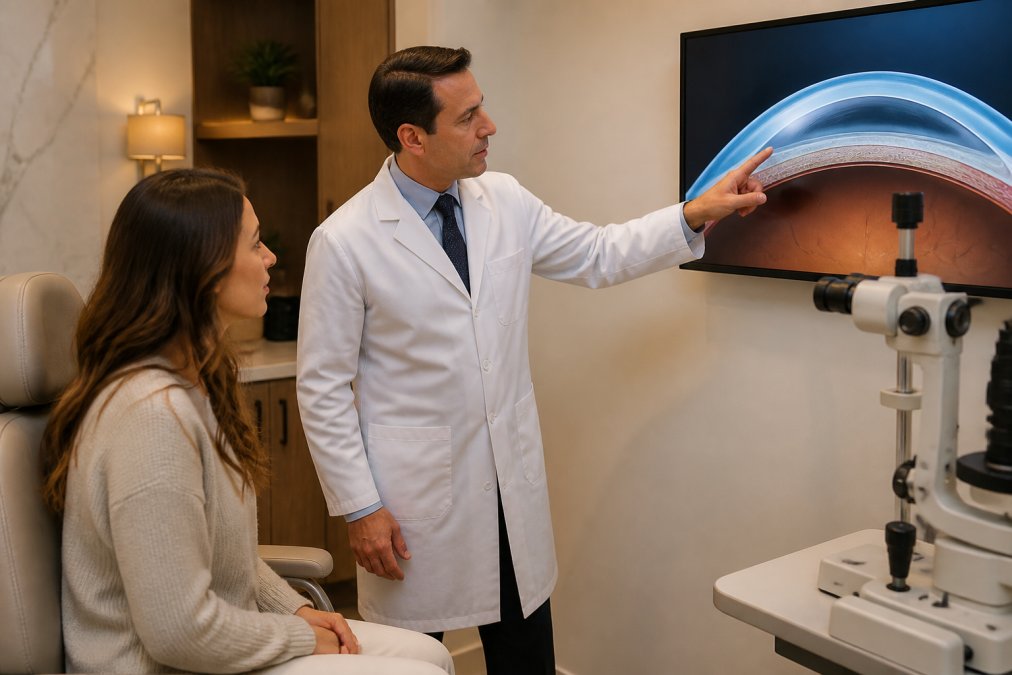
The cornea bends incoming light. When its curve doesn’t match the eye’s length, images land slightly off the retina, producing a refractive error. LASIK uses a laser to remove microscopic amounts of corneal tissue, flattening a steep curve or steepening a flat one. The goal is sharper focus at distance, and for most candidates it works well.
The FDA guide to LASIK notes that the procedure is intended to reduce dependence on corrective lenses, not to guarantee perfect vision for life. That distinction matters. A patient who reads the fine print understands that outcomes vary, and that follow-up care shapes the long-term result as much as the surgery itself.
What LASIK Can and Cannot Fix: Nearsightedness, Farsightedness, and Astigmatism
LASIK treats three main refractive errors: myopia (nearsightedness), hyperopia (farsightedness), and astigmatism. It does not treat presbyopia, the age-related loss of near focus that begins in the early-to-mid 40s, nor does it resolve cataracts, glaucoma, or macular degeneration.
For nearsighted patients, the laser flattens a cornea that was too steep, improving distance vision. For farsighted patients, it steepens a flatter cornea. Astigmatism, which comes from an unevenly curved cornea, is corrected by smoothing the surface into a more regular shape.
What LASIK cannot do is stop the eye from aging. A patient who is 20/20 after surgery still develops presbyopia later, and that is normal. Understanding this before surgery prevents disappointment afterward.
Some patients assume LASIK replaces reading glasses forever. If you are over 40 or nearing that milestone, ask your surgeon how the procedure interacts with presbyopia before scheduling. Ignoring this leads to frustration when near vision still requires help.
The LASIK Enhancement Rate: Why Some Patients Need a Second Procedure
A small share of patients need an enhancement, a second laser procedure to fine-tune the result. The enhancement rate varies by surgeon, technology, and the patient’s original prescription. Higher corrections, thinner corneas, and younger patients with high myopia tend to need touch-ups more often. The enhancement rate varies by surgeon, technology, and the patient’s original prescription. Higher corrections, thinner corneas, and younger patients with high myopia tend to need touch-ups more often.
Why vision drifts in the first place. Two forces are at work. The first is biological: the cornea heals individually, and as tissue remodels in the months after surgery, the final refractive outcome can shift slightly from the surgical plan. The second is structural: the eye continues to change with age, and for patients who were still progressing before surgery, a small amount of myopic drift can return. Neither is a surgical failure, they are the eye doing what eyes do.
When enhancements happen. Surgeons generally wait until vision has stabilized, which usually means at least three to six months after the primary procedure, and often longer. Operating on an eye that is still settling risks over-correcting and creating a new problem. A common pattern is a touch-up at the one-year mark, once refraction has held steady across two or more visits.
How an enhancement is performed. There are two main routes:
- Flap lift. If the original LASIK flap is still accessible, the surgeon lifts it and applies additional excimer laser treatment to the exposed stromal bed. Recovery is typically fast because the surface epithelium is left largely intact.
- Surface ablation (PRK-style). If the flap cannot be safely lifted, because of scarring, epithelial ingrowth, or simply too much time, the surgeon removes the surface epithelium and treats the cornea directly. Recovery is slower and more uncomfortable, but it avoids disturbing the original flap.
What it costs and who pays. Many practices include a window for enhancements in the original surgical fee, while others charge a per-procedure fee or exclude touch-ups entirely. This is one of the most important line items to confirm in writing before scheduling.
Needing an enhancement is not a failure of the surgery. It reflects the reality that the eye heals individually and continues to age. The right question is not “will I need one?” but “what is this practice’s enhancement policy, and does the quoted price cover it?”
Presbyopia After LASIK: Why Reading Glasses May Still Be Needed
Presbyopia after LASIK is one of the most common sources of confusion. LASIK corrects the shape of the cornea, but presbyopia comes from the lens inside the eye losing flexibility with age. The laser never touches that lens, so it cannot prevent presbyopia.
Patients in their 40s and older often still reach for reading glasses after surgery, especially for close work like reading or phone screens. Some surgeons use monovision, correcting one eye for distance and the other for near, to reduce that dependence. Others recommend a refractive lens exchange for patients who want to address both distance and near vision at once.
If reading glasses are a dealbreaker, say so during your consultation. The right surgical plan depends on your goals, not a one-size-fits-all approach.
The Cost for Laser Eye Surgery: What Factors Drive the Price
The cost for laser eye surgery depends on several variables, and pricing varies widely between practices. Technology, surgeon experience, pre- and post-operative care, and whether enhancements are included all influence the final figure. Some quotes cover everything; others exclude follow-up visits or touch-ups.
Because pricing is not standardized, the honest answer is that you should request a written quote that lists what is and isn’t included. At Clear Vision San Antonio, we review each patient’s needs and provide transparent pricing during the consultation.
| Cost Factor | What It Covers | Why It Matters |
|---|---|---|
| Technology used | Laser platform and mapping tools | Newer systems can improve precision |
| Surgeon experience | Skill and case volume | Affects outcomes and complication rates |
| Follow-up care | Post-op visits and monitoring | Catches issues early |
| Enhancement policy | Whether touch-ups are included | Avoids surprise costs later |
Ask whether the quoted price includes enhancements, post-operative visits, and any required eye drops. A lower headline number often excludes these, and the total can climb quickly.
Corneal Thickness and Other Factors That Affect Your Candidacy
Corneal thickness is one of the most important factors in LASIK candidacy, and it is also one of the least explained. The laser removes tissue to reshape the cornea, so a cornea that is too thin leaves insufficient remaining thickness beneath the flap, a condition surgeons call a low residual stromal bed. Below a certain threshold, the cornea can lose structural integrity and develop a rare but serious complication called post-LASIK ectasia, in which the cornea progressively bulges and vision worsens.
How surgeons measure it. Two instruments do the heavy lifting. Corneal topography maps the surface curvature and flags irregular patterns that suggest keratoconus or forme fruste keratoconus, conditions that disqualify a patient from LASIK. Pachymetry measures corneal thickness in microns. Pachymetry measures corneal thickness in microns.
Other candidacy factors. Beyond thickness and topography:
- Stable prescription. Generally unchanged for at least one year. A prescription still drifting suggests the eye has not finished changing, and operating on it invites regression.
- Healthy corneas. No keratoconus, no significant scarring, no recurrent erosion.
- No active eye infection or inflammation. Conjunctivitis, uveitis, and severe blepharitis should be resolved first.
- Age and hormonal status. Pregnancy and breastfeeding can temporarily change refraction and should be avoided around surgery (Checking your browser). Certain autoimmune conditions and uncontrolled diabetes can impair healing and are evaluated case by case.
- Dry eye. Significant pre-existing dry eye is a relative contraindication because LASIK can worsen it.
Do not treat a low price or a fast approval as a green light. A proper candidacy evaluation includes topography, pachymetry, a dilated retinal exam, and a refraction, not just a quick vision test. If a practice skips these, the “complete correction” promise is built on incomplete information.
Long-Term Vision Stability and Post-LASIK Maintenance
Long-term vision stability after LASIK is generally good, but it is not guaranteed for life. Most patients maintain their corrected vision for years, yet natural aging continues. Presbyopia arrives regardless of surgery, and cataracts can develop later just as they would without LASIK.
Frequently Asked Questions
What happens 20 years after LASIK?
Twenty years after LASIK, many patients maintain good vision, but age-related changes like presbyopia and cataract development can still occur. The cornea may also change slightly over time. Regular eye exams are important to monitor ocular health and address any vision changes. Some patients may need reading glasses or an enhancement procedure later.
What is the statistical failure or enhancement rate of LASIK?
The LASIK enhancement rate varies by study and surgeon. An enhancement may be recommended if there is residual refractive error or visual regression. Your candidacy for enhancement depends on corneal thickness and overall eye health.
Does LASIK prevent the need for reading glasses as you age?
No, LASIK does not prevent presbyopia, which is the age-related loss of near focusing ability. Even after successful LASIK, most people will eventually need reading glasses or bifocals for close-up tasks. Monovision LASIK, where one eye is corrected for distance and the other for near, can reduce dependence on reading glasses but is not a cure for presbyopia.
At what age is LASIK not worth it?
LASIK is generally not recommended for individuals under 18 or those with unstable vision. For adults over 40, presbyopia may limit the benefits of LASIK for near vision. In some cases, refractive lens exchange may be a better option. A consultation with an eye doctor can help determine if LASIK is worth it for your specific situation.