
Table of Contents
- Why Early School Vision Screenings Matter More Than You Think
- The Hidden Link Between Vision and Academic Performance
- Common Signs of Vision Problems in Students
- What Actually Happens During a School Screening
- School Screening vs Comprehensive Pediatric Eye Exam
- Understanding Texas Vision Screening Requirements for Schools
- Your Post-Screening Roadmap: What Parents Should Do Next
- Conclusion: Prioritizing Pediatric Eye Health Starts Early
- Frequently Asked Questions
Last Updated: September 4, 2026
Why Early School Vision Screenings Matter More Than You Think
Undetected vision problems remain one of the most common yet treatable barriers to learning, which is why the benefits of early school vision screenings extend far beyond a simple eye chart check. A child who cannot see the board clearly often gets labeled as inattentive or disruptive when the real issue is an uncorrected refractive error.
Early detection is the single most effective tool against conditions like amblyopia and strabismus. When caught during the developmental window of early childhood, these conditions respond well to treatment. Miss that window, and the visual system may never fully develop the binocular vision and depth perception required for tasks like reading or catching a ball.
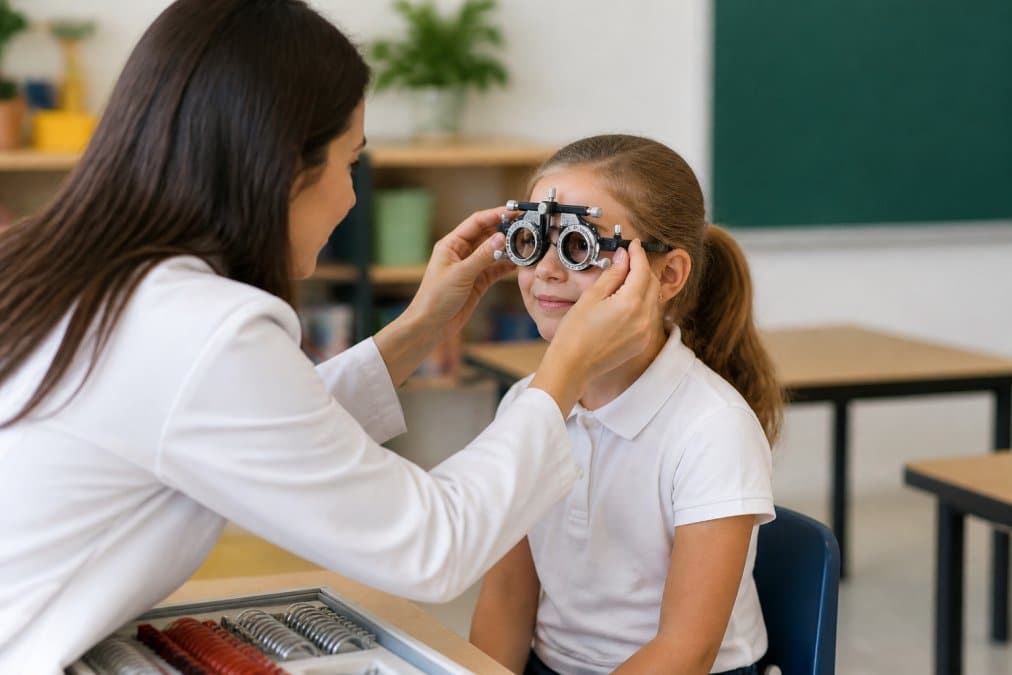
The preschool and early elementary years are the critical period for vision development. Screenings during this time catch problems while treatment has the best chance of working.
The Hidden Link Between Vision and Academic Performance
Research consistently shows that vision and learning are deeply connected, with up to 80% of what a child learns in school delivered through visual processing. A student with myopia cannot see the whiteboard; with hyperopia, they may experience headaches and fatigue during close work. These directly impact classroom performance.
The learning environment demands sustained visual effort, switching focus between a distant board and a nearby desk. When that system is strained, children often avoid reading, compounding learning gaps over time. This is why the link between undetected vision impairment and lower test scores is well documented.
Many parents assume a child would complain if they could not see well. In practice, children rarely do; they adapt, often assuming everyone sees the world the same way. That adaptation means squinting, tilting their head, or losing their place while reading, silent signals of a deeper visual issue.
Common Signs of Vision Problems in Students
Most parents are surprised to learn how subtle the signs of vision problems in students can be. A child does not need to fail an eye test to be struggling. Watch for behavioral cues that suggest visual discomfort or an inability to focus clearly.
Refractive Errors (Myopia, Hyperopia, Astigmatism)
These are the most common vision problems, affecting how the eye focuses light. They are not diseases but rather variations in the shape of the eye.
- Myopia (Nearsightedness): Difficulty seeing distant objects clearly. Signs include squinting to see the board, sitting very close to the television, or complaining that the board is “blurry.” A child with uncorrected myopia may seem disengaged in class because they simply cannot see what is being taught.
- Hyperopia (Farsightedness): Difficulty seeing close objects clearly, though young children can often compensate by straining their focusing muscles. This strain leads to the classic signs of eye fatigue, headaches, and rubbing eyes, especially after reading or doing close work. A child may avoid reading altogether because it is physically uncomfortable.
- Astigmatism: Blurred or distorted vision at all distances due to an irregularly shaped cornea. Signs include squinting, headaches, and tilting the head to try to find a clearer angle.
Binocular Vision Problems (Strabismus and Amblyopia)
These conditions involve how the eyes work together as a team.
- Strabismus (Eye Misalignment): One eye may turn in, out, up, or down. A child might close one eye to avoid double vision or tilt their head to align the eyes. This is not a cosmetic issue; it can lead to amblyopia if untreated.
- Amblyopia (Lazy Eye): This occurs when the brain begins to ignore signals from one eye because it is not receiving a clear image. It is often a consequence of uncorrected strabismus or a large refractive error in one eye. A child may not show obvious outward signs, but you might notice them bumping into things on one side, having poor depth perception, or covering one eye to see better.
Accommodative and Focusing Problems
- Convergence Insufficiency: Difficulty keeping both eyes aligned when looking at a close object. Signs include losing their place while reading, words appearing to move or float on the page, and avoiding reading or other near work. A child may complain of eye strain or double vision after just a few minutes of reading.
Behavioral and Academic Red Flags
Beyond physical symptoms, watch for these classroom and homework behaviors:
- Frequent eye rubbing or blinking during close work
- Complaints of headaches, especially after school
- Sitting unusually close to the television or holding books very near the face
- Losing their place while reading or using a finger to track lines
- Covering one eye to see better or tilting the head to one side
- Short attention span for visual tasks like puzzles or drawing
- Declining grades or a sudden lack of interest in schoolwork
- Avoiding activities that require good vision, like catching a ball or riding a bike
These symptoms point to refractive errors, eye alignment problems, or visual tracking difficulties. If you notice several patterns, a school screening is a sensible first step; if it raises concerns, a comprehensive eye exam is the next stop.
Do not assume a child will outgrow crossed eyes or frequent squinting. [Conditions like strabismus and amblyopia](/amblyopia-vs-strabismus-treatment-differences/) require early intervention; waiting often reduces treatment options and makes the condition harder to correct.
Pay attention to clusters of behaviors. A single squint may be a fluke, but a pattern of squinting, headaches, and avoiding reading is a strong signal that a comprehensive eye exam is needed.
What Actually Happens During a School Screening
A school vision screening is a quick, non-invasive process designed to identify children who may need a full examination. It is not a diagnosis. Knowing what will happen can turn a confusing experience into a calm one for both you and your child.
The Typical Screening Flow
- Distance Visual Acuity Test: This is the classic eye chart test. Trained personnel, often school nurses or trained volunteers, will have your child stand 10 feet from a chart and read letters, shapes, or symbols (called optotypes) with each eye covered separately. For younger children who cannot yet read, matching games with shapes or pictures are used instead.
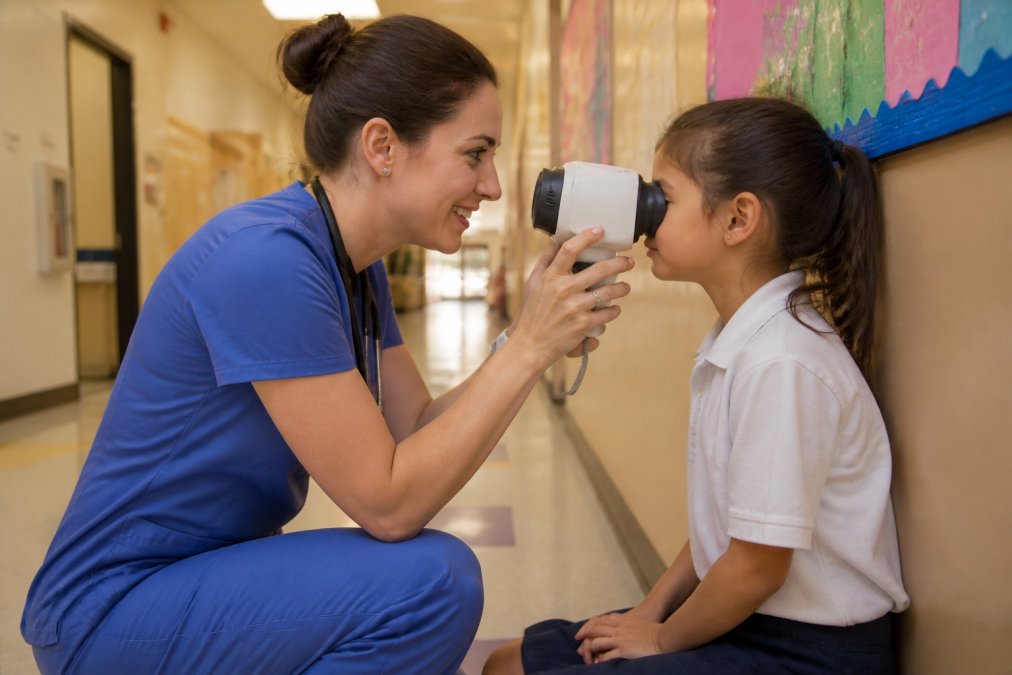
- Photoscreening (Increasingly Common): Many schools now use a specialized camera that takes digital images of the eyes. This device can detect risk factors for amblyopia (lazy eye), strabismus (eye misalignment), and significant refractive errors like myopia and hyperopia. It is quick, requires minimal cooperation, and is highly effective at catching issues that a simple eye chart might miss.
- Near Vision Check (Sometimes Included): Some screenings also check a child’s ability to see clearly at close range, which is essential for reading and desk work. This is often done with a small card held about 14 inches from the face.
- Color Vision Screening (Less Common): While not a standard part of every school screening, some programs include a basic color vision test, especially in early grades.
The entire process typically takes only 3 to 5 minutes per child. It is designed to be low-stress and is not a medical procedure.
How to Prepare Your Child (The Parental Preparation Guide)
A little preparation goes a long way in reducing anxiety and getting accurate results.
- Talk About It in Advance: A week before the screening, mention it casually. Say something like, “Next week, a nice nurse will check how well your eyes see. It’s like a fun game where you read letters or point to pictures. It won’t hurt at all.” Avoid using words like “test” or “exam” which can sound scary.
- Practice at Home (For Younger Kids): If your child is in preschool or kindergarten, practice the matching game. Show them a card with shapes and ask them to point to the same shape on a larger chart. This familiarizes them with the task so they are not confused on the day.
- Role-Play the Eye Covering: Explain that they will get to wear a cool pirate patch over one eye at a time. Practice covering each eye with a hand at home so they are comfortable with the sensation.
- Ensure They Are Well-Rested: A tired child is less cooperative and may not perform their best. Make sure they get a good night’s sleep before the screening day.
- Bring Glasses if They Wear Them: If your child already wears glasses, remind them to wear them on screening day. The screening is meant to check their vision with their current correction.
If your child is particularly anxious about new experiences, let the school nurse or screening volunteer know in advance. They are trained to work with children and can often take extra time to make your child feel comfortable.
Passing a screening does not guarantee perfect vision. Screenings are a public health tool for population-level detection, not a substitute for a clinical evaluation, the first filter, not the final word.
School Screening vs Comprehensive Pediatric Eye Exam
Many parents wonder whether a school screening is enough; the answer depends on the goal. A screening is a valuable, cost-effective public health measure that flags potential issues. It checks basic visual acuity and risk factors, but it does not assess how well the eyes work together.
A comprehensive pediatric eye exam goes much deeper, evaluating visual acuity plus eye alignment, focusing ability, depth perception, and overall eye health. This is how amblyopia and strabismus are definitively diagnosed. The American Optometric Association and the American Academy of Ophthalmology both recommend a comprehensive exam before starting school and at regular intervals.
| Screening Type | What It Checks | Who Performs It | Best For |
|---|---|---|---|
| School Screening | Basic visual acuity, some risk factors | School nurse or trained volunteer | Identifying children who need a full exam |
| Comprehensive Eye Exam | Full eye health, alignment, focusing, depth perception | Optometrist or Ophthalmologist | Confirming a diagnosis and starting treatment |
Screenings catch the children most likely to need help; comprehensive exams provide the definitive diagnosis and treatment roadmap. Both are essential.
Understanding Texas Vision Screening Requirements for Schools
Texas stands out for its proactive approach to children’s vision health, with mandatory screening requirements among the most structured in the nation. The state mandates screenings at specific grade levels, administered by the Texas Department of State Health Services, which provides guidance and training for school personnel.
Screening is required for students in Pre-Kindergarten, Kindergarten, 1st, 3rd, 5th, and 7th grades. Students entering Texas public schools for the first time must be screened within their first 120 days of enrollment. Screenings must follow standardized protocols, ensuring consistency across districts.
For parents, this means your child will likely be screened at school, but you should not wait for that notification if you suspect a problem. The state’s program is a safety net, not a ceiling. If you have concerns about your child’s vision, schedule a comprehensive exam regardless of when the last school screening occurred. The Texas Department of State Health Services vision screening guidelines provide a clear overview of what schools are required to do.
Keep a record of your child’s screening results. If a school screening suggests a problem, share that report with your eye doctor. It provides a useful baseline for the comprehensive exam.
Your Post-Screening Roadmap: What Parents Should Do Next
Receiving a referral from a school screening can feel alarming, but treat it as an opportunity, not a crisis. Schedule a comprehensive pediatric eye exam. Bring the school’s screening report, as it gives the doctor a starting point for evaluation.
If the exam finds a problem, the doctor will outline a treatment plan, which may include glasses, vision therapy, or patching. Early intervention for amblyopia is highly effective, which is why prompt follow-up matters; delaying treatment, even by a few months, can reduce its effectiveness.
For families without insurance or with limited access to care, resources exist to help. Programs like Prevent Blindness Children’s Vision Screening Program and Head Start vision screening guidelines offer guidance and can connect families with local services. The goal is to ensure that every child, regardless of background, has access to the vision care they need to succeed in school and in life.
Conclusion: Prioritizing Pediatric Eye Health Starts Early
The case for early school vision screenings is built on a simple premise: children cannot learn what they cannot see. These screenings are the first line of defense in catching conditions like amblyopia and strabismus during the critical developmental window. For parents, the screening is a starting point, not an endpoint.
If your child has been referred for a comprehensive exam, or if you have noticed signs of vision problems in students, do not delay. At Clear Vision San Antonio, our team of expert eye doctors provides comprehensive evaluations and personalized treatment plans. We combine advanced technology with a commitment to seeing every patient as an individual, ensuring your child receives the highest standards of eye care.
Frequently Asked Questions
Are school vision screenings reliable?
School vision screenings are a valuable first step, but they are not diagnostic. They are designed to spot potential red flags, not to measure overall eye health. A screening can miss conditions like amblyopia or focusing issues that don’t affect distance vision. Think of a screening as a referral tool: if your child passes, it is a good sign, but if they fail or show any signs of vision problems, it is essential to book a comprehensive pediatric eye exam with an eye doctor for a full evaluation.
At what age should a child’s first comprehensive eye exam occur?
Experts recommend a comprehensive eye exam before a child starts first grade, even if they passed a school screening. Many pediatric eye doctors suggest an initial exam around age 3 to check for amblyopia and strabismus, with another before kindergarten. These exams check more than visual acuity; they evaluate eye alignment, focusing ability, and overall eye health. Early detection of issues like lazy eye is critical because treatment is most effective when started young.
What is the difference between a school vision screening and a comprehensive eye exam?
A school vision screening is a quick, basic check that typically only tests distance visual acuity using an eye chart. It is often performed by a nurse or trained volunteer and takes a few minutes. In contrast, a comprehensive pediatric eye exam is performed by an optometrist or ophthalmologist. It includes a thorough evaluation of refractive errors like myopia and hyperopia, eye alignment, binocular vision, and the overall health of the eye. Only a comprehensive exam can provide a complete diagnosis and prescription for glasses.
How do undiagnosed vision problems affect student performance?
Undiagnosed vision problems can significantly impact a child’s ability to learn. A student who cannot see the board clearly may fall behind on lessons. Difficulty with near vision can make reading and homework frustrating, leading to avoidance and poor academic achievement. Children may also be mislabeled as having attention issues when they are simply struggling to see. Early school vision screenings help identify these issues, ensuring children get the support they need for classroom performance and child development.
The challenge for parents is knowing when a screening result requires action. Trust your instincts. If something feels off with your child’s vision, a comprehensive exam provides clarity. Clear Vision San Antonio offers the expert, personalized care needed to address pediatric eye health concerns and support your child’s development. Request an appointment today and give your child the gift of clear vision for life.
This article was written using GrandRanker