
Table of Contents
- LASIK vs ICL Vision Correction: Key Differences at a Glance
- How LASIK and ICL Procedures Work
- LASIK Candidacy Requirements and Who Should Consider It
- Is ICL Reversible? Understanding the Removability Factor
- ICL Surgery Recovery Time vs. LASIK Visual Recovery
- Cost of ICL vs LASIK: Pricing, Financing, and Insurance
- Pros and Cons: Which Procedure Matches Your Lifestyle?
- Long-Term Maintenance and Age-Related Vision Changes
Last Updated: July 10, 2026
When choosing a vision correction procedure, the decision between lasik vs icl vision correction shapes not just your eyesight, but your lifestyle for decades to come. These two procedures represent fundamentally different approaches to fixing refractive errors, and the choice depends on your corneal anatomy, prescription strength, and how you want to live after surgery. At Clear Vision San Antonio, we’ve guided thousands of patients through this exact decision, and the answer is rarely one-size-fits-all.
LASIK vs ICL Vision Correction: Key Differences at a Glance
LASIK and ICL are both refractive surgery options that correct myopia, hyperopia, and astigmatism, but they work through opposite mechanisms. LASIK uses a laser to reshape your cornea directly. ICL implants a thin lens inside your eye without touching the corneal tissue. This fundamental distinction cascades into differences in candidacy, reversibility, recovery speed, and long-term maintenance.
What is LASIK?
LASIK stands for laser-assisted in situ keratomileusis. A surgeon creates a thin corneal flap, uses an excimer laser to reshape the underlying corneal tissue, and replaces the flap. The reshaped cornea bends light rays correctly, allowing them to focus on the retina. LASIK has been performed for over 25 years and remains the most common refractive surgery in the United States. Most patients achieve 20/20 vision or better, with visual recovery within days to weeks.
What is EVO ICL?
ICL stands for implantable collamer lens. Rather than reshaping corneal tissue, ICL surgery places a prescription lens inside your eye, positioned between the iris and your natural lens. The lens is made from Collamer, a biocompatible material that your eye tolerates without inflammation or rejection. ICL is reversible, the lens can be removed or replaced if your vision changes or if you need different correction in the future.
How LASIK and ICL Procedures Work
Both procedures take 10-15 minutes per eye in an outpatient surgical center. You receive numbing drops and mild sedation, remaining awake but relaxed.
The LASIK Process: Corneal Reshaping Step-by-Step
Your surgeon applies numbing drops and positions your eye under the laser. A microkeratome or femtosecond laser creates a thin corneal flap (100-160 microns thick), which is lifted away to expose the stromal tissue beneath. The excimer laser fires ultraviolet pulses across your cornea, each removing a microscopic layer of tissue. For myopia, the laser flattens the corneal center. For hyperopia, it steepens the center. For astigmatism, it smooths irregular curvature.
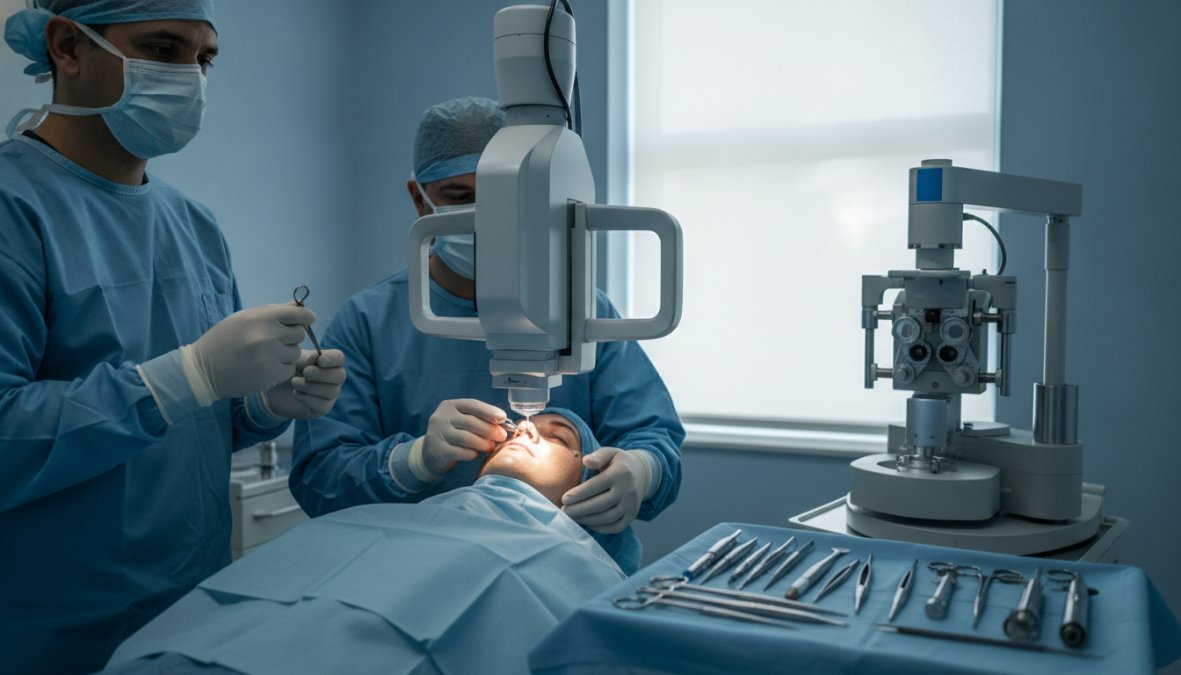
Once reshaping is complete, the surgeon repositions the corneal flap. It adheres naturally without stitches, and your vision begins improving immediately, though full clarity takes 2-4 weeks. Modern systems like WaveLight Plus use topography-guided technology, mapping over 100,000 data points on your cornea to customize treatment and reduce halos and glare.
The ICL Process: Intraocular Lens Implantation
ICL surgery requires precise measurement of your eye’s internal dimensions, anterior chamber depth, lens thickness, and white-to-white distance to select the correct lens size. During surgery, your surgeon makes a small 3mm incision at the corneal edge. The ICL is inserted through this opening in a folded state using a specialized injector, then unfolds and positions itself behind the iris and in front of your natural lens. The incision is so small it often doesn’t require stitches. The EVO ICL includes a small hole (KXL technology) that improves fluid circulation inside the eye, reducing the risk of increased eye pressure.
LASIK Candidacy Requirements and Who Should Consider It
LASIK candidacy depends on corneal thickness, prescription strength, and eye health. Your cornea must be thick enough to safely remove tissue, typically at least 480 microns after the procedure. Your prescription must fall within treatable ranges: myopia up to about -12.00 diopters, hyperopia up to +6.00 diopters, and astigmatism up to about 6.00 diopters. Your eyes must be healthy, active corneal disease, severe dry eye, or certain autoimmune conditions can disqualify you. Your prescription must have been stable for at least one year, and most surgeons recommend waiting until age 20-22 for younger patients. LASIK is ideal for patients with adequate corneal thickness, moderate to high myopia, and those who want immediate visual recovery and permanent correction.
Is ICL Reversible? Understanding the Removability Factor
ICL is completely reversible. If your vision changes, if you develop complications, or if you simply change your mind, your surgeon can remove the lens through a small incision. The lens can be replaced with a different prescription or removed entirely. This reversibility appeals to younger patients who worry about long-term effects they can’t yet predict, and to patients with progressive conditions where myopia continues to worsen. LASIK, by contrast, is permanent. Once your cornea is reshaped, that tissue doesn’t regenerate. If your vision changes later due to aging or presbyopia, you’d need an enhancement procedure or reading glasses.
ICL Surgery Recovery Time vs. LASIK Visual Recovery
Recovery speed is one of the most dramatic differences between these procedures.
LASIK Recovery Timeline and Visual Results
Your vision improves almost immediately after LASIK. Many patients report clearer sight within hours. By day one, most patients see well enough to recognize faces and read large text. By one week, vision is typically 20/40 or better. By four weeks, vision stabilizes at its final result, usually 20/20 or better.
During the first week, you’ll experience some grittiness, mild light sensitivity, and occasional halos around lights at night. These symptoms resolve quickly. You can return to desk work within 3-5 days and resume exercise within 1-2 weeks, though contact sports require 4 weeks of healing. Dry eye is the most common post-operative effect, typically managed with lubricating drops and normalizing by six months.
ICL Recovery Timeline and Visual Results
ICL recovery is slower initially. Your vision on day one is typically blurry, often 20/100 or worse, this is expected and not a problem. By one week, vision improves to around 20/40. By two weeks, many patients reach 20/20. By one month, vision stabilizes at its final result.
During the first two weeks after ICL, you’ll use anti-inflammatory and antibiotic eye drops four times daily and have more post-operative visits than LASIK patients to ensure the lens is positioned correctly and your eye pressure remains normal. Dry eye is less common after ICL than LASIK because your corneal nerves aren’t disrupted. You can resume light activities within one week and most normal activities within two weeks.
Cost of ICL vs LASIK: Pricing, Financing, and Insurance
Pricing for both procedures varies significantly based on your surgeon’s experience, location, and technology used. Both are elective procedures not covered by most insurance plans. When comparing prices, ensure you’re comparing complete packages, including the surgeon’s fee, facility fees, pre-operative testing, and post-operative care.
Check your health insurance policy and employer’s vision benefits. Some plans offer $500-$1,500 reimbursement toward refractive surgery. HSA and FSA accounts can often be used to pay for these procedures with pre-tax dollars. Many surgeons offer payment plans through third-party financing companies, allowing you to spread payments over 12-24 months with no interest if paid in full within the promotional period.
Ask your surgeon specifically what’s included in their quoted price. Some include all post-operative visits and enhancements; others charge separately. A seemingly lower price may actually cost more once you add these extras.
Pros and Cons: Which Procedure Matches Your Lifestyle?
Neither procedure is objectively "better." The right choice depends on your corneal anatomy, prescription, lifestyle, and personal preferences.
Advantages and Disadvantages of LASIK
Advantages:
LASIK offers unmatched speed. You see clearly within days, not weeks. For athletes, professionals, or those with demanding jobs, this matters enormously. The procedure is permanent, no future maintenance or replacement lenses. LASIK has the longest track record, with millions of procedures performed since the 1990s and stable results decades after surgery. Modern systems like WaveLight Plus use advanced eye-tracking and topography-guided customization, reducing complications and improving visual quality.
Disadvantages:
LASIK requires adequate corneal thickness. If your corneas are thin, you’re not a candidate. Corneal flap creation carries small risks, though rare. LASIK is irreversible, if your vision changes unexpectedly or if you develop presbyopia, you’ll need reading glasses or an enhancement procedure. Dry eye is more common after LASIK than ICL, though usually temporary.
If you have thin corneas (under 480 microns) or very high myopia (beyond -12.00), LASIK may not be safe. Your surgeon will measure corneal thickness during your evaluation and advise whether you’re a candidate.
Advantages and Disadvantages of ICL
Advantages:
ICL is reversible. If your vision changes or you want the lens removed for any reason, your surgeon can extract it. ICL doesn’t require corneal thickness, making it the best option for patients disqualified from LASIK due to thin corneas. ICL handles extreme prescriptions better, with very high myopia (beyond -12.00) responding well. Dry eye is less common with ICL because your corneal nerves aren’t disrupted. The cornea remains completely intact.
Disadvantages:
ICL recovery is slower initially, with blurry vision for the first week. As an intraocular procedure, it carries inherent risks, though serious complications are rare. ICL requires precise sizing, incorrect sizing can cause vault problems. ICL lenses eventually age and aren’t permanent replacements for your natural lens. ICL is typically more expensive than LASIK for most prescriptions.
Long-Term Maintenance and Age-Related Vision Changes
Both LASIK and ICL patients experience presbyopia, the age-related difficulty focusing on near objects, starting around age 40-45. LASIK patients typically manage presbyopia with reading glasses, bifocals, or progressive lenses. Some surgeons offer monovision LASIK, where one eye is corrected for distance and the other for near vision.
ICL patients face the same presbyopia. However, because ICL doesn’t alter your cornea, some surgeons can perform corneal procedures on top of your ICL to create monovision if desired. After LASIK, your corneal shape is fixed. After ICL, your cornea remains unchanged, allowing for potential lens replacement or corneal surgery if vision adjustment is needed.
Long-term cataract development is unaffected by either procedure. ICL patients should know that cataract surgery is slightly more complex with an ICL in place, though experienced surgeons manage this routinely.
| Aspect | LASIK | ICL |
|---|---|---|
| Recovery Speed | 2-4 weeks to stable vision | 2-4 weeks to stable vision |
| Initial Visual Recovery | Hours to days | 1-2 weeks |
| Corneal Thickness Required | Minimum 480 microns after | No requirement |
| Reversibility | Permanent | Reversible |
| Dry Eye Risk | Moderate (usually temporary) | Low |
| Suitable for High Myopia | Up to -12.00 | Beyond -12.00 |
| Corneal Flap Risk | Small but present | None |
| Intraocular Surgery Risk | None | Small but present |
| Long-term Stability | Excellent (25+ years data) | Excellent (15+ years data) |
| Presbyopia Management | Reading glasses or monovision | Reading glasses or lens replacement |
The choice between lasik vs icl vision correction ultimately depends on your corneal anatomy, prescription strength, lifestyle demands, and comfort level with procedural risks. If you have adequate corneal thickness and want the fastest visual recovery, LASIK is an excellent choice. If you have thin corneas, high myopia, or value reversibility, ICL may be better. Clear Vision San Antonio offers comprehensive evaluations for both procedures, including advanced corneal mapping, anterior chamber measurements, and detailed discussions of your specific anatomy and lifestyle.
Frequently Asked Questions
Is ICL better than LASIK for vision correction?
Neither is universally 'better', it depends on your eye anatomy and lifestyle. ICL excels for patients with thin corneas, high myopia, or those concerned about dry eye syndrome. LASIK works well for patients with adequate corneal thickness and moderate refractive errors. Both achieve excellent visual acuity and permanent correction. Consult a refractive surgeon to determine which suits your specific needs.
What is the main difference in how LASIK and ICL correct refractive errors?
LASIK uses a laser to reshape the cornea, removing tissue to correct myopia, hyperopia, and astigmatism. ICL (implantable collamer lens) is an additive procedure, a biocompatible intraocular lens is placed inside the eye without removing corneal tissue. This fundamental difference affects candidacy, reversibility, dry eye risk, and long-term outcomes.
Can you get LASIK if you have thin corneas?
Thin corneas are a significant limitation for LASIK because the procedure requires removing corneal tissue to reshape it. Patients with insufficient corneal thickness may not have enough tissue remaining for safe correction. ICL is often the better alternative for thin-cornea patients, as it doesn't require corneal removal and is reversible if needed.
How long does ICL surgery recovery take compared to LASIK?
LASIK typically provides functional vision within 24 hours, with full visual recovery in 1-3 months. ICL recovery is slightly longer, vision stabilizes within 1-2 weeks, with complete visual recovery in 1-3 months. Both procedures involve similar post-op care protocols, including antibiotic drops and avoiding strenuous activity. Your ophthalmologist will provide a personalized timeline based on your healing response.
The decision between vision correction procedures is deeply personal. At Clear Vision San Antonio, our expert ophthalmologists combine advanced diagnostic technology with personalized attention to help you choose the procedure that fits your unique eye anatomy and lifestyle. Whether LASIK’s rapid recovery or ICL’s reversibility appeals to you, we’re here to guide you toward clear vision for life. Request an appointment today to discuss which procedure is right for you.
This article was written using GrandRanker