

Table of Contents
- Refractive Lens Exchange vs Cataract Surgery: Key Differences Explained
- Proactive vs. Reactive: When Each Procedure Makes Sense
- Surgical Technique Similarities and Differences
- Pros and Cons of Refractive Lens Exchange
- Refractive Lens Exchange Recovery Time and Expectations
- RLE Surgery Cost and Financial Planning
- Patient Candidacy and Eligibility Criteria
- IOL Technology Breakdown: Monofocal, Multifocal, and EDOF Options
Refractive Lens Exchange vs Cataract Surgery: Complete Guide
Last Updated: June 26, 2026
Refractive Lens Exchange vs Cataract Surgery: Key Differences Explained
Both refractive lens exchange (RLE) and cataract surgery replace your natural lens with an intraocular lens (IOL), but they serve fundamentally different purposes. RLE is an elective procedure that corrects refractive errors like myopia, hyperopia, and presbyopia before cataracts develop. Cataract surgery is medically necessary, performed when your natural lens becomes clouded and impairs vision. The surgical technique is nearly identical; what differs is your starting point and motivation.
What Is Refractive Lens Exchange?
Refractive lens exchange (RLE), also called clear lens exchange (CLE), removes your clear, healthy natural lens and replaces it with a premium intraocular lens to correct refractive errors and achieve spectacle independence. RLE is particularly valuable for patients with high refractive errors or presbyopia who are poor candidates for LASIK due to thin corneas or extreme prescriptions. Unlike LASIK, which reshapes the cornea, RLE replaces the lens itself, making it suitable for patients LASIK cannot help.
What Is Cataract Surgery?
Cataract surgery is a medically necessary procedure performed when your natural lens becomes clouded due to aging, UV exposure, medications, or trauma. The surgeon removes the clouded lens using phacoemulsification, ultrasonic energy breaks the lens into fragments that are gently aspirated from the eye, then implants an intraocular lens to restore clear vision. Cataract surgery addresses a medical condition actively degrading your vision.
Proactive vs. Reactive: When Each Procedure Makes Sense
RLE is proactive: you choose the procedure before vision problems significantly impact your life. Cataract surgery is reactive: you undergo it because a medical condition has developed and is affecting your vision quality.
Choose RLE when you’re frustrated with glasses or contacts, have a high refractive error unsuitable for LASIK, or want to address presbyopia. Choose cataract surgery when your lens has become clouded and your vision has noticeably declined, it’s medically necessary.
The proactive vs. reactive distinction affects insurance coverage (RLE is typically not covered; cataract surgery usually is), cost responsibility, and IOL selection. Proactive patients often [invest in premium IOL technology](/can-premium-lens-implants-reduce-your-need-for-reading-glasses/) because they’re paying out-of-pocket. Reactive patients may rely on standard monofocal lenses covered by insurance.
Surgical Technique Similarities and Differences
Phacoemulsification and IOL Implantation
Both RLE and cataract surgery use identical core technique: phacoemulsification followed by intraocular lens implantation. The surgeon makes a small incision (2.2-2.75mm), inserts a phacoemulsification probe using ultrasonic vibrations to break apart the lens, and aspirates the fragments. The capsular bag remains intact to support the new IOL, which is inserted through the same small incision. The entire procedure takes 10-15 minutes per eye.
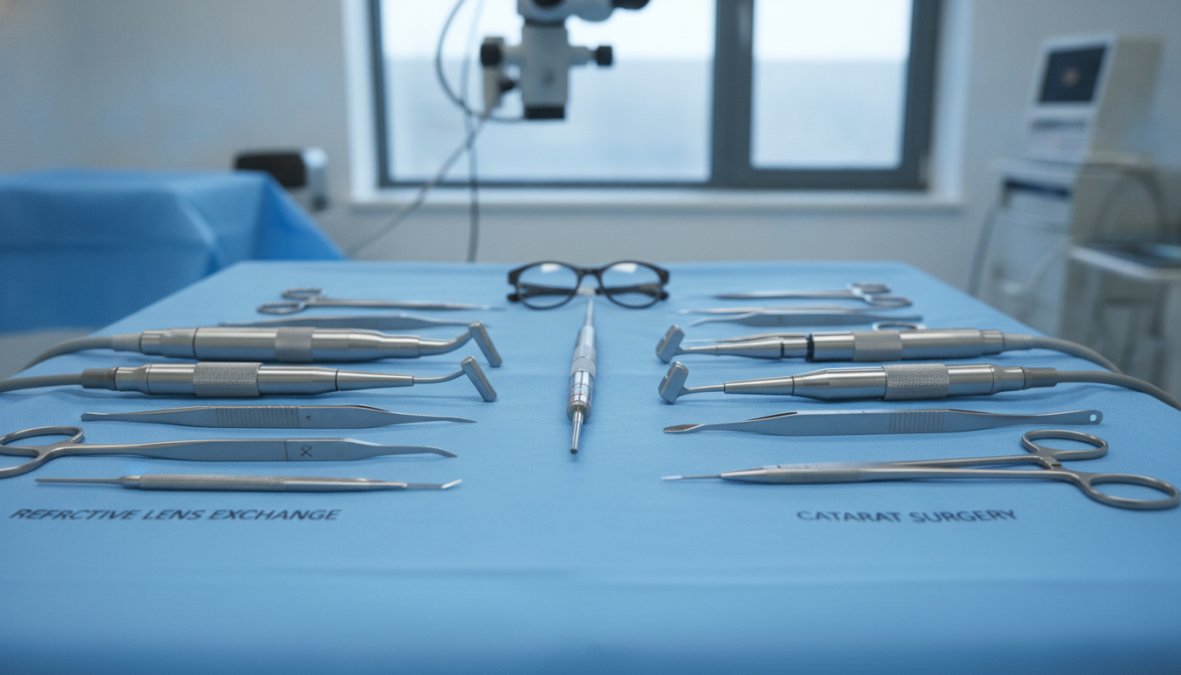
Surgical outcomes are nearly identical between RLE and cataract surgery when performed by experienced surgeons. The difference emerges in IOL types chosen and patient expectations.
Recovery Timeline and Post-Operative Care
Recovery follows a similar timeline for both procedures. Most patients notice improved vision within 24-48 hours, with vision stabilizing over 4-6 weeks. During the first week, use antibiotic and anti-inflammatory eye drops four times daily. Follow-up visits occur at 1 day, 1 week, and 1 month post-operatively.
Activity restrictions are identical: avoid heavy lifting, strenuous exercise, and swimming for 1-2 weeks. Most patients return to desk work within 3-5 days. Contact sports should be avoided for 4 weeks.
Pros and Cons of Refractive Lens Exchange
Advantages of RLE
RLE provides permanent vision correction without glasses or contacts. Once the IOL is implanted, your refractive error is corrected for life. You won’t develop presbyopia in the treated eye, since the IOL doesn’t age like your natural lens.
RLE eliminates future cataract surgery risk, your natural lens is already removed. It also provides access to premium IOL technology that corrects multiple refractive errors simultaneously. Multifocal IOLs, extended depth of focus (EDOF) lenses, and toric IOLs for astigmatism correction enable many patients to achieve 20/20 or better vision at multiple distances.
RLE is an excellent option for patients with high refractive errors or thin corneas unsuitable for LASIK.
Limitations and Considerations
RLE is elective, so insurance doesn’t cover it. Out-of-pocket costs typically range from $4,000-$8,000 per eye, with premium IOL options adding significant cost.
RLE carries surgical risks including infection, retinal detachment, posterior capsular opacification (PCO), and IOL malposition. Most complications are treatable but require additional procedures.
Some premium IOL technologies cause visual side effects. Multifocal IOLs can cause halos and glare around lights, particularly at night. While neuroadaptation typically reduces these symptoms over 3-6 months, some patients find them bothersome long-term.
RLE is irreversible. Once your natural lens is removed, it cannot be replaced. If you’re unhappy with your IOL choice, your options are limited to IOL exchange or supplementary corneal procedures.
Choosing the wrong IOL type for your lifestyle is a common regret. A patient selecting a monofocal IOL optimized for distance but spending 8 hours daily reading will struggle with near vision. Detailed pre-operative consultation is critical.
Refractive Lens Exchange Recovery Time and Expectations
Immediate Post-Operative Period
The first 24 hours after RLE are critical. You’ll experience some discomfort, mild irritation, and blurred vision as the eye heals. Rest with your eyes closed for the first few hours. Most patients notice significant vision improvement by the next morning.
During the first week, vision fluctuates slightly as the cornea heals and swelling decreases. Some patients report clearer morning vision and slightly hazier evening vision, this is normal and resolves within 1-2 weeks. Use medicated eye drops frequently to prevent infection and reduce inflammation.
Avoid rubbing your eyes, getting water in them, or exposing them to dust and debris. Wear sunglasses outdoors. Most patients can drive safely by day 3-5, pending surgeon clearance.
Long-Term Visual Stabilization
Vision stabilizes significantly by 4-6 weeks post-operatively, though subtle improvements continue for 3 months. By the 1-month mark, most patients have a clear sense of their final visual outcome.
Long-term visual outcomes from RLE are excellent. Studies show patients achieve their target refraction in approximately 90% of cases, with visual acuity typically stabilizing at 20/20 or better. Your vision remains stable because your IOL doesn’t age. You won’t experience progressive presbyopia or develop cataracts.
RLE Surgery Cost and Financial Planning
Insurance Coverage and Medical Necessity
RLE is classified as elective, so health insurance plans do not cover it. Insurance considers it a lifestyle improvement rather than treatment for a medical condition. This contrasts with cataract surgery, which is medically necessary and typically covered by Medicare and most private insurance.
For cataract surgery, insurance usually covers the procedure and a standard monofocal IOL. If you choose a premium IOL, you pay the difference out-of-pocket. RLE is entirely your financial responsibility, regardless of IOL selection.
Out-of-Pocket Costs and Premium IOL Options
RLE costs vary based on surgeon experience, geographic location, and IOL technology. Typical RLE ranges from $4,000-$8,000 per eye for surgical fee plus standard monofocal IOL. Premium IOL options add $1,500-$3,500 per eye.
| IOL Type | Cost Per Eye | Bilateral Total | Best For |
|---|---|---|---|
| Standard Monofocal | $4,000-$5,000 | $8,000-$10,000 | Distance vision priority |
| EDOF (Extended Depth of Focus) | $5,500-$6,500 | $11,000-$13,000 | Intermediate and distance |
| Multifocal | $5,500-$6,500 | $11,000-$13,000 | Near, intermediate, distance |
| Toric (Astigmatism Correction) | $5,500-$7,000 | $11,000-$14,000 | Astigmatism correction |
Some surgeons offer financing plans to make the procedure more accessible.
HSA and FSA Eligibility for Vision Correction
Health Savings Accounts (HSAs) and Flexible Spending Accounts (FSAs) can be used for RLE if deemed medically necessary by your plan. Contact your HSA or FSA administrator before scheduling to confirm coverage. If eligible, you can use pre-tax dollars, effectively reducing your out-of-pocket cost by your marginal tax rate (typically 22-37%).
RLE is a significant financial commitment, but the long-term value is substantial. You’re investing in permanent vision correction that eliminates glasses and contacts for life, plus eliminating future cataract surgery risk. When amortized over 30+ years, the annual cost becomes reasonable, especially compared to ongoing glasses, contacts, and lens solution expenses.
Patient Candidacy and Eligibility Criteria
Ideal Candidates for RLE
The ideal RLE candidate is typically 50 years or older with a stable refractive error and frustration with glasses or contacts. Younger patients with high refractive errors unsuitable for LASIK can also be excellent candidates.
Your surgeon will evaluate corneal health and thickness, absence of significant eye diseases like glaucoma or macular degeneration, and stable refractive error (ideally unchanged for 12 months). Patients with presbyopia are particularly good candidates, RLE with a multifocal or EDOF IOL can eliminate presbyopia permanently.
Patients with thin corneas or very high refractive errors are also excellent candidates, as LASIK may be unsafe for them.
Who Benefits Most from Cataract Surgery
Cataract surgery candidates are anyone with a clouded lens affecting their vision. Age is not a barrier. Your surgeon will recommend surgery when vision loss affects daily activities: difficulty reading, trouble driving at night, or reduced visual clarity impacting work or hobbies.
Cataract surgery is appropriate for patients of all ages and health statuses. Even patients with other eye conditions like glaucoma can benefit, provided the cataract is the primary cause of vision loss.
IOL Technology Breakdown: Monofocal, Multifocal, and EDOF Options
Standard Monofocal Lenses
Monofocal IOLs provide excellent vision at a single focal distance, typically optimized for distance. They’re the most common and affordable option, covered by insurance for cataract surgery. They have no visual side effects like halos or glare and provide excellent contrast sensitivity, particularly in low-light conditions.
The trade-off is clear: you’ll need reading glasses for near work. If you spend significant time reading or doing detailed work, a distance-optimized monofocal lens will require glasses for these activities.
Extended Depth of Focus (EDOF) Technology
Extended depth of focus lenses provide good vision at distance and intermediate distances, with functional near vision for many patients. The Alcon AcrySof IQ Vivity uses X-WAVE technology to stretch light without splitting it, reducing visual side effects. The Johnson & Johnson TECNIS Symfony uses a diffractive echelette design to extend the vision range.
EDOF lenses are an excellent choice for patients wanting reduced glasses dependence without halos and glare concerns. They typically cost $1,500-$2,500 more per eye than monofocal lenses.
EDOF lenses are ideal for active individuals wanting spectacle independence without multifocal visual side effects. They’re particularly well-suited for patients spending substantial time on computers or intermediate-distance work.
Multifocal and Toric Options for Astigmatism
Multifocal IOLs provide vision correction at multiple distances, near, intermediate, and far, allowing many patients to function without glasses for most daily activities. These lenses split incoming light into multiple focal points so your brain receives clear images at multiple distances simultaneously.
The trade-off is visual side effects: halos around lights at night, reduced contrast sensitivity, and glare. Most patients experience significant improvement through neuroadaptation within 3-6 months, though some find side effects bothersome long-term.
Toric IOLs correct astigmatism, an irregular corneal shape affecting approximately 30% of the population. Standard IOLs don’t correct astigmatism; patients would still need glasses. Toric IOLs are available in monofocal, EDOF, and multifocal designs, costing $500-$1,500 more per eye than non-toric counterparts.
The decision between refractive lens exchange vs cataract surgery depends on your circumstances. If you’re facing a clouded lens and vision loss, cataract surgery is medically necessary and will restore lost vision. If you’re proactively seeking to eliminate glasses or contacts, RLE offers permanent vision correction with advanced IOL technology. Request an appointment with Clear Vision San Antonio to discuss which procedure aligns with your vision goals and learn how advanced lens implant options can help you achieve clear vision for life.
Frequently Asked Questions
Is refractive lens exchange the same as cataract surgery?
No. While both procedures use phacoemulsification to remove the natural lens and implant an intraocular lens (IOL), they differ in purpose. Cataract surgery is a reactive, medically necessary procedure to remove a clouded lens caused by cataract formation. Refractive lens exchange (RLE), also called clear lens exchange (CLE), is a proactive elective surgery performed on a clear lens to correct refractive errors like presbyopia and myopia. Both achieve vision correction through lens replacement, but RLE is preventative while cataract surgery treats an existing condition.
How long does refractive lens exchange recovery time typically take?
Most patients experience functional vision within 24-48 hours after RLE, though complete visual stabilization takes 4-6 weeks. During the first week, you may experience mild discomfort, light sensitivity, and fluctuating vision as the eye heals. Strenuous activities and heavy lifting should be avoided for 2-3 weeks. Full neuroadaptation to your new IOL, especially with multifocal or EDOF lenses, can take 3-6 months as your brain adjusts to the new visual quality. Your ophthalmologist will schedule follow-up visits to monitor healing and adjust any medications accordingly.
Does insurance cover refractive lens exchange surgery?
Insurance typically does not cover RLE because it is classified as an elective, refractive surgery rather than a medically necessary procedure. Cataract surgery, by contrast, is usually covered by insurance when the clouded lens significantly impacts visual acuity. RLE costs are generally out-of-pocket expenses. However, you may use HSA (Health Savings Account) or FSA (Flexible Spending Account) funds to pay for RLE if you have an eligible plan. Premium IOL upgrades, such as multifocal or EDOF lenses, incur additional out-of-pocket costs beyond the base procedure, typically ranging from $2,000+ per eye depending on the technology.
What are the main pros and cons of refractive lens exchange?
Key benefits of RLE include permanent vision correction without reliance on glasses or contacts, elimination of presbyopia symptoms, and the ability to choose advanced IOL technology (EDOF, multifocal) for near, far, and intermediate vision. Drawbacks include surgical risks (though rare), the need for neuroadaptation to multifocal lenses, potential visual side effects like halos or glare with certain IOL types, and higher upfront costs. Additionally, RLE is irreversible, once your natural lens is removed, it cannot be restored. Careful patient selection and realistic expectations about visual quality are essential for satisfaction.
This article was written using GrandRanker