

Table of Contents
- What Is Cataract Surgery and Why Cost Varies in San Antonio
- Breaking Down Cataract Surgery Costs: Facility Fees vs. Surgeon Fees
- Does Medicare Cover Cataract Surgery in San Antonio?
- Private Insurance and Vision Coverage for Cataract Surgery
- Monofocal vs. Multifocal Lens Implants: Cost and Vision Outcomes
- Cataract Surgery Recovery Time and Hidden Costs
- Cataract Surgery Financing Options and Payment Plans
- Laser-Assisted Cataract Surgery vs. Traditional Phacoemulsification
Last Updated: June 23, 2026
Understanding cataract surgery costs in San Antonio is more complicated than most patients expect. This guide breaks down every cost component, from facility fees to lens implant upgrades, so you can make an informed decision. We’ll show you how Medicare and private insurance interact with surgical costs, which lens options affect your out-of-pocket exposure, and how to use HSA and FSA accounts to your advantage.
The real difference between a straightforward bill and an unexpectedly high one comes down to three things: the type of lens implant chosen, whether laser-assisted technology is used, and how well you understand your insurance benefits before the procedure.
What Is Cataract Surgery and Why Cost Varies in San Antonio
Cataract surgery removes the eye’s clouded natural lens and replaces it with a clear artificial intraocular lens (IOL). It is among the most commonly performed surgeries in the United States with a strong safety record and brief recovery period.
Pricing differs across San Antonio providers because of surgical setting (hospital-based operating rooms carry higher facility overhead than ambulatory surgical centers), surgeon experience and available technology, lens implant selection, and insurance coverage rules about what qualifies as medically necessary versus elective.
Understanding the Surgical Procedure
The standard technique is phacoemulsification. The surgeon makes a small corneal incision, inserts an ultrasonic probe to break up the clouded lens, and removes fragments through suction. A foldable IOL is then inserted and unfolds into position. The procedure typically takes 15 to 30 minutes per eye.
Laser-assisted cataract surgery uses a femtosecond laser to perform the incision and lens fragmentation with computer-guided precision before the surgeon completes extraction. This distinction matters for cost purposes, addressed in a dedicated section below.
Why Pricing Differs Across San Antonio Providers
San Antonio has hospital-affiliated ophthalmology departments, independent ASCs, and private surgical practices, each with different overhead structures. An ASC typically offers lower facility fees than a hospital outpatient department. Surgeon fees vary based on specialization and Medicare assignment status. These variables mean two patients having the same procedure can receive very different bills.
Breaking Down Cataract Surgery Costs: Facility Fees vs. Surgeon Fees
The total cost is the sum of at least three separate charges billed by different entities, each subject to different insurance rules.
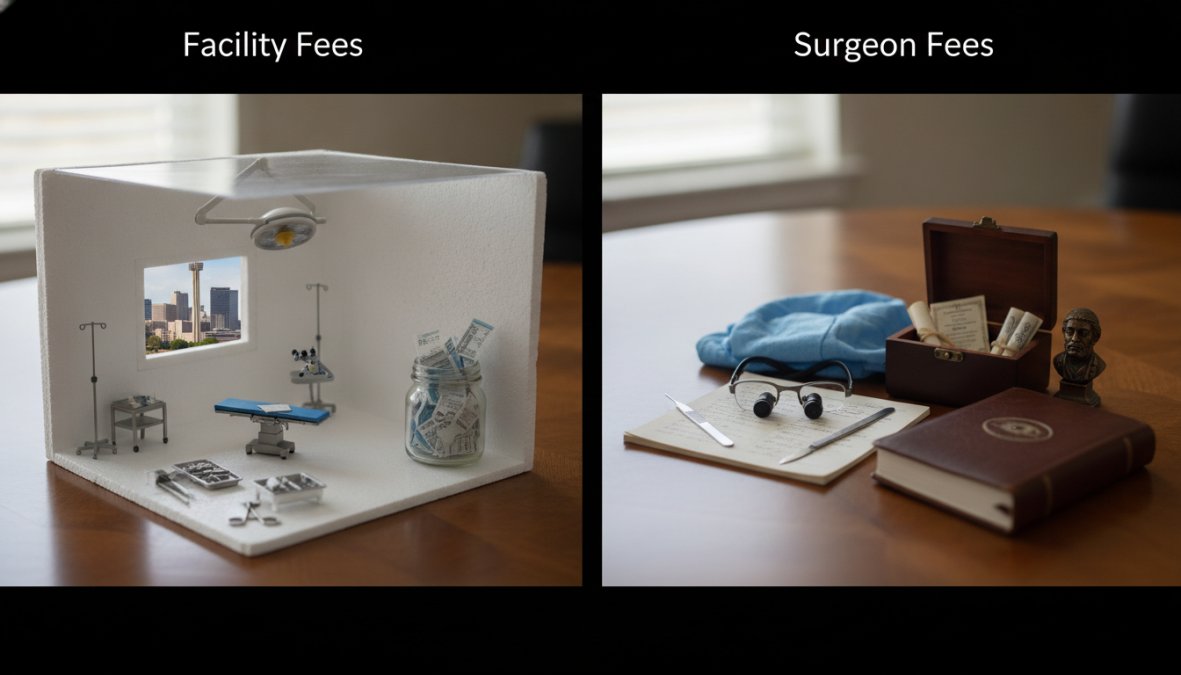
Surgical Facility Fees Explained
The surgical facility fee covers the operating room, nursing staff, sterile supplies, equipment use, and post-operative recovery space. Hospital outpatient departments typically bill higher facility fees than independent ASCs. For Medicare patients, the fee is subject to the Medicare Outpatient Prospective Payment System. For private insurance, the contracted rate depends on in-network status.
Always ask for a separate facility fee estimate when requesting surgical pricing, as the surgeon’s quote often does not include it.
If your surgeon operates at multiple locations, the facility fee can vary significantly between them. A procedure at a hospital-affiliated site may cost substantially more than the same procedure at a freestanding ASC, even with the same surgeon. Confirm which facility your procedure is scheduled at before accepting a quote.
Surgeon Fees and Professional Charges
The surgeon’s professional fee covers the physician’s time, skill, and pre- and post-operative care visits bundled into the global surgical period. For Medicare patients, this fee is billed under the Medicare Physician Fee Schedule. Surgeons who accept Medicare assignment charge only the Medicare-approved amount, and patients pay 20% coinsurance after the Part B deductible. Surgeons who do not accept assignment may charge up to a legal limiting charge, a critical distinction to clarify before scheduling.
Anesthesia and Additional Procedural Costs
Cataract surgery is typically performed under local anesthesia with IV sedation administered by an anesthesiologist or certified registered nurse anesthetist (CRNA). Anesthesia is billed separately by the anesthesia provider. Pre-operative testing, including corneal measurements and vision assessments required to select the correct IOL power, may also generate separate charges.
| Cost Component | Billed By | Insurance Coverage Typical |
|---|---|---|
| Facility fee | Hospital or ASC | Covered if medically necessary, subject to deductible |
| Surgeon fee | Ophthalmologist | Covered if medically necessary, 20% coinsurance typical |
| Anesthesia fee | Anesthesia provider | Covered if medically necessary, separate deductible may apply |
| IOL (standard monofocal) | Bundled with facility | Covered under Medicare and most private plans |
| Premium IOL upgrade | Facility/surgeon | Patient pays the upgrade difference |
| Laser-assisted upgrade | Facility | Generally not covered; patient pays out-of-pocket |
| Pre-op testing | Lab or practice | Usually covered, subject to plan rules |
Does Medicare Cover Cataract Surgery in San Antonio?
Medicare covers cataract surgery when medically necessary, meaning the cataract significantly impairs vision and daily function. Coverage applies to the surgical procedure, standard monofocal IOL, anesthesia, and one pair of eyeglasses or contact lenses following surgery.
According to Medicare’s official coverage guidelines for cataract surgery, cataract extraction is covered under Medicare Part B as a medically necessary outpatient procedure.
Medicare Coverage Eligibility and Requirements
To qualify, the patient must have documented cataracts meeting clinical criteria for surgical intervention. The procedure must be performed by a Medicare-enrolled ophthalmologist at a Medicare-certified surgical center or hospital outpatient department. There is no age-specific cutoff beyond standard Medicare eligibility at age 65, though younger patients with qualifying disabilities may also be covered.
Deductibles, Copays, and Out-of-Pocket Limits
Under Medicare Part B, patients are responsible for the annual deductible and 20% coinsurance of the Medicare-approved amount after the deductible is satisfied. Medicare does not have an out-of-pocket maximum for Part B services, so costs can accumulate if both eyes are done in the same year.
Medicare Advantage (Part C) plans cover cataract surgery, but cost-sharing structures, network restrictions, and prior authorization requirements vary by plan. San Antonio residents should verify their specific plan’s surgical benefits before scheduling.
If you have both Medicare and a Medigap (Medicare Supplement) policy, the Medigap plan may cover all or part of your 20% coinsurance, potentially reducing your out-of-pocket cost to near zero for a standard procedure with a monofocal lens. Review your Medigap policy’s Part B coinsurance coverage before your procedure date.
Private Insurance and Vision Coverage for Cataract Surgery
Private insurance handles cataract surgery similarly to Medicare when medically necessary. The cataract must be clinically documented, and surgery must be ordered by a qualified ophthalmologist. Most major commercial plans cover the procedure under medical benefits, not vision benefits, a distinction that trips up many patients.
How Private Insurance Handles Medically Necessary Surgery
Medical insurance (not vision insurance) covers cataract surgery because it is a medical condition. Vision insurance typically covers routine eye exams and corrective lenses, not surgical procedures. Confirm coverage through your medical insurance carrier, not your vision plan.
Prior authorization is commonly required. Submit documentation of visual acuity loss, impact on daily activities, and the surgeon’s recommendation proactively to prevent claim delays.
Premium Lens Implants and Insurance Limitations
Private insurance, like Medicare, covers a standard monofocal IOL. Any upgrade to a premium lens, multifocal, extended depth-of-focus (EDOF), or toric (astigmatism-correcting), is considered elective. The insurer pays the standard IOL allowance, and the patient pays the difference. This out-of-pocket difference is the primary driver of higher surgical costs for patients wanting to reduce dependence on glasses after surgery.
Monofocal vs. Multifocal Lens Implants: Cost and Vision Outcomes
The choice of intraocular lens is the single biggest variable in cataract surgery cost that patients can control.
Standard Monofocal Lens Coverage and Costs
A monofocal IOL corrects vision at one focal distance, typically distance. Patients generally still need reading glasses for near tasks after surgery. This lens is covered by Medicare and most private insurance plans with no additional patient charge beyond standard cost-sharing. For patients comfortable wearing glasses for some activities, a monofocal lens is cost-effective.
Premium Multifocal and Astigmatism-Correcting Lenses
Premium IOLs reduce or eliminate the need for glasses at multiple distances. Multifocal IOLs provide vision at near, intermediate, and distance ranges. Extended Depth-of-Focus (EDOF) IOLs provide continuous vision range with fewer optical side effects. Toric IOLs correct astigmatism in addition to the cataract, reducing the need for astigmatism-correcting glasses after surgery.
The upgrade cost for premium lenses is paid entirely by the patient, on top of what insurance covers. Ask your surgeon for a detailed breakdown of the upgrade fee versus the standard allowance.
As noted in the American Academy of Ophthalmology’s patient resource on IOL types, the right lens choice depends on your lifestyle, visual demands, and eye anatomy.
Cataract Surgery Recovery Time and Hidden Costs
Cataract surgery recovery is shorter than most patients expect. The first 24 hours require a responsible adult to drive you home. Most patients notice significant vision improvement within days, though full stabilization takes several weeks.
Timeline and Post-Operative Care Expenses
A typical recovery timeline spans from day 1 (eye shield worn overnight; follow-up visit the next morning) through weeks 2-4 (vision continues to stabilize; second-eye surgery may be scheduled) to week 6 (final vision assessment and glasses prescription if needed). Most surgeons include global post-operative care in their fee for a defined period (typically 90 days), but verify this before assuming visits are included.
Medication and Follow-Up Visit Costs
Post-operative eye drops are a genuine hidden cost. The standard regimen includes antibiotic drops to prevent infection and anti-inflammatory drops to reduce swelling. These are prescription medications and may not be fully covered by your drug plan. Ask your surgeon’s office about expected medication costs and whether generic alternatives are available.
Cataract Surgery Financing Options and Payment Plans
The out-of-pocket portion of cataract surgery, particularly with premium lenses or laser-assisted technology, can be substantial. Several financing mechanisms exist to spread that cost over time.
CareCredit and Medical Payment Plans
CareCredit is a healthcare-specific credit product that many ophthalmology practices in San Antonio accept. It offers promotional financing periods, often with deferred interest if the balance is paid within the promotional window. The key risk: if the balance is not paid before the promotional period ends, interest is applied retroactively at a high rate. Read the terms carefully before enrolling.
Some practices offer in-house payment plans with more straightforward terms. Ask whether the plan charges interest and what happens if a payment is missed.
HSA and FSA Eligibility for Cataract Surgery
Cataract surgery is a qualified medical expense under IRS guidelines, making it eligible for payment with Health Savings Account (HSA) or Flexible Spending Account (FSA) funds. This is one of the most tax-efficient ways to cover out-of-pocket surgical costs, including premium lens upgrades, because the funds used are pre-tax dollars.
According to IRS Publication 502 on medical and dental expenses, cataract surgery and related expenses, including prescription eye drops, qualify as deductible medical expenses and eligible HSA/FSA expenditures.
FSA funds are generally subject to a "use it or lose it" rule at year-end, so timing your surgery to align with your FSA balance can maximize the benefit. HSA funds roll over indefinitely, offering more flexibility.
Using HSA or FSA funds to pay for cataract surgery, including premium lens upgrades, effectively reduces the real cost by your marginal tax rate. For many patients, this is meaningful savings that doesn’t require any additional negotiation with the provider.
Direct Pay Packages and Price Transparency
Some San Antonio ophthalmology practices offer bundled direct-pay packages for patients without insurance or those who prefer to pay cash. These bundle the facility fee, surgeon fee, standard IOL, and post-operative care into a single transparent price. Direct-pay pricing is often lower than individually billed components because it eliminates administrative overhead.
Request an itemized estimate that separates the facility fee, surgeon fee, anesthesia estimate, and any lens upgrade costs before committing to a surgical date.
Laser-Assisted Cataract Surgery vs. Traditional Phacoemulsification
Both laser-assisted cataract surgery and traditional phacoemulsification are proven techniques. The question is whether the additional precision of laser assistance justifies the additional cost for your specific situation.
Cost Differences Between Surgical Methods
Traditional phacoemulsification is covered by Medicare and private insurance when medically necessary. Laser-assisted cataract surgery (LACS) using a femtosecond laser is classified as a technology upgrade, not a medically necessary distinction, by most insurers. The laser portion is therefore an out-of-pocket expense for the patient, on top of the standard covered procedure cost.
When Advanced Technology Justifies Additional Expense
Laser-assisted technology offers documented advantages in specific scenarios: complex cataracts, patients with astigmatism choosing a toric IOL, and cases where corneal incision precision is particularly important. For a straightforward cataract in an otherwise healthy eye, the clinical benefit over skilled manual phacoemulsification is more nuanced, and the additional cost may not be warranted.
The right choice depends on your eye’s specific anatomy, your surgeon’s assessment, and your personal priorities around vision correction. A surgeon who recommends laser assistance for every patient without discussing cost-benefit tradeoffs is not giving you complete information.
At Clear Vision San Antonio, our ophthalmologists provide personalized consultations addressing your specific visual needs, anatomy, and financial considerations, including transparent discussion of which technology genuinely benefits your case versus what is optional. Request an appointment to receive a transparent, itemized cost estimate and a lens consultation tailored to your vision goals and budget.
Frequently Asked Questions
How much does cataract surgery cost in San Antonio without insurance?
Without insurance, the cost of cataract surgery in San Antonio typically ranges from $3,000 to $6,000 per eye, depending on the surgeon, facility, and lens type selected. Monofocal lenses (covered by insurance when medically necessary) fall at the lower end, while premium multifocal or astigmatism-correcting lenses can push costs higher. Many surgical centers offer direct pay packages with transparent pricing to help uninsured patients plan their expenses.
Does Medicare cover cataract surgery in San Antonio?
Yes, Medicare covers cataract surgery when deemed medically necessary. Original Medicare covers the surgical procedure and a standard monofocal intraocular lens implant. You'll typically pay a deductible and coinsurance (usually 20% of approved costs after deductible). Premium lens implants or laser-assisted cataract surgery cost extra and are not covered by Medicare, you pay the full difference out-of-pocket for these upgrades.
What factors influence the price of cataract surgery in San Antonio?
Key cost factors include: the surgeon's experience and reputation, surgical facility fees, type of intraocular lens (monofocal vs. multifocal), surgical technology (traditional phacoemulsification vs. laser-assisted), whether astigmatism correction is needed, anesthesia type, and post-operative care. Insurance status and whether surgery is medically necessary or elective also significantly affect your final bill. San Antonio ophthalmologists may charge differently based on their practice location and equipment.
What cataract surgery financing options are available in San Antonio?
Common financing options include CareCredit (medical credit card with promotional financing), direct payment plans through surgical centers, and use of Health Savings Accounts (HSA) or Flexible Spending Accounts (FSA) if you have them. Many San Antonio providers offer interest-free payment plans for uninsured patients. Some practices provide bundled pricing for both eyes, reducing overall costs. Always ask about price transparency and available payment plans before scheduling your vision assessment.
This article was written using GrandRanker