

There is a narrow window of time between the first signs of retinal detachment and serious, lasting vision loss. This condition affects roughly 1 in 300 adults over a lifetime, according to the American Academy of Ophthalmology, and its symptoms often appear suddenly, without any pain. The good news is that when caught early, retinal detachment is highly treatable. The key is knowing what to look for.
What makes this condition particularly tricky is that many of its early warning signs can seem minor. A few extra floaters, a brief flash of light, or a subtle shift in your side vision are easy to dismiss as nothing. But for retinal detachment, acting within hours rather than days can be the difference between a full recovery and permanent vision loss.
Keep reading to learn the seven symptoms of retinal detachment that should prompt you to seek immediate care.
What Is Retinal Detachment?
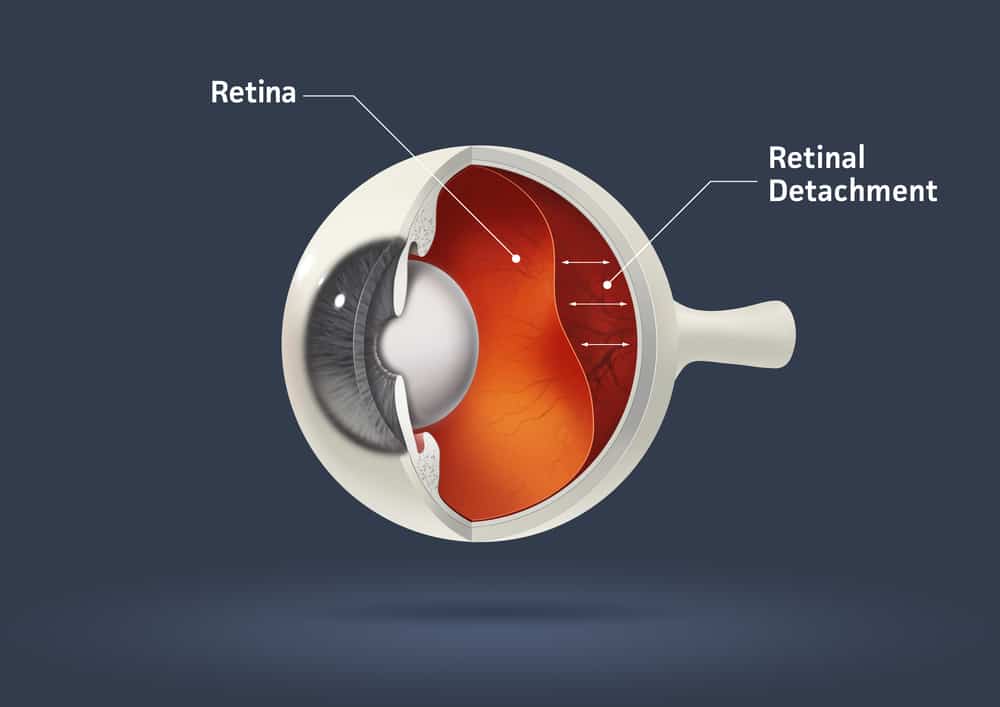
The retina is a thin layer of light-sensitive tissue that lines the back of your eye. When light enters your eye, the retina captures it and converts it into electrical signals that your brain interprets as images. When the retina detaches, it lifts or pulls away from the eye wall, separating from the blood vessels that supply it with oxygen and nutrients.
There are three main types. The most common type, called rhegmatogenous detachment, occurs when a tear or hole in the retina allows fluid to accumulate beneath it, lifting it away. Tractional detachment occurs when scar tissue, often associated with poorly controlled diabetes, pulls the retina away from its attachment.
Exudative detachment involves fluid accumulating beneath the retina without a tear, sometimes caused by inflammation or age-related conditions. In all three cases, the detached area stops functioning, and vision in that part of the eye goes dark.
Who Is Most at Risk?
Retinal detachment can happen to adults of any age, but the risk increases significantly after 40, with the highest occurrence in people between 40 and 70. Several factors beyond age alone raise your chances. Extreme nearsightedness is one of the strongest risk factors, as highly myopic eyes have longer-than-normal axial lengths, which, over time, place stress on the retina.
Prior eye surgery, including cataract surgery, also increases the risk, as does a history of serious eye injury or certain eye conditions, such as lattice degeneration (a thinning of the retina). If you have already experienced a retinal detachment in one eye, your other eye faces an elevated risk as well.
A family history of the condition is worth knowing and should be mentioned to your eye doctor. People with poorly controlled diabetes should be particularly attentive, since diabetic changes to the retina can lead to the tractional form of detachment.
The 7 Emergency Signs of Retinal Detachment
Retinal detachment is painless, which means visual changes are your only warning. If you notice any of the following, treat it as an emergency and contact your eye doctor right away.
1. Sudden Increase in Eye Floaters

Floaters, those small specks or squiggly lines that drift through your field of vision, are common and often harmless. What’s not normal is a sudden, dramatic increase in floaters appearing all at once. A shower of new floaters, especially paired with any other symptom on this list, can signal a retinal tear or early detachment.
2. Flashes of Light in Your Vision
Seeing brief flashes or streaks of light, particularly in the peripheral areas of your vision, is one of the classic signs of retinal detachment. These flashes, called photopsias, occur when the vitreous (the gel-like substance inside your eye) tugs on the retina. If they appear suddenly or persist, get evaluated that same day.
3. A Shadow or Curtain Across Your Field of Vision
Many patients describe this symptom as a dark curtain, shade, or veil slowly closing over part of their field of vision. This happens as more of the retina detaches, and that portion of the visual field goes dark. The shadow often begins at the edges and can advance toward the center of the field of vision if left untreated.
4. Blurred or Distorted Vision
A sudden change in the sharpness or quality of your vision can accompany retinal detachment, particularly if it occurs quickly and without an obvious cause such as eye strain. If your vision feels wavy, distorted, or significantly less clear than normal without any change in your glasses prescription, it warrants immediate attention.
5. Loss of Peripheral (Side) Vision
Since retinal detachments often begin at the outer edges of the retina, the loss of side vision is frequently one of the earliest signs. You might notice that things at the edges of your field of view seem cut off or darkened. Because central vision stays intact early on, this symptom can be easy to overlook.
6. A Gray Veil or Dark Area That Spreads
Some patients report a grayish or dark film that appears to cover part of their vision and gradually expands. Unlike a shadow seen in one glance, this tends to persist and grow. This spreading darkness reflects advancing detachment and is a strong signal that the situation is worsening.
7. Vision Changes in One Eye Only
Retinal detachment typically affects one eye at a time. If you notice any of the above symptoms isolated to one eye, do not assume it is a minor issue. Covering each eye individually and comparing your vision can help you catch single-eye changes that might otherwise go unnoticed.
Why Retinal Detachment Is an Eye Emergency

Once the retina separates from its blood supply, the cells in the detached area begin to deteriorate. The longer the treatment is delayed, the greater the extent of permanent damage.
This is especially true when the macula, the small central region of the retina responsible for sharp detail and color vision, becomes involved in the detachment. Macular involvement significantly affects the quality of vision a patient can expect after treatment.
Retinal detachment does not resolve on its own. There is no medication, no waiting period, and no watchful approach. If you experience the signs of retinal detachment, contact an eye doctor immediately or seek emergency care. Do not delay, hoping the symptoms improve.
Protect Your Vision: Know When to Act
The signs of retinal detachment are manageable when recognized in time. A sudden surge of floaters, flashes of light, a spreading shadow, or any unexplained shift in your vision in one eye are all reasons to seek same-day care.
If you experience any of these symptoms, contact Clear Vision San Antonio in San Antonio, TX, right away by calling (210) 904-2020 or going to the emergency room. Early evaluation and prompt treatment give you the best possible chance of preserving your vision.