
Last Updated: October 31, 2026
Quick Summary
You cannot eliminate glasses fog for good with sprays or wipes alone, since they wear off within hours and need reapplication after cleaning. Fix the moisture source first, such as your mask seal, then consider a permanent anti-fog coating or vision correction for a lasting solution.
- Anti-fog spray lasts a few hours per application and rarely a full day.
- Pinching the nose wire and pulling your mask higher stops most mask-related fogging.
- Permanent anti-fog coatings are built into the lens during manufacturing and resist washing off.
- Wipes are single-use, so cost per use is highest for daily wearers.
- LASIK suitability depends on a stable prescription, corneal health, and no uncontrolled eye disease.
Table of Contents
- Why Your Glasses Fog Up and What Actually Helps
- Best Anti-Fog Spray for Glasses: What to Expect
- Anti-Fog Wipes for Eyeglasses: Convenience vs. Cost
- Glasses Fogging When Wearing a Mask: Fit Fixes That Work
- Permanent Anti-Fog Coatings and Lens Treatments
- Vision Correction Options Beyond Glasses and Contacts
- Side-by-Side: Which Anti-Fog Approach Fits Your Day?
- Request an Appointment to Discuss Your Vision Correction Options
- Frequently Asked Questions
Why Your Glasses Fog Up and What Actually Helps
Glasses fog when warm, moist breath hits a cool lens surface and condenses into thousands of tiny droplets. That is the whole mechanism, and it explains why every effective fix works the same way: it either changes the lens surface or moves the moisture somewhere else. Patients often describe this same complaint, especially those who spend long periods in a mask or move between air-conditioned rooms and summer heat.
The physics matters because it rules out shortcuts. Wiping a foggy lens clears it for seconds, then the droplets return. Foggy glasses are a moisture problem, not a dirt problem, and the best clear vision for life for eliminate glasses fog starts with understanding which layer you are actually changing.
Below, we break down every practical option, from sprays to surgical vision correction, with honest trade-offs for each.
Best Anti-Fog Spray for Glasses: What to Expect
An anti-fog spray for glasses leaves a thin hydrophilic film on the lens that spreads moisture into an even sheet instead of scattered droplets. That is the mechanism, and it is why sprays help for a while and then stop: the film wears away with handling, cleaning, and moisture exposure.
What to expect in practice:
- Application: one or two sprays per lens, buffed with a clean microfiber lens cloth until the haze disappears
- Duration: commonly a few hours per application; rarely a full day, and shorter in cold, humid, or high-sweat conditions
- Reapplication: needed after any cleaning, because washing the lens removes the film
- Compatibility: check the label before using it on anti-reflective, hydrophobic, or oleophobic coatings
- Lens material matters: results vary by lens material and existing coating, so a product that works on uncoated CR-39 may streak on a premium anti-reflective lens
Alcohol-based sprays and homemade soap or shampoo mixes can degrade lens coatings and leave a haze that is hard to remove. Distinguish lens-safe products from household remedies before you treat an expensive pair. Follow the manufacturer’s instructions, and ask your eye-care professional before applying anything not labeled for eyewear.
Sprays are generally a better fit for occasional fogging, such as a commute or a quick errand, than for all-day fogging, because the film may not last through a full day of cleaning and handling. If you need all-day performance, a permanent lens treatment or a fit fix is the better layer to change. The American Academy of Ophthalmology guidance on lens care is a sensible starting point for what is safe to put on a lens.
Cost picture: sprays are a recurring cost, not a one-time purchase, so the per-use cost can add up for daily users. Compare that recurring spend with other options before you commit to a routine.
Anti-Fog Wipes for Eyeglasses: Convenience vs. Cost
Anti-fog wipes for eyeglasses are pre-moistened cloths that deposit the same kind of film as a spray, with no bottle to carry. They are the easiest option to keep in a bag or desk drawer, and they work well for short bursts, like a commute or a quick errand.
The trade-off is cost per use. Wipes are single-use, so the expense adds up for anyone treating lenses daily. They also leave residue if you skip the final buff, which smears under bright light.
Wipes are generally suited to occasional use and less suited to all-day fogging. If you wear glasses every day, keeping wipes as a backup may be a practical choice.
Glasses Fogging When Wearing a Mask: Fit Fixes That Work
Mask-related glasses fogging comes down to one thing: breath escaping upward instead of through the mask. Fix the seal, and most of the fog disappears without any product at all. But masks are only one fogging environment, and the same fit-first logic applies to every situation where warm, moist air meets a cool lens.
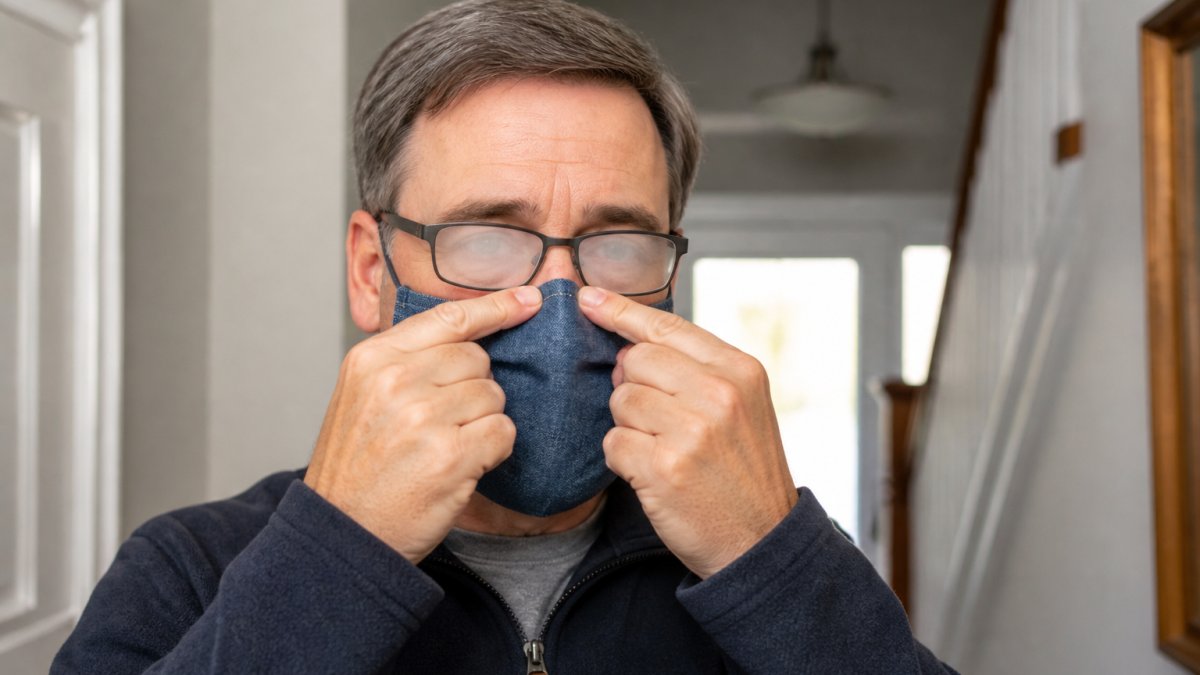
Fit fixes that work, in order of effort:
- Pinch the nose wire so it molds to the bridge of your nose.
- Pull the mask higher so the top edge sits above the glasses frame, not under it.
- Tighten the ear loops or add a behind-the-head strap to reduce leakage.
- Tape the top edge with medical tape for high-exposure settings.
- Rest your glasses on top of the mask fabric so breath vents sideways.
A common mistake is wearing the mask low and expecting sprays to compensate. No treatment beats a well-sealed mask. If you wear a mask for long periods at work, fix the fit first, then treat the lenses.
Beyond masks: fogging across environments. The same physics drives fogging in every setting, and the best fix depends on the environment:
- Exercise: sweat and body heat fog lenses fast; a headband that keeps sweat off the frame and a snug fit help more than a spray that wears off mid-workout.
- Temperature changes: walking from air conditioning into summer heat, or from cold outdoors into a warm room, fogs lenses instantly; letting the lens warm gradually or using a permanent coating reduces the swing.
- Cooking: steam from pots and kettles fogs lenses at the stove; stepping back, using a splatter guard, or wearing a permanent anti-fog coating helps.
- Workplace PPE: safety glasses and goggles trap moisture; fit and ventilation matter more than product, and any treatment must be compatible with the PPE’s own coating.
- High humidity: in humid weather or damp workplaces, sprays and wipes last noticeably less time, so plan for more frequent reapplication or a permanent treatment.
Fix the source of the moisture first, mask seal, sweat, steam, or trapped air, then treat the lens. A product cannot outwork a bad seal or a steam-filled kitchen.
If you wear glasses every day across several of these environments, the recurring cost and hassle of sprays and wipes is worth comparing with a permanent coating or a vision-correction consultation. Our 6 common LASIK myths that keep people wearing glasses addresses the fears that stop most patients from exploring a permanent fix.
Permanent Anti-Fog Coatings and Lens Treatments
Permanent anti-fog coatings are applied to the lens surface during manufacturing and are designed to resist washing off with cleaning. Some lens manufacturers offer permanent anti-fog treatments that are built into the lens during manufacturing. For anyone who keeps wearing glasses, this is the most convenient long-term lens option.
Two honest limits. First, permanent coatings reduce fogging rather than making it impossible, and performance varies with humidity and temperature swings. Second, you are still wearing glasses, which means scratches, cleaning routines, and prescription changes remain part of your life.
If you are weighing that trade-off, our 6 common LASIK myths that keep people wearing glasses addresses the fears that stop most patients from exploring a permanent fix.
Vision Correction Options Beyond Glasses and Contacts
Surgical vision correction changes how the eye focuses light, which can reduce or remove the need for glasses. LASIK reshapes the cornea to reduce dependence on glasses or contact lenses, and Mayo Clinic’s overview of LASIK is clear that suitability depends on the individual and requires a proper assessment.
Candidacy is the part most guides skip. In general, suitability for these procedures depends on factors such as a stable prescription, corneal health, and the absence of uncontrolled eye disease. Adults over 40 may have age-related changes, and a professional evaluation can help determine which options apply.
For a wider look at the options, read our guide to alternatives to wearing glasses for vision correction, or the best vision correction for over 50 if you are comparing procedures at this stage of life.
Side-by-Side: Which Anti-Fog Approach Fits Your Day?
Here is a general comparison of the main approaches:
| Approach | Upfront Effort | Ongoing Cost | Lasts | Best For |
|---|---|---|---|---|
| Anti-fog spray | Low | Recurring | Hours per use | Occasional fogging |
| Anti-fog wipes | Lowest | Highest per use | One session | Travel and backup |
| Mask fit fixes | Moderate | None | While worn | Mask wearers |
| Permanent coating | Lab order | One-time | Life of lens | Daily glasses wearers |
| Vision correction | Consultation | Procedure cost | Long-term | Wanting to ditch glasses |
Pricing for sprays and wipes varies by brand and retailer. For surgical options, pricing depends on factors such as the procedure, your eye health, and coverage. Contact Clear Vision San Antonio directly for current pricing or a quote. Our cost for laser eye surgery page explains what affects pricing and how to plan for it.
Request an Appointment to Discuss Your Vision Correction Options
Foggy glasses are solvable. The real question is whether you want to manage the symptom for another decade or address the cause, and that decision deserves a proper eye exam rather than a product aisle.
At Clear Vision San Antonio, our expert eye doctors offer LASIK, ICL, cataract surgery, and advanced technology lens implants, with a high level of personalized attention at every step. Our goal is to help patients achieve clear vision at near, far, and intermediate distances through a plan tailored to their eyes.
Contact Clear Vision San Antonio to learn which options may fit your needs. Request an appointment to discuss refractive lens exchange or call our team to talk through what is available for your eyes.
Frequently Asked Questions
What is the best thing to stop glasses from fogging up?
There is no single best fix, because the right choice depends on how often your glasses fog and where. For quick relief, an anti-fog spray or wipe creates a temporary film that reduces condensation for a few hours. A permanent anti-fog coating applied when you order new lenses lasts far longer and needs no reapplication. If fogging happens mainly with a mask, improving the mask’s nose fit often solves it without any product at all. For a lasting fix, ask an eye doctor about vision correction options beyond glasses.
Does anti-fog spray really work on glasses?
Anti-fog spray does reduce fogging, but the effect is temporary. Most sprays leave a thin film that helps moisture spread evenly instead of forming droplets, and that film wears off with cleaning, wiping, and handling. Expect a few hours of benefit, not all day. Sprays also need to be compatible with your lens coating, since some lens materials and anti-reflective layers can be damaged by harsh formulas. Test on a small area first, and follow the product’s instructions for lens care.
Why do my glasses fog up when I wear a mask?
Warm, moist breath escapes upward from the top edge of the mask and hits the cooler surface of your lenses, where it condenses into droplets. The looser the mask sits across your nose, the more breath escapes upward. A mask with a moldable nose wire, pulled snug against the bridge of your nose, sends most of that breath out through the mask fabric instead. That single adjustment often reduces glasses fogging more than any spray or wipe.
Can vision correction surgery eliminate the need for glasses that fog up?
For some people, yes. Procedures such as LASIK and refractive lens exchange can reduce or remove the need for distance glasses, which means nothing left on your face to fog. Suitability depends on your prescription, eye health, age, and other factors, and a surgeon must assess this in person. Surgery is not right for everyone, and it does not prevent the normal reading-vision changes that come with age. A consultation is the only way to know which options apply to you.
