

Table of Contents
- Why Get Specialized Glaucoma Care
- Glaucoma Specialist vs General Ophthalmologist
- How to Prepare for a Glaucoma Eye Exam
- Questions to Ask Your Glaucoma Doctor
- Finding and Accessing Specialized Glaucoma Care
- Building Your Long-Term Glaucoma Care Plan
- Assistive Technology and Vision Support Resources
- Conclusion
Get Specialized Glaucoma Care: A Patient’s Guide
Last Updated: July 3, 2026
If you’ve been diagnosed with glaucoma or suspect you might have it, understanding when to get specialized glaucoma care can make the difference between preserving your vision and experiencing irreversible sight loss. Glaucoma affects millions of people worldwide, yet many don’t realize they need expert care until significant damage has occurred. Below, we’ll walk you through everything you need to know about accessing specialized glaucoma care, preparing for appointments, and building a long-term vision preservation plan.
Why Get Specialized Glaucoma Care
General ophthalmologists provide valuable eye health services, but glaucoma demands focused expertise. This condition progresses silently, often without symptoms until substantial irreversible damage has occurred. A glaucoma specialist brings advanced diagnostic equipment and treatment protocols specifically designed to slow or halt disease progression.
Early detection and aggressive management can prevent blindness. Delayed or inadequate treatment frequently results in permanent vision loss that no surgery can restore. Specialists understand the nuances of different glaucoma types, recognize subtle warning signs that generalists might miss, and stay current with emerging therapies.
Specialized glaucoma care involves long-term management with precision monitoring, treatment adjustments based on individual response, and coordination with other specialists when needed.
If you have a family history of glaucoma, have been told you have elevated eye pressure, or have experienced vision changes, requesting a referral to a glaucoma specialist should be your immediate next step. Early intervention at the specialist level can preserve decades of functional vision.
Glaucoma Specialist vs General Ophthalmologist
Choosing between a general ophthalmologist and a glaucoma specialist requires understanding the real differences in training and capabilities.
Training and Expertise Differences
A general ophthalmologist completes medical school, residency in ophthalmology, and obtains a medical license. They manage many eye conditions including cataracts, refractive errors, and retinal problems, with broad glaucoma training.
A glaucoma specialist completes all of that, then pursues an additional 1-2 year fellowship dedicated exclusively to glaucoma. During this fellowship, they perform hundreds of glaucoma surgeries, master advanced imaging technology, and learn complex treatment algorithms. They understand aqueous humor flow biomechanics, interpret subtle changes in optic nerve imaging, and manage complicated cases that don’t respond to standard approaches.
The practical difference shows up in diagnosis and treatment decisions. A generalist might recommend eye drops as first-line therapy for newly diagnosed glaucoma. A specialist evaluates whether those drops will work for your specific glaucoma type, considers laser procedures or surgery if drops alone won’t suffice, and monitors your response with more sophisticated analysis.
When a Referral to a Specialist Becomes Essential
Your general ophthalmologist should refer you to a glaucoma specialist if you’ve been diagnosed with glaucoma. The specialist can confirm the diagnosis, classify the glaucoma subtype, and establish baseline measurements that inform your long-term care plan.
You also need specialist care if your intraocular pressure remains elevated despite multiple medications, if you’re experiencing progressive vision loss despite treatment, or if you have advanced glaucoma at presentation. Certain glaucoma types, angle-closure glaucoma, secondary glaucomas, neovascular glaucoma, almost always require specialist management from diagnosis forward. Normal-tension glaucoma, where vision loss occurs despite seemingly normal eye pressure, also demands specialist expertise because treatment decisions are more nuanced.
If your general ophthalmologist hasn’t referred you to a glaucoma specialist despite a glaucoma diagnosis, ask why. A referral is the standard of care for this serious condition.
How to Prepare for a Glaucoma Eye Exam
Walking into a glaucoma specialist’s office without preparation wastes valuable appointment time. Smart preparation ensures you get accurate measurements and make the most of your visit.
Before Your Appointment
Gather your complete eye care history, including records from your general ophthalmologist, previous specialists, and any eye surgeries. Collect dates of diagnosis, previous eye pressure readings, and names of medications you’ve tried. Bring a list of ALL medications you’re currently taking, as systemic medications can affect glaucoma management.
Document any vision changes you’ve noticed, even subtle ones. Have you experienced peripheral vision loss, difficulty seeing in dim lighting, or trouble with side vision? Write these down with approximate dates.
Arrange your schedule to allow 2-3 hours for your first appointment. Initial glaucoma evaluations include extensive testing: visual field analysis, optic nerve imaging, eye pressure measurement, gonioscopy, and detailed optic nerve photography.
Bring your insurance card and photo ID. Ask about parking, payment plans if uninsured, and whether the office offers financial assistance programs. Clarify what to expect regarding dilating drops, your pupils will be dilated, so plan to have someone drive you home.
What to Bring and Expect
Arrive 15 minutes early to complete intake paperwork. You’ll answer questions about your medical history, family history of glaucoma, past eye surgeries, and current symptoms. Family history is particularly important because genetic factors significantly influence glaucoma risk.
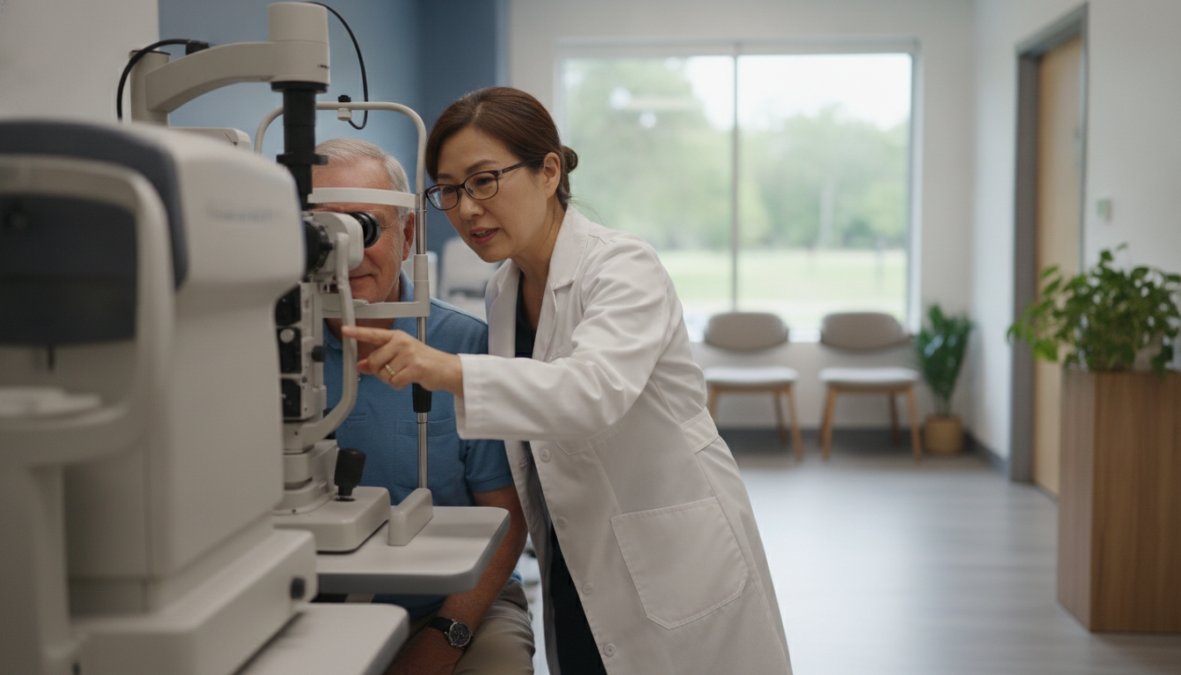
The examination follows a standard sequence. A technician will measure your eye pressure using tonometry, take detailed photographs of your optic nerve, and perform visual field testing. Visual field testing asks you to click a button when you see small lights appear in your peripheral vision, taking 5-10 minutes per eye.
Optical coherence tomography (OCT) imaging creates detailed cross-sectional pictures of your optic nerve and retina. Gonioscopy involves the specialist placing a special lens on your eye to examine the drainage angle, determining your glaucoma type and guiding treatment decisions.
The specialist will dilate your pupils to examine the optic nerve head directly, looking for optic nerve cupping, pallor, and other signs of glaucoma damage. Dilation blurs your near vision for 4-6 hours.
If you experience sudden eye pain, significant vision loss, or red eye with nausea before your appointment, go to an emergency room. These symptoms suggest acute angle-closure glaucoma, a medical emergency.
Questions to Ask Your Glaucoma Doctor
A productive specialist visit requires asking the right questions. Write these down and bring them to your appointment.
Understanding Your Diagnosis and Risk
Start with fundamentals: "What type of glaucoma do I have?" The answer determines your treatment approach. Ask "What is my current eye pressure, and what is my target pressure?" Understanding your numbers helps you track progress over time.
Request "What does my optic nerve look like, and how much damage has occurred?" Ask the specialist to explain your visual field results. Do you have central vision loss, peripheral loss, or damage in specific areas?
Ask about your risk factors: "Am I at high risk for rapid progression?" Family history, age, degree of optic nerve damage, and baseline eye pressure all influence progression rates.
Treatment Options and Long-Term Management
Get specific about treatment: "What are my treatment options, and which do you recommend for me?" A good specialist explains why they’re recommending specific medications, laser procedures, or surgery.
Ask "How often will I need follow-up appointments?" Standard care typically involves visits every 3-6 months initially, then annually once stable.
Request "What happens if my current treatment isn’t working?" Understanding the escalation plan reduces anxiety and helps you plan ahead.
Ask about clinical trials: "Are there any clinical trials I might be eligible for?" Specialists often know about trials that could benefit their patients.
Discuss lifestyle: "Are there activities I should avoid?" Most glaucoma patients can do normal exercise, but certain activities might temporarily raise eye pressure.
Finding and Accessing Specialized Glaucoma Care
Locating a qualified glaucoma specialist requires knowing where to look and what credentials to verify.
Locating a Qualified Glaucoma Specialist
Start with referrals from your general ophthalmologist. Check the American Academy of Ophthalmology (AAO) directory online for verified listings of ophthalmologists with "Glaucoma" listed as their subspecialty. Verify they completed an accredited fellowship program.
Search the American Glaucoma Society membership directory for highly specialized practitioners. Ask your insurance company for in-network glaucoma specialists to save money and prevent surprise bills.
Research the specialist’s hospital affiliations. Doctors at academic medical centers and larger ophthalmology practices typically have access to more advanced technology and surgical capabilities. Check whether they perform glaucoma surgery.
Call the office before scheduling. Ask how long the wait is for new patient appointments, whether the specialist accepts your insurance, and what the typical out-of-pocket cost is for a new patient visit.
Insurance and Financial Considerations
Glaucoma care involves expensive testing and potentially costly medications or surgery. Call your insurance company before your first appointment and ask about coverage for specialist office visits, visual field testing, OCT imaging, glaucoma medications, laser procedures, and glaucoma surgery.
Ask about your deductible, copay amounts, and whether prior authorization is required for any treatments.
If you’re uninsured or underinsured, ask the specialist’s office about assistance programs. Many practices participate in pharmaceutical company programs that provide free or reduced-cost glaucoma medications. Some offer sliding-scale fees based on income.
| Consideration | What to Ask | Why It Matters |
|---|---|---|
| Specialist Credentials | "Did you complete a glaucoma fellowship?" | Ensures advanced training in glaucoma management |
| Insurance Coverage | "Do you accept my plan?" | Prevents surprise bills and out-of-pocket costs |
| Appointment Wait Time | "How long until you can see new patients?" | Determines how quickly you can start care |
| Surgical Capabilities | "Do you perform glaucoma surgery?" | Ensures all treatment options are available |
| Follow-up Frequency | "How often will I need appointments?" | Helps you plan time and budget for ongoing care |
Building Your Long-Term Glaucoma Care Plan
Getting specialized glaucoma care is the first step. Maintaining that care over years and decades requires a structured approach.
Ongoing Monitoring and Follow-Up Care
Consistency matters profoundly in glaucoma management. Missing appointments, skipping visual field tests, or stopping medications without discussing it with your specialist allows disease progression to accelerate silently.
Schedule your follow-up appointments before you leave the specialist’s office. Keep a log of your medications and when you take them. Glaucoma eye drops must be used consistently to work effectively.
Request copies of your visual field tests, optic nerve photographs, and OCT images. Keep these in a personal file for future reference if you change specialists or need to compare results over years.
Discuss with your specialist what signs of progression would prompt treatment changes. Some patients benefit from home eye pressure monitoring if they have access to appropriate equipment.
Mental Health and Emotional Support
Glaucoma diagnosis triggers real psychological responses: anxiety about future vision loss, grief over the diagnosis, and fear about becoming blind. Addressing these emotional impacts improves your overall health outcomes.
Connect with support groups. The Glaucoma Research Foundation sponsors in-person and online support groups where you meet other people managing glaucoma. Talk with your specialist about your emotional response to diagnosis. If you’re struggling emotionally, ask for a referral to a mental health professional experienced with chronic eye disease.
Involve your family in your care. Help them understand glaucoma so they can support you meaningfully.
Many people with glaucoma experience depression and anxiety at rates higher than the general population. Addressing mental health is part of comprehensive glaucoma care that preserves both your vision and your quality of life.
Assistive Technology and Vision Support Resources
Even with excellent medical care, glaucoma may eventually affect your vision. Knowing about assistive technology and support services helps you maintain independence.
Low-vision specialists work with people experiencing significant vision loss to maximize remaining vision and adapt to changes. They prescribe magnifying glasses, recommend lighting modifications, and teach techniques for reading, cooking, and navigating safely.
Screen magnification software enlarges text on computers and mobile devices. Audiobooks, screen readers, and text-to-speech technology allow you to access information without relying on vision. Lighting modifications make a dramatic difference for people with glaucoma-related vision loss.
The American Foundation for the Blind provides resources, training, and support services including counseling, job training, and adaptive technology instruction.
Living with glaucoma requires proactive, specialized medical care combined with emotional support and practical adaptation strategies. When you get specialized glaucoma care from a qualified glaucoma specialist, you gain access to advanced diagnostic technology, sophisticated treatment protocols, and the expertise needed to make complex management decisions. Clear Vision San Antonio connects patients with glaucoma specialists who combine rigorous training with personalized attention, ensuring you receive the highest standard of care for your specific condition. Request an appointment today to begin your specialized glaucoma care journey and take control of your vision health.
Frequently Asked Questions
What is the difference between an ophthalmologist and a glaucoma specialist?
A general ophthalmologist is trained to diagnose and treat a wide range of eye conditions, including glaucoma, cataracts, and refractive errors. A glaucoma specialist is an ophthalmologist with additional fellowship training (typically 1-2 years) focused specifically on glaucoma management, advanced diagnostic techniques, and complex treatment options. If you have glaucoma or are at risk, a glaucoma specialist provides deeper expertise in disease progression, medication adjustments, and surgical interventions.
When should I be referred to a glaucoma specialist for specialized glaucoma care?
You should seek specialized glaucoma care if you have been diagnosed with glaucoma, have elevated intraocular pressure, a family history of glaucoma, or if your condition is not responding well to standard treatment. Additionally, if you require advanced procedures such as laser surgery or are considering clinical trials, a specialist is essential. Your general ophthalmologist can recommend a referral based on your individual risk factors and disease severity.
How do I prepare for a glaucoma eye exam with a specialist?
Gather your complete eye health history, including past prescriptions, previous eye surgeries, and any medications you take. Bring your insurance card and photo ID. Wear comfortable clothing and arrange for transportation, as your pupils may be dilated. Write down any symptoms you've noticed, such as vision changes or eye discomfort. If possible, bring records from your general ophthalmologist, including previous test results and imaging. Arrive 15 minutes early to complete any necessary paperwork.
What questions should I ask my glaucoma doctor during my first visit?
Ask about your specific glaucoma type, current eye pressure readings, and your target pressure range. Inquire about treatment options available to you, potential side effects of medications, and what happens if your condition progresses. Ask about the frequency of follow-up appointments and what signs of progression you should watch for. Also ask about lifestyle modifications, whether clinical trials might be appropriate, and how to contact the office if you have concerns between appointments.
This article was written using GrandRanker