

Table of Contents
- Understanding Macular Degeneration and Treatment Options
- Dry vs. Wet Macular Degeneration Treatment Approaches
- Medical Treatments: Anti-VEGF Injections for Eyes and Beyond
- Macular Degeneration Diet and Supplements for Disease Management
- Lifestyle Changes for Macular Degeneration and Vision Preservation
- Managing Vision Loss: Low Vision Aids and Assistive Technology
- Emotional Support and Long-Term Care Planning
- How to Treat Macular Degeneration: Your Next Steps
How to Treat Macular Degeneration: Complete Guide
Last Updated: July 2, 2026
Age-related macular degeneration affects millions of people worldwide. Understanding treatment options is essential for preserving vision and maintaining independence. This guide covers medical interventions, nutritional therapy, lifestyle modifications, assistive technology, and long-term planning strategies.
The macula is the central part of the retina responsible for sharp, detailed vision. When it degenerates, reading, recognizing faces, and driving become progressively difficult. Early detection and treatment can significantly impact outcomes.
Understanding Macular Degeneration and Treatment Options
What is Age-Related Macular Degeneration (AMD)?
Age-related macular degeneration is a progressive eye disease that damages the macula, the light-sensitive tissue at the back of the retina. It’s the leading cause of vision loss in adults over 50.
AMD comes in two primary forms. Dry AMD accounts for about 80% of cases and involves gradual accumulation of drusen (yellow deposits) under the retina. Wet AMD, though less common, progresses more rapidly and involves abnormal blood vessel growth beneath the macula. Both forms can lead to legal blindness if untreated, but both respond to intervention when caught early.
The critical difference between AMD types determines your treatment path. Dry AMD focuses on slowing progression; wet AMD requires immediate medical intervention to prevent severe vision loss.
Why Early Diagnosis Matters for Treatment Success
Detecting AMD in its early stages dramatically improves treatment outcomes. An ophthalmologist or retina specialist can identify the disease through a comprehensive dilated eye exam, often before you notice symptoms. Research from the National Eye Institute on age-related macular degeneration emphasizes that early diagnosis is the strongest predictor of long-term visual outcomes.
Dry vs. Wet Macular Degeneration Treatment Approaches
Treatment strategies differ fundamentally between the two forms of AMD. Dry AMD progresses slowly and focuses on slowing decline through nutrition and lifestyle modifications. Wet AMD requires aggressive medical intervention to stop abnormal blood vessel growth.
For dry AMD, the AREDS2 formula, a specific combination of lutein, zeaxanthin, vitamin C, vitamin E, zinc, and copper, has demonstrated effectiveness in slowing progression by approximately 25%.
Wet AMD demands different tactics. Anti-VEGF injections directly target abnormal neovascularization, administered monthly or every other month depending on the medication and patient response.
| AMD Type | Primary Treatment | Frequency | Expected Outcome |
|---|---|---|---|
| Dry AMD | AREDS2 supplements + lifestyle changes | Daily + ongoing | Slows progression by ~25% |
| Wet AMD | Anti-VEGF injections | Monthly or bi-monthly | Stabilizes or improves vision |
Wet AMD is a medical emergency. Vision loss can accelerate rapidly without treatment. If you experience sudden [vision changes](/why-vision-changes-after-forty/), flashing lights, or new floaters, contact your retina specialist immediately.
Medical Treatments: Anti-VEGF Injections for Eyes and Beyond
How Anti-VEGF Therapy Works
Anti-VEGF injections represent the most effective treatment for wet AMD available today. These medications block vascular endothelial growth factor, a protein that signals abnormal blood vessel formation. The injection procedure takes about 10 minutes in an ophthalmologist’s office. After numbing drops and sterilization, the doctor injects medication directly into the vitreous cavity.
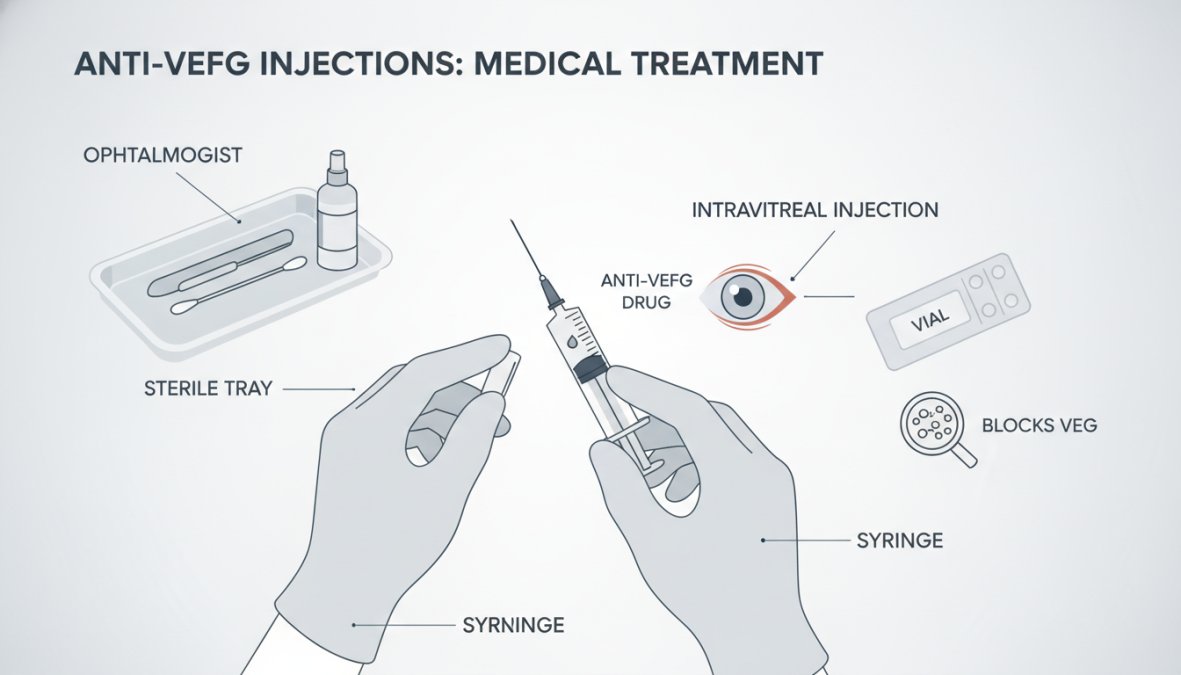
Common anti-VEGF medications include bevacizumab, ranibizumab, aflibercept, and brolucizumab. Each has slightly different dosing schedules and efficacy profiles. Many patients achieve stable vision or modest vision improvement with consistent treatment.
Other Advanced Treatment Options
Beyond anti-VEGF injections, several emerging treatments show promise for wet AMD. Photodynamic therapy uses a light-activated drug to destroy abnormal blood vessels. Tyrosine kinase inhibitors represent a newer class of AMD treatment. Axpaxli, a recently approved tyrosine kinase inhibitor, offers patients an alternative to frequent injections. Clinical trials demonstrate that oral treatment can slow progression and preserve vision, though it typically works best combined with anti-VEGF therapy.
Laser surgery destroys tissue to prevent further damage and is used selectively when abnormal vessels are located away from the fovea.
Ask your retina specialist about combination therapy. Many advanced cases benefit from using multiple treatment modalities simultaneously, such as anti-VEGF injections plus oral tyrosine kinase inhibitors.
Macular Degeneration Diet and Supplements for Disease Management
AREDS2 Supplements and Nutritional Therapy
The Age-Related Eye Disease Study 2 (AREDS2) established the gold standard for nutritional AMD management. The specific formula includes lutein 10 mg, zeaxanthin 2 mg, vitamin C 500 mg, vitamin E 400 IU, zinc oxide 80 mg, and cupric oxide 2 mg daily. This combination slows progression of intermediate dry AMD by approximately 25%, according to the AREDS2 research published by the National Institutes of Health. The supplement is available under various brand names and costs $15-$30 monthly.
Starting AREDS2 supplementation early matters. Once advanced geographic atrophy develops, supplements have limited effectiveness.
Key Nutrients: Lutein, Zeaxanthin, and Antioxidants
Lutein and zeaxanthin are carotenoids that accumulate in the macula and filter harmful blue light. These nutrients are found in dark leafy greens, spinach, kale, and orange vegetables. Antioxidants like vitamin C and vitamin E neutralize free radicals generated by light exposure and metabolism. Zinc supports the retina’s ability to absorb lutein and zeaxanthin, which is why the AREDS2 formula includes both nutrients together.
Lifestyle Changes for Macular Degeneration and Vision Preservation
Smoking accelerates AMD by 3-4 times compared to non-smokers. Quitting is the single most impactful change you can make for your eyes.
UV light exposure damages retinal tissue over decades. Wearing UV-protective sunglasses outdoors reduces AMD risk and slows progression. Look for sunglasses blocking 100% UVA and UVB rays.
A Mediterranean-style diet rich in fish, vegetables, whole grains, and healthy fats supports retinal health. Omega-3 fatty acids in cold-water fish reduce inflammation and support photoreceptor function. Aim for 2-3 servings weekly.
Exercise improves blood flow to the retina and slows disease progression. Moderate aerobic activity, 30 minutes of brisk walking most days, has been shown to slow AMD progression.
Managing blood pressure and cholesterol prevents AMD progression. Work with your primary care physician to keep these risk factors controlled.
Managing Vision Loss: Low Vision Aids and Assistive Technology
Optical and Electronic Magnification Devices
Handheld magnifiers are the most affordable entry point, ranging from $10-$50. Stand magnifiers ($30-$150) free both hands for sustained tasks like reading or writing. Electronic video magnifiers (closed-circuit televisions) use a camera and monitor to enlarge text to 60x magnification or more, costing $500-$3,000 but often covered by insurance or Medicare if prescribed by an ophthalmologist.
Portable electronic magnifiers like the HumanWare Inspira or Optelec Compact 5 HD ($400-$800) offer flexibility for reading menus and documents outside the home. Smartphone magnification apps are free and surprisingly effective for quick magnification tasks.
Screen Readers and Digital Accessibility
Screen reader software converts text and interface elements to audio, allowing you to navigate email, websites, and banking portals without relying on vision. NVDA (NonVisual Desktop Access) is free on Windows. JAWS (Job Access With Speech) costs $90-$195 on Windows. VoiceOver is built-in and free on Mac. On iPhone and Android, VoiceOver and TalkBack are native accessibility features.
Text-to-speech browser extensions like Read Aloud (Chrome) allow you to have web articles read aloud without learning screen reader commands.
Home Modifications and Lighting
Lighting is often the single most impactful modification. Task lighting, a bright LED desk lamp positioned to illuminate reading material without glare, can restore the ability to read bills and medication bottles. Full-spectrum LED bulbs (5000-6500K color temperature) provide better contrast than warm incandescent bulbs.
High-contrast labels and markers transform a home environment. Black labels on white backgrounds, white tape on dark stair edges, and colored dots on frequently used appliances allow patients to navigate safely. Dymo label makers ($20-$40) print high-contrast labels quickly.
Specialized Tools for Specific Tasks
Reading: Large-print books are available through the National Library Service (free), Project Gutenberg (free digital versions), and commercial publishers. E-readers like Kindle allow unlimited font size adjustment. Audiobooks through Audible, Libby, or Bookshare (free for people with vision loss) provide alternative access.
Cooking: Talking kitchen scales ($30-$60) announce weight. Liquid level indicators ($15-$25) alert you when a cup is full. Talking thermometers ($20-$40) eliminate the need to read temperature displays.
Money management: Talking calculators ($15-$50) announce numbers as you press keys. Bill pay and banking apps with screen reader support allow independent financial management.
Mobility and safety: Canes with reflective tape, motion-sensor lights, and clear pathways reduce fall risk.
Vision Rehabilitation Services
Vision rehabilitation specialists conduct functional assessments to identify which devices and modifications will have the most impact for your specific vision loss pattern. They teach you to use remaining peripheral vision efficiently and train you on assistive devices. Most insurance plans and Medicare cover vision rehabilitation when prescribed by an ophthalmologist.
Start exploring assistive technology while you still have some central vision. Learning to use these tools proactively, rather than in crisis mode, dramatically improves your ability to maintain independence.
Not all devices work for all patients. Vision loss patterns vary widely. A vision rehabilitation specialist can help you identify the tools most likely to succeed for your specific situation.
Emotional Support and Long-Term Care Planning
Mental Health and Emotional Resilience
Vision loss is a significant life transition. Research shows that people diagnosed with AMD experience depression at rates 2-3 times higher than the general population. These responses are normal and treatable.
Cognitive behavioral therapy (CBT) adapted for vision loss helps patients process grief and develop coping strategies. Support groups provide both practical strategies and emotional validation. The American Foundation for the Blind (AFB) maintains a referral list of mental health professionals with vision loss expertise.
Family counseling can help partners, adult children, and caregivers understand AMD and adjust to role changes.
Insurance Coverage and Financial Planning for AMD Treatment
The financial burden of long-term AMD care is substantial. Understanding coverage options early allows you to plan strategically.
Medicare Coverage for Anti-VEGF Injections: Medicare Part B covers anti-VEGF injections when administered in an ophthalmologist’s office. You pay 20% coinsurance after meeting your annual Part B deductible (typically $226 in 2024). A single anti-VEGF injection costs Medicare approximately $1,900-$2,200; your 20% coinsurance is roughly $380-$440 per injection. Monthly injections over a year total $4,500-$5,300 in out-of-pocket costs. If you have supplemental Medigap insurance, your coinsurance may be covered entirely.
Private Insurance Coverage: Coverage varies widely by plan. Most commercial plans cover anti-VEGF injections for wet AMD with prior authorization. Call your insurance company before your first injection to confirm coverage and your out-of-pocket maximum.
AREDS2 Supplements: Over-the-counter AREDS2 formulas ($15-$30 monthly) are not covered by insurance but are tax-deductible as a medical expense if you itemize deductions.
Low Vision Aids and Assistive Technology: Medicare covers some low vision devices if prescribed by an ophthalmologist and obtained through a Medicare-enrolled supplier, typically covering 80% after your Part B deductible. State vocational rehabilitation agencies often provide assistive technology at no cost.
Vision Rehabilitation Services: Medicare covers vision rehabilitation when prescribed by an ophthalmologist, typically covering 80% after your Part B deductible.
Long-Term Care Planning and Family Conversations
As AMD progresses, conversations about long-term care become necessary.
Home Modifications: Budget $500-$5,000 for basic modifications (lighting, grab bars, stair markers, kitchen organization). Some states offer home modification grants; contact your state agency for the blind.
Transportation Alternatives: If driving becomes unsafe, plan for alternatives: public transportation, ride-sharing services, volunteer driver programs, or family support. Your local Area Agency on Aging can provide information.
Caregiver Support and Respite Care: Discuss expectations, boundaries, and support needs early. Respite care (temporary relief for the primary caregiver) prevents exhaustion. Adult day programs, in-home care aides ($20-$30/hour), and overnight respite care facilities provide breaks.
Long-Term Care Insurance: If you are under 75 and in good health, long-term care insurance can protect assets from future care costs. Policies typically cost $1,500-$3,000 annually.
Legal and Financial Documents: Establish a healthcare power of attorney, financial power of attorney, and living will. An elder law attorney can help; costs typically range from $500-$1,500.
Practical Resources for Ongoing Support
The Macular Degeneration Association (macular.org) offers free educational materials, support groups, and a helpline staffed by counselors with vision loss expertise. The American Foundation for the Blind (afb.org) provides resources on assistive technology, employment, and emotional support. Your state agency for the blind and visually impaired offers free services including vision rehabilitation and assistive technology.
Have difficult conversations about long-term care while you can still participate fully in planning. Planning ahead maintains greater independence and quality of life.
Financial and legal planning for vision loss is responsible self-care. Many patients who plan ahead maintain greater independence than those who avoid these conversations until forced into crisis mode.
Frequently Asked Questions
Can macular degeneration be reversed or cured?
Currently, age-related macular degeneration cannot be fully reversed, but treatments can slow progression and preserve remaining vision. Wet AMD responds well to anti-VEGF injections, which can stabilize or improve vision in many patients. Dry AMD has fewer treatment options, making early detection and nutritional management critical. Clinical trials continue exploring new therapies, including tyrosine kinase inhibitors like Axpaxli, offering hope for future breakthroughs.
How often do you need injections for macular degeneration?
Injection frequency varies by treatment and individual response. Most anti-VEGF therapies for wet AMD begin with monthly injections for three months, then transition to maintenance schedules, often every 4-8 weeks depending on disease activity. Your retina specialist monitors your condition closely through regular eye exams and optical coherence tomography (OCT) imaging to determine the optimal injection schedule, which may change over time.
What are the best supplements for macular degeneration?
The AREDS2 formula is the gold-standard nutritional therapy for AMD, containing lutein, zeaxanthin, zinc, copper, vitamins C and E, and antioxidants. This combination has been shown to reduce progression risk in intermediate to advanced dry AMD. However, supplements work best alongside other treatments and lifestyle changes. Always consult your ophthalmologist before starting supplements, as some may interact with medications or be unsuitable for certain health conditions.
What lifestyle changes help slow macular degeneration progression?
Key lifestyle modifications include smoking cessation (smoking accelerates AMD progression), protecting eyes from UV light with sunglasses, maintaining a heart-healthy diet rich in leafy greens and fish, regular exercise, controlling blood pressure and cholesterol, and managing diabetes. These changes support overall eye health and complement medical treatments. Combined with proper nutrition and regular monitoring by your retina specialist, lifestyle changes form an essential part of comprehensive AMD management.
This article was written using GrandRanker